


Views: 0 Author: Site Editor Publish Time: 2026-07-23 Origin: Site


HVAC and heat pump original equipment manufacturers face mounting operational pressure today. Stricter global energy efficiency mandates strictly govern all new system designs. European ErP directives set rigorous operational limits. Elevated minimum SEER2 and SCOP ratings force immediate product redesigns. Simultaneously, consumer expectations for acoustic comfort rise daily. Homeowners demand whisper-quiet operation. These compounded demands force engineers to rethink foundational system architectures. Standard AC motors no longer fulfill modern compliance standards. They require complex, bulky mechanical workarounds. They consume excessive power. They lack intelligent speed modulation.
Therefore, the EC axial fan confidently serves as the industry-standard solution. It optimizes outdoor units beautifully. It inherently resolves the critical engineering trilemma. It maximizes airflow volume. It minimizes energy consumption. It achieves precise variable-load control. You will learn how these advanced aerodynamic components optimize acoustics. You will discover how they improve defrosting cycles and simplify factory integration.
OEMs face severe engineering bottlenecks when designing modern HVAC equipment. Regulatory bodies continuously update energy performance mandates globally. They demand systems operate cleaner. Units must fit into smaller spaces. They must run significantly quieter. They must utilize energy vastly more efficiently. Engineers must squeeze higher performance out of shrinking physical footprints. You cannot simply build larger boxes anymore. Real estate constraints heavily restrict outdoor equipment sizes.
An ideal cooling component must meet strict success criteria. First, it must minimize the parasitic electrical load. Any power drawn by internal cooling fans directly lowers the overall efficiency score. Higher parasitic loads destroy your energy ratings. Second, the fan must maximize heat exchange efficiency across the condenser coils. It must push dense air evenly. Finally, it must operate reliably in extreme environments. Outdoor units face scorching summers and freezing winters.
Traditional AC motors consistently fail these critical criteria. They operate at a severe aerodynamic and electrical disadvantage. They suffer from high inherent power loss. Much of the electrical energy converts into wasted heat. This heat stays trapped within the motor itself. When a motor runs hot, the surrounding air inside the cabinet warms up. This heat transfer directly opposes the cooling objective. Furthermore, AC motors offer limited speed control. You typically get simple on-and-off functions. Some offer rigid multi-speed taps. They cannot dynamically adjust to subtle shifts in outdoor temperatures. This rigid operation causes massive power spikes. It creates excessive aerodynamic noise. It results in suboptimal thermal management across the coil surface.
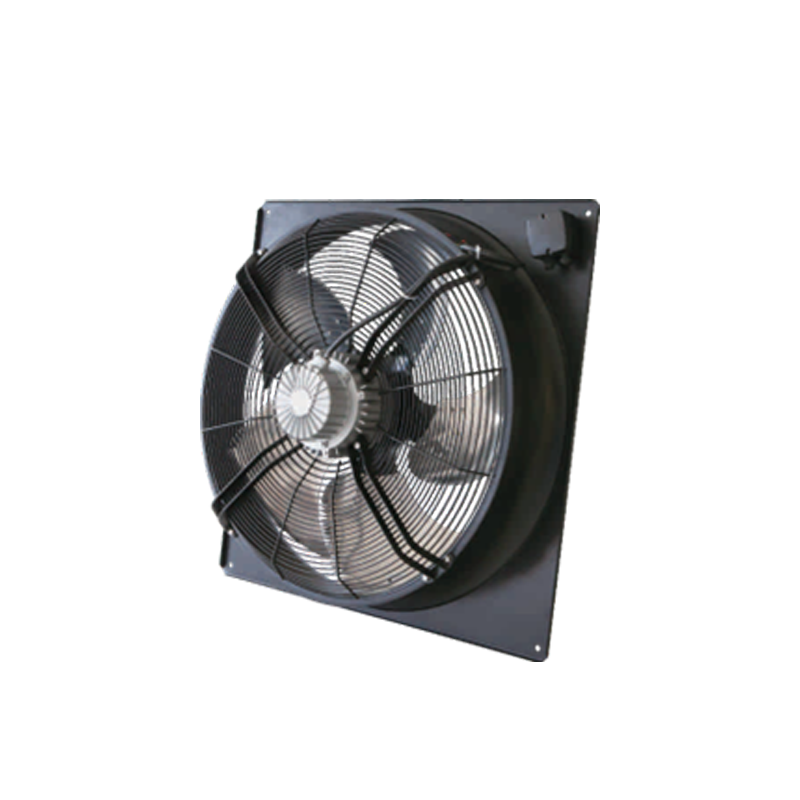
Engineers must compare fan topologies logically. You must address common engineering questions about airflow physics. We evaluate these components based on airflow profile. We look closely at motor intelligence and physical footprint.
Outdoor condenser boxes share specific physical requirements. They require moving massive volumes of air. This air must travel across wide heat exchanger coils. It moves against relatively low static pressure. Axial designs excel in this exact environment. They pull air linearly along the central shaft. They spread the air evenly across broad coil surfaces. This geometry perfectly matches outdoor unit shapes.
In contrast, centrifugal fans serve completely different purposes. They are necessary for ducted environments. They push air through restrictive channels and tight building vents. However, they are excessively bulky. They consume too much physical space. You cannot easily fit them inside compact heat pump enclosures. They also run inefficiently when handling low-pressure exhaust tasks. They simply draw too much power for open-air applications.
The EC difference fundamentally transforms motor performance. These units utilize brushless DC motors. They feature highly intelligent internal electronics. You feed them standard alternating current. They internally convert this power to direct current. This allows the magnetic fields to commute electronically. They do not rely on physical carbon brushes. They experience zero mechanical friction from commutation.
The performance result is dramatic. You achieve up to 30 to 50 percent higher efficiency. They easily outperform traditional AC alternatives. This massive leap in performance easily meets strict ErP directives. Furthermore, you eliminate external Variable Frequency Drives. The fan handles its own speed modulation. It simplifies the electrical panel entirely. It keeps the power conversion completely inside the motor hub.
| Performance Dimension | Standard AC Motor | Electronically Commutated Solution |
|---|---|---|
| Speed Control Flexibility | Fixed RPM or limited steps | Stepless adjustment (0-10V / PWM) |
| Overall Energy Efficiency | Lower due to high heat loss | 30 to 50 percent higher |
| External Drive Requirements | Requires bulky external VFDs | Integrated onboard electronics |
| Acoustic Output Profile | Loud cycling at partial loads | Whisper-quiet at low RPMs |
Engineers choose the heat pump axial fan to achieve measurable outcomes. These outcomes directly impact end-user satisfaction. They ensure strict regulatory compliance across global markets.
Noise pollution poses a critical challenge for residential compliance. Many municipalities enforce strict nighttime decibel limits. Variable speed control solves this problem. It allows the fan to run at significantly lower RPMs. Thermal loads naturally drop at night. The fan automatically slows down. It pushes just enough air to maintain the set temperature. Manufacturers often utilize sickle-shaped blades. They incorporate specially designed trailing edge serrations. These physical features break up sound waves. This drastically reduces aerodynamic noise. It eliminates loud, jarring start-up sounds. Homeowners sleep better. You avoid costly noise complaint violations.
Winter weather causes severe frost accumulation. Ice heavily covers the outdoor coils. Frost blocks airflow and tanks heating efficiency. Smart motors aid in the rapid clearing of frost. They offer immediate, precise speed control. Some models even allow rapid airflow reversal. When the system enters a defrost cycle, the fan adjusts instantly. It optimizes the coil temperature. It melts the ice much faster. It then ramps back up smoothly. Normal heating resumes without a long delay.
Mechanical stress destroys HVAC components over time. Standard motors slam on at full speed. This violent action jolts the motor bearings. It stresses the plastic or metal fan blades. It also creates massive electrical demand spikes. Smart technology includes native soft-start capabilities. It gently ramps up the speed. This protects your hardware completely.
Procurement teams need a reliable buyer's checklist. You must evaluate a specific HVAC EC axial fan rigorously. Not all units survive extreme environments. You must verify their capabilities before finalizing purchase orders.
Modern HVAC setups rely heavily on centralized intelligence. You should look for native support for standard protocols. The Building Management System needs seamless data. Modbus RTU serves as an absolute industry standard. Your fan must communicate flawlessly. The central controller must read fan speeds easily. Alongside Modbus, ensure the unit accepts simple analog signals. Standard 0-10V inputs work perfectly. Pulse Width Modulation (PWM) inputs also offer great flexibility. These inputs allow simple, reliable, stepless speed regulation. They let the main thermostat dictate the exact RPM needed at any second.
Outdoor units endure brutal weather conditions. Define strict necessary specs for outdoor deployment. Your hardware must survive nature.
Do not evaluate the fan purely on bare motor efficiency. You must look at the entire physical assembly. Advise your engineering team to check the combined efficiency. Look at the motor, impeller, and housing together. Many top-tier suppliers offer optimized plug-and-play modules. The manufacturer perfectly matches the blade pitch. They align it precisely to the motor torque. The outer housing shroud minimizes air recirculation. A poorly designed shroud allows air to leak backward. Premium modules feature aerodynamically optimized wall rings. They direct the airflow straight through the coil fins. This holistic approach guarantees maximum airflow per watt consumed.
Transitioning to advanced aerodynamic systems requires honest factory planning. We must acknowledge transparent assumptions about the manufacturing shift. Advanced motors command a premium upfront price over traditional AC fans. However, the operational benefits far outweigh this initial friction.
Adopting integrated modules streamlines your entire supply chain. Using complete fan modules drastically reduces your Bill of Materials. In the past, you sourced multiple parts. You bought the motor separately. You purchased an external inverter. You sourced the impeller and safety grille from different vendors. Now, you combine everything into one single SKU. You buy the motor, intelligent controller, and impeller together. This standardization minimizes inventory headaches. It speeds up procurement cycles. It simplifies vendor management. You deal with one single supplier for the entire airflow system.
Factory assembly times improve significantly. A streamlined assembly process cuts manufacturing time. Time-motion studies consistently show huge time savings. Workers bolt in one cohesive unit. They connect a single power harness. They attach one simple signal wire. They no longer wire complicated external variable frequency drives. This drastically reduces human error. It directly lowers the chance of faulty wiring on the assembly line.
Furthermore, eliminating external drive cables reduces electromagnetic interference. Long cables between external inverters and motors often cause signal noise. Built-in electronics protect themselves intelligently. They feature active locked-rotor protection. They include thermal overload safeguards. If a fallen branch jams the fan blades, the motor stops safely. It does not burn out. This directly reduces future warranty claims. Your field service teams spend less time replacing ruined motors. You protect your brand reputation through superior product reliability.
The integration of advanced intelligent fans is no longer a premium feature. It serves as a strict baseline requirement. You need it for competitive, compliant HVAC design. You cannot easily meet 2025 efficiency mandates without them. They solve the hardest aerodynamic challenges effortlessly.
We strongly advise readers to audit their current product data. Compare your legacy power draw against proposed efficiency curves. You will likely spot massive optimization opportunities. Look closely at your acoustic performance metrics.
Take immediate action to future-proof your equipment lines. Consult an aerodynamics and motor specialist today. Request detailed 3D CAD models. Use them to check spatial fit. Ask for comprehensive performance curves. Finally, order sample units for hands-on prototype testing. Elevate your next generation of thermal management systems.
A: Yes, retrofitting is highly possible. However, it requires evaluating the existing control system carefully. These modern fans require different control signals. You must provide a 0-10V, PWM, or Modbus signal to utilize their full variable-speed benefits. Simply feeding them basic AC power without a control wire limits their advanced functionality.
A: Axial fans are specifically engineered for high airflow volume. They push air over a large surface area like a condenser coil. They achieve this using a minimal spatial footprint. Centrifugal fans push air through restrictive ductwork. They are aerodynamically inefficient and far too bulky for outdoor heat pump enclosures.
A: They perform exceptionally well in freezing conditions. The internal electronics are rated for severe environments. Their precise variable speed capabilities prove highly effective during cold-weather defrost cycles. They maintain high torque without stalling. You must always check the specific IP and temperature ratings to match your deployment climate.
