


Views: 0 Author: Site Editor Publish Time: 2026-09-01 Origin: Site


Upgrading fans in commercial HVAC systems carries significant capital and long-term operational implications. Facility managers face immense pressure to slash energy usage and meet stringent environmental compliance standards. While Electronically Commutated (EC) technology offers undeniable energy savings, selecting the optimal unit requires balancing aerodynamic performance, spatial constraints, and system integration.
If you choose the wrong configuration, you risk poor efficiency, acoustic issues, and systemic bottlenecks. You need a reliable, engineering-focused framework to make the right choice. This guide provides exactly that structure. We will explore how to evaluate, compare, and specify a modern fan for air handling unit applications based on pure operational reliability and verifiable energy performance.
We must first define the core business problem driving the upgrade. Facilities rarely replace equipment without a compelling catalyst. Perhaps your legacy belt-driven fans are failing repeatedly. Maybe sky-high energy costs drain your operational budget. Strict new environmental compliance targets also force building owners to rethink their legacy equipment. You must define clear success criteria before you purchase anything. Are you trying to reduce weekly maintenance hours? Do you need higher airflow delivered within a highly restricted cabinet space? Clarifying these foundational goals simplifies the entire engineering selection process.
Next, you must establish a baseline for evaluating capital expenditure against long-term energy savings. You need to look past the initial price tag on the invoice. Evaluate the lifetime energy consumption of the proposed units. Factor in the massive reductions in routine maintenance. You no longer need to order or replace broken belts. You benefit directly from lifetime-lubricated bearings. This shifts your financial focus toward operational efficiency and reliability rather than simply hunting for the cheapest upfront equipment costs.
Space and weight considerations also dictate equipment selection heavily. Modern commercial facilities often lack adequate mechanical room space. Older air handling units usually feature massive, heavy blower housings. The compact, direct-drive nature of an EC fan for air handling unit applications frees up internal cabinet space entirely. It drastically reduces the overall footprint of the system. You get much more working room for your maintenance personnel. Furthermore, removing bulky scroll housings improves internal aerodynamics and reduces internal static pressure drops.
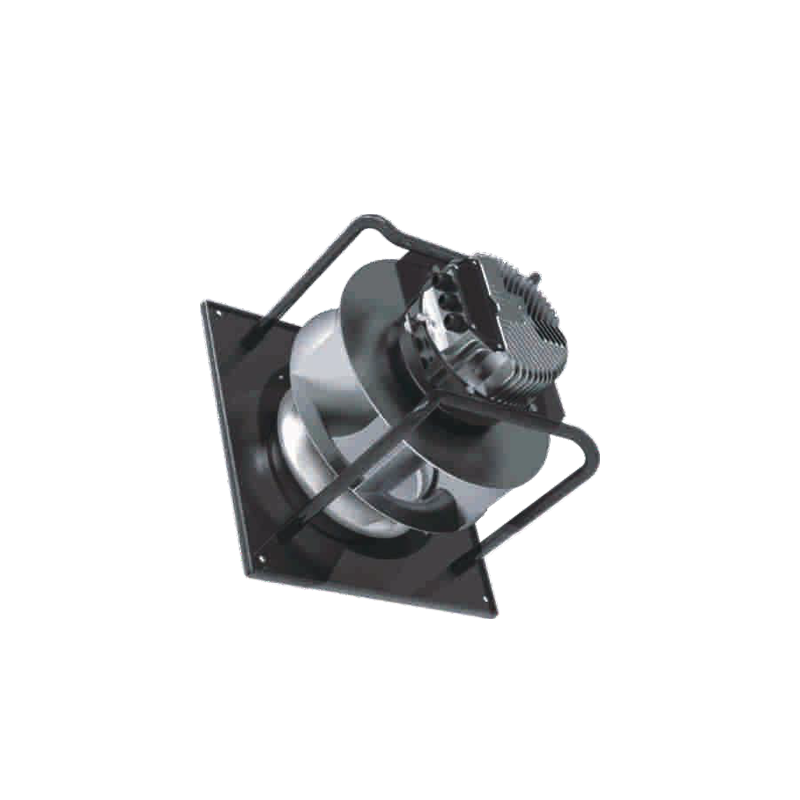
You cannot select a fan based on horsepower or physical dimensions alone. You must define the precise operating point of your system. Map your required airflow against the necessary static pressure. Engineers measure airflow in Cubic Feet per Minute (CFM) or Cubic Meters per Hour (CMH). You map these figures directly onto the manufacturer’s specific performance curve. Avoid oversizing the equipment at all costs. Oversizing pushes the fan completely out of its optimal efficiency zone. This common mistake entirely negates the energy gains you expect from upgrading to EC motors.
Aerodynamic efficiency heavily depends on the actual impeller design. Evaluate backward-curved centrifugal impellers for your high-pressure applications. They handle heavy air resistance exceptionally well. They push air efficiently through dense cooling coils, complex ductwork, and thick HEPA filters. Forward-curved impellers might move high volumes of air, but they struggle against the high static pressure typical in modern commercial buildings.
The acoustic profile is another critical evaluation dimension. You must assess the overall sound power levels generated by the unit. Differentiate carefully between broadband noise and tonal frequencies. High-pitched tonal noise irritates building occupants much more than low, rushing broadband hums. Review acoustic spectrum data across all octave bands. Ensure your final selection complies fully with strict facility acoustic standards, especially in healthcare or educational environments.
Finally, match the motor precisely to your available facility power supply. Consider whether you need a single-phase or three-phase input. Check the 50Hz or 60Hz adaptability of the specific electronics. Mismatched voltage causes immediate nuisance tripping or premature motor failure. Always verify the electrical panel capacity before ordering.
We must contrast the motor efficiency directly to understand the technological leap. A permanent magnet synchronous motor forms the core heart of an EC system. It operates completely without the magnetic slip losses inherent in standard AC induction motors. This fundamental physical difference means the motor runs much cooler. It uses significantly less electricity to achieve the exact same rotational speed. The built-in electronic commutation ensures the magnetic fields align perfectly at all times.
Speed control and part-load performance showcase the biggest operational differences. AC fans rely on external Variable Frequency Drives (VFDs) to modulate their speed. Unfortunately, AC induction motors lose significant efficiency when you slow them down. Conversely, EC motors maintain a flat, highly efficient profile across a wide operating range. They adapt quickly to variable demands without wasting power. This makes them perfectly suited for Variable Air Volume (VAV) systems where airflow needs fluctuate constantly.
Parasitic losses plague older mechanical systems. Traditional setups suffer from severe drivetrain losses caused by slipping belts and worn out pulleys. VFDs also generate excess heat inside the mechanical room, which the HVAC system then has to cool down. An AHU EC fan eliminates these drivetrain losses entirely through its direct-drive design. The integrated electronics dissipate minimal heat, ensuring maximum system efficiency.
Table 1: Efficiency and Operational Comparison Chart
| Feature | Traditional AC Fan + VFD | Modern EC Fan |
|---|---|---|
| Motor Type | AC Induction Motor | Permanent Magnet Synchronous |
| Part-Load Efficiency | Drops significantly at lower speeds | Remains exceptionally high across the curve |
| Drivetrain Losses | High (belts, pulleys, bearings) | Zero (Direct-drive mechanism) |
| Control Integration | Requires external VFD and complex wiring | Built-in electronics (Modbus, 0-10V native) |
| Maintenance Needs | High (belt tensioning, greasing bearings) | Minimal (visual inspections only) |
Modern building management heavily relies on seamless automation. Your new equipment must integrate effortlessly with the existing Building Management System (BMS). Look for units supporting standardized protocols like BACnet, Modbus RTU, or basic analog 0-10V/PWM signals. Direct digital communication provides real-time performance data. It simplifies remote troubleshooting for facility managers. You can monitor RPM, power consumption, and operating temperatures from a central dashboard.
Sometimes, installing one large fan is not the smartest engineering answer. Consider adopting the fan array (or fan grid) strategy instead. Using multiple smaller fans arranged in parallel offers distinct structural and operational advantages.
Regulatory compliance remains non-negotiable in commercial HVAC upgrades. You must ensure the selected unit meets or exceeds regional energy directives. Check for ErP 2015 compliance if you operate in Europe. Verify adherence to ASHRAE 90.1 standards in North America. Strict compliance avoids costly fines and guarantees you install top-tier, high-performance equipment.
Retrofitting mechanical equipment always carries hidden engineering risks. You must anticipate these challenges to ensure a smooth project delivery. Harmonic distortion represents a major electrical concern during extensive upgrades.
Addressing these risks early in the design phase saves thousands of dollars in rework. Involve electrical engineers to review the power quality impact. Consult structural experts if the existing air handler cabinets show signs of severe rusting or metal fatigue.
You need a highly structured approach to finalize your equipment choice. Prioritize manufacturers offering robust, transparent selection software. Good software lets you model exact operating conditions accurately. It predicts energy consumption based on your specific climate zone and duty cycle. Do not accept manual estimations when advanced modeling tools exist.
Demand independent, third-party performance verification for all submitted equipment. Do not rely solely on internal manufacturer marketing brochures. Require AMCA (Air Movement and Control Association) certification for both air performance and acoustics. This certification guarantees the unit will perform exactly as advertised under laboratory conditions.
When moving toward actual procurement, plan your steps carefully. For large multi-unit facilities, establish a pilot retrofit first. Upgrade one single air handler and measure the results for thirty days. Verify the energy savings before committing to a campus-wide upgrade. Review the warranty terms specifically covering the integrated electronics, as these often differ from standard mechanical motor warranties. Finally, confirm the exact lead times for critical replacement parts to avoid prolonged downtime during future emergencies.
Selecting the right equipment for air handling unit optimization requires matching precise aerodynamic needs with facility control strategies. It is an engineering exercise that demands attention to detail, electrical compatibility, and structural integrity. By defining your required operating point accurately, you avoid the common pitfall of oversizing.
To succeed, you must audit your current airflow and static pressure requirements rigorously. Evaluate the physical space inside your cabinets to decide between a single unit or a multi-fan array. Always verify electrical compatibility and ensure seamless BMS communication protocols are in place before authorizing a purchase.
While the initial capital investment is undeniably higher, the verifiable reduction in energy consumption justifies the expense. The total elimination of VFD complexities, coupled with vastly improved system reliability, make properly specified EC fans the definitive choice for modern commercial HVAC infrastructure.
A: Most facilities see a return on investment within 1.5 to 3 years. The exact timeframe depends heavily on local utility rates and annual operating hours. Systems running continuously in high-energy-cost regions achieve payback much faster than those operating strictly on standard office schedules.
A: Yes, it absolutely can. The technology features integrated electronics handling speed modulation natively. You simply feed a control signal directly to the unit. This completely eliminates the need for an external, wall-mounted Variable Frequency Drive and its associated wiring.
A: No, they do not. The maintenance paradigm shifts away from mechanical tasks like belt-tensioning and greasing bearings. Instead, maintenance focuses entirely on basic digital monitoring through the automation system and routine visual inspections to ensure the impeller remains clean.
A: A fan array utilizes multiple smaller fans working simultaneously, creating built-in N+1 redundancy. If one unit fails unexpectedly, the integrated control system senses the pressure drop immediately. The remaining operational fans ramp up their speed to maintain the required static pressure, preventing downtime.
