


Views: 0 Author: Site Editor Publish Time: 2026-09-02 Origin: Site


Have you ever wondered why an HVAC system underperforms despite having top-tier equipment installed? Incorrect fan specification often causes compromised airflow. It leads to excessive energy consumption. It frequently causes premature motor failure. Both primary fan types move air efficiently. However, their aerodynamic principles dictate completely different operational strengths. You must understand how they handle volume. You must know how they react to static pressure. You must evaluate their response to system resistance.
We aim to provide engineers, facility managers, and procurement teams with an evidence-based framework for fan selection. You need to move past basic definitions. We will explore efficiency ratings, performance curves, and spatial realities. You will learn exactly how to match the right aerodynamic profile to your specific building requirements. This guide will help you prevent costly installation errors. It ensures your mechanical systems operate at peak aerodynamic efficiency.
Axial fans are optimized for high-volume, low-pressure applications (e.g., general ventilation, heat exchangers) where air moves parallel to the shaft.
Centrifugal fans excel in high-pressure, high-resistance environments (e.g., complex ductwork, HEPA filtration) by utilizing radial airflow to generate static pressure.
Fan selection must prioritize the intersection of required Airflow (CFM) and Total System Resistance (Static Pressure), followed by acoustic, spatial, and efficiency constraints.
Understanding how air moves is critical for system design. Both machines move air differently. We must examine their aerodynamic cores. You need to understand the physics behind the hardware.
Axial Flow Mechanics: These units feature a recognizable propeller-style design. The blades mount securely around a central hub. The motor spins this hub rapidly. Air is drawn in directly. It is then expelled parallel to the rotating axis. The system focuses entirely on kinetic energy. It moves massive amounts of air very quickly. You use them when air faces minimal resistance. Think of large wind tunnels. Consider expansive warehouse exhaust vents. The air travels in a straight, uninterrupted line. The blades slice cleanly through the air stream. This generates extremely high volume. However, it generates very low pressure. If you block the airflow, performance drops immediately. They simply cannot push against heavy physical barriers.
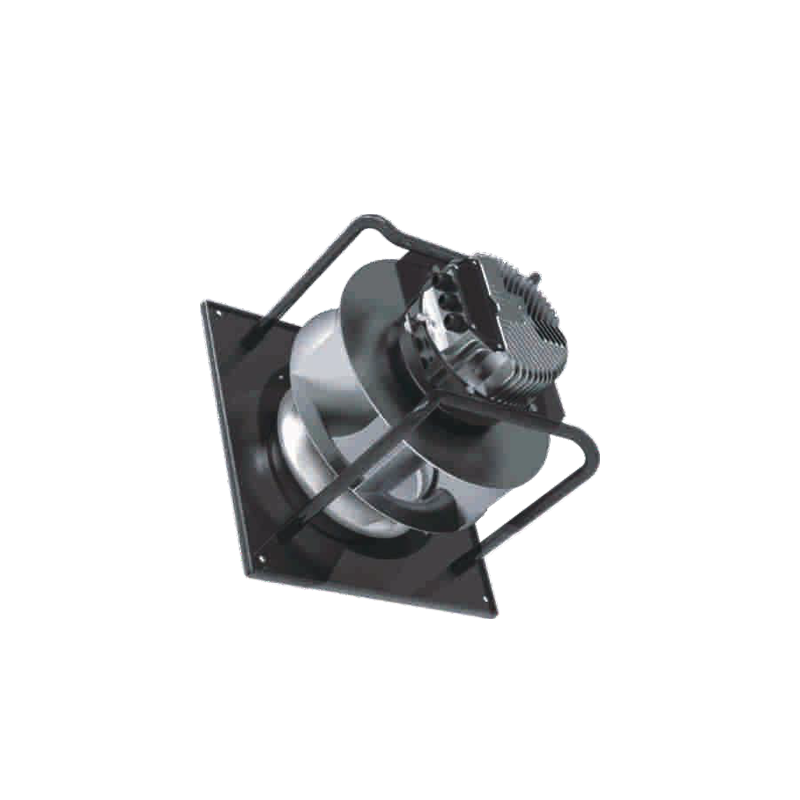
Centrifugal Flow Mechanics: These units operate on a completely different principle. They utilize a rotating impeller. This impeller sits inside a sturdy scroll-housing enclosure. Air enters the center of the spinning impeller axially. The spinning blades then capture this air immediately. Centrifugal force accelerates the air radially. It pushes the air outward perpendicular to the shaft. The scroll housing catches this fast-moving air. It forces the air out through a designated duct. This severe directional change is vital. It converts kinetic energy into robust static pressure. You rely on this design to overcome heavy friction. They easily push air through dense filters. They handle long, twisted duct networks effectively. They thrive under heavy resistance.
To make an informed choice, you need quantitative lenses. We must look at several performance criteria. You must evaluate these metrics during your bottom-of-funnel decision process.
Engineers rely heavily on the inverse relationship rule. High airflow usually means low static pressure. High static pressure usually means lower airflow. You measure this resistance in inches of water gauge (in. w.g.).
Axial fans possess a much flatter performance curve. They deliver their absolute peak CFM at zero static pressure. Efficiency experiences a rapid drop-off soon after resistance applies. They struggle significantly when encountering duct friction. They fail against dense filters. They simply stall against high resistance. Common Mistake: Never install standard axial units behind MERV 13 filters. The unit will spin constantly but move zero air.
Centrifugal models feature a much steeper performance curve. They generate immense internal pressure. They maintain consistent CFM even when system resistance fluctuates. A clogged filter will not stop them entirely. This makes them exceptionally reliable for complex ductwork. They power through the friction effectively.
Mechanical room space is often severely limited. You must plan for spatial constraints early in the design phase.
Axial fans offer a highly compact, inline profile. They do not change the airflow direction at all. You can easily integrate them into walls. You can mount them in tight ceilings. They fit perfectly inside straight duct runs. They save incredibly valuable floor space. Best Practice: Use them for straight-through wall exhaust applications to minimize footprint.
Centrifugal fans require a much larger footprint. The bulky scroll housing takes up significant room. The perpendicular discharge angles require complex duct transitions. You need more physical clearance to install them. However, manufacturers now produce inline centrifugal models. These offer a smart hybrid compromise. They fit inline but provide higher pressure capabilities.
Noise profiles dictate where you can safely install equipment. You must compare decibel outputs carefully. You must also evaluate the specific frequency tones.
Axial fans typically generate lower-frequency noise. These deep, rumbling tones easily vibrate through rigid structures. Lower frequencies prove much harder to attenuate. You need heavy physical mass to block them effectively. They often require expensive vibration isolation pads.
Centrifugal fans generate higher-frequency noise. They produce a higher-pitched whirring sound. You can muffle higher frequencies relatively easily. Standard acoustic duct lining absorbs these sound waves well. Duct silencers also work highly effectively on high-frequency noise. This makes them better suited for sensitive office environments.
Aerodynamic efficiency impacts long-term energy consumption heavily. Every fan has a specific peak efficiency zone. You must operate the fan entirely within this zone. Running outside the ideal curve wastes massive amounts of energy.
You can pair both fan types with advanced motors. Electronically Commutated (EC) motors represent the modern standard. EC motors meet strict HVAC energy compliance standards. They offer seamless variable speed control. They run much cooler than traditional AC motors. This advanced pairing ensures maximum aerodynamic efficiency. It prevents massive energy waste during partial load conditions. It provides precise airflow management.
Operational Metric |
Axial Design Profile |
Centrifugal Design Profile |
|---|---|---|
Primary Airflow Direction |
Parallel to the rotating shaft |
Perpendicular to the rotating shaft |
Static Pressure Generation |
Low (Struggles with heavy friction) |
High (Overcomes heavy friction easily) |
Air Volume Capability (CFM) |
Extremely High |
Moderate to High |
Acoustic Tone Frequency |
Low frequency (Difficult to attenuate) |
High frequency (Easier to attenuate) |
Installation Footprint |
Highly compact, linear inline |
Large, requires offset discharge routing |
When evaluating an axial fan vs centrifugal fan, mapping features to specific facility outcomes is essential. You must align the hardware with your business goals.
You should deploy these when prioritizing bulk air movement. They excel in environments with minimal ducting. They provide rapid air exchange.
Large-scale commercial ventilation: This includes expansive warehouse exhaust systems. It includes massive agricultural facilities. These buildings require rapid indoor air exchange to maintain safe environments.
Cooling towers and air-cooled condensers: These massive units require pulling huge volumes of ambient air. They pull this air across large heat exchange coils to reject heat quickly.
Portable air movers: Spot-cooling applications rely on them heavily. They work perfectly where permanent ductwork remains entirely absent. Construction sites use them frequently for immediate air circulation.
You should select these when fighting high system resistance. They handle complex physical barriers effortlessly. They push air where others fail.
Air Handling Units (AHUs): Commercial HVAC setups rely on them exclusively. They push conditioned air through large office buildings. They handle the friction of extensive duct branches.
Advanced filtration systems: Applications requiring MERV 13+ or HEPA filters depend on them. These dense media filters create massive static pressure drops. Only radial acceleration can overcome this density.
Harsh industrial exhaust: They excel at moving particulate-laden air. They handle corrosive or extremely high-temperature air safely. Engineers specifically utilize backward-inclined or radial blade designs for these tough industrial jobs.
Trust requires acknowledging real post-installation challenges. Every mechanical system carries specific operational risks. We must examine the maintenance realities.
You must match the equipment to the physical environment carefully. Aerodynamics can turn against you rapidly.
Over-pressurizing an axial unit poses serious physical dangers. If duct resistance becomes too high, the fan enters aerodynamic stall. The air simply spins around the blades without moving forward. This causes severe vibration. It leads to rapid mechanical fatigue.
Conversely, undersizing a centrifugal unit leads to system surge. The system gasps for air rapidly. The pressure fluctuates wildly. Both conditions completely destroy operating efficiency. They will eventually shatter the internal motor bearings. Best Practice: Always include a 10% safety margin when calculating your initial static pressure.
Routine maintenance prevents catastrophic system failures. You must plan for service access during the initial design phase.
Axial units generally offer much easier service access. You can reach the blades quickly for routine cleaning. Motor replacement usually requires minimal system teardown. They simplify the maintenance workflow.
Centrifugal units often demand extensive labor to service. You usually have to remove heavy access panels. Service technicians frequently need specialized confined-space access. Reaching the internal impeller takes significant time. Servicing drive belts or bearings proves highly challenging. Large belt-driven HVAC units prove particularly cumbersome to maintain safely.
Air quality directly impacts blade longevity. Airborne particles affect different aerodynamic designs uniquely.
Certain centrifugal blade types accumulate dust rapidly. Forward-curved blades trap debris inside their tight, scoop-like profiles. This buildup alters the aerodynamic shape over time. It shifts the entire performance curve downward. The motor must work much harder to push air. This accelerates component wear.
Axial blades boast a more self-cleaning aerodynamic profile. The high-speed straight airflow blows dust off the blades naturally. However, they remain highly susceptible to structural imbalance. If large debris strikes and damages a blade edge, severe vibration follows immediately. Always protect them using proper intake grilles.
You need a reliable shortlisting logic for your upcoming projects. Navigating the axial fan vs centrifugal fan,fan selection process requires a highly structured approach. Follow these precise steps carefully to ensure success.
Step 1: Calculate Total System Static Pressure. You must map out all ductwork systematically. Measure every single straight run. Account for every elbow, duct transition, and air damper. Include the exact pressure drops from all heating coils and air filters. Add these metrics together to find your absolute peak system resistance. Do not estimate this number blindly.
Step 2: Define Target CFM. Establish your exact volumetric requirements. Base these numbers strictly on local building ventilation codes. You can also calculate them using the building's specific thermal loads. Accuracy here prevents poor indoor air quality. It ensures the environment remains perfectly comfortable and compliant.
Step 3: Plot the Operating Point. Open the specific manufacturer performance curves. Intersect your calculated CFM and total static pressure on the graph. This visual dot becomes your precise operating point. Identify the exact fan size that places this point in its highest aerodynamic efficiency range. Avoid selecting a unit operating near the extreme edges of its curve.
Step 4: Apply Physical Constraints. Filter your technical shortlist using hard physical realities. Check your available mechanical room space meticulously. Ensure the selected unit physically fits through the facility doors. Confirm that the fan meets all required acoustic noise thresholds. Add flexible duct connectors to isolate future vibrations.
Let us review the fundamental realities of airflow engineering. Neither fan type is universally superior across all applications. The ultimate choice hinges entirely on your specific system resistance. Spatial parameters also dictate what you can practically install. You must respect the physical constraints of your unique duct network.
We strongly advise relying on dedicated manufacturer selection software. You should consult closely with a certified HVAC engineer. They can finalize precise motor sizing. They will also determine the optimal blade pitch. Do this only after selecting your foundational base category.
Take action on your system design today. Request a technical consultation to review your specific blueprints. Download a comprehensive fan selection cheat sheet to guide your team. View specific product spec sheets to finalize your mechanical schedules confidently.
A: You should only do this if high static pressure is causing the poor airflow. If duct resistance overcomes your axial unit, a centrifugal upgrade helps. However, if system resistance remains very low, a centrifugal fan may over-amp the motor. It will consume significantly more power without meaningfully boosting the actual air volume.
A: Centrifugal fans are almost universally required for these applications. The dense glass-fiber media of HEPA filters creates extremely high static pressure drops. Axial models simply cannot generate enough forward force. They will stall rapidly attempting to push air through such heavy physical resistance.
A: They offer a highly effective middle ground. They provide the convenient, straight-through airflow profile of an axial unit. Yet, they utilize a backward-curved centrifugal impeller inside. This delivers much higher pressure capabilities. They are ideal when you have restricted mechanical space but must overcome moderate duct friction.
