


Views: 0 Author: Site Editor Publish Time: 2026-07-24 Origin: Site


Cooling tower operations demand significant operational expenditure from facility budgets. Continuous fan usage draws massive amounts of electricity year-round. Legacy AC belt-driven systems amplify this financial drain. They suffer from high mechanical losses. They also require frequent maintenance stops. Direct-drive Electronically Commutated (EC) technology offers a superior modern alternative. It eliminates belts, pulleys, and external drives entirely.
Facility managers and consulting engineers face mounting pressure today. You must meet stringent energy compliance standards. You need to reduce maintenance downtime. You also must optimize overall thermal management. Specifying an EC axial fan addresses these specific industrial challenges head-on.
This article explains exactly why you should upgrade your cooling infrastructure. You will learn about aerodynamic advantages. You will discover precise control capabilities. We also break down the financial business case for replacing outdated setups. Understanding these core factors ensures you make data-driven decisions for your next retrofit or new facility build.
Facility managers often inherit legacy cooling systems. Older setups rely heavily on traditional AC motors. Belt-driven AC axial and centrifugal units introduce severe operational bottlenecks. You lose approximately 5% to 15% of motor power directly through mechanical transmission. Belts slip constantly. They degrade over time. They waste valuable energy as friction and heat.
Inefficiency at partial loads creates another major issue. Cooling demands fluctuate based on ambient temperatures. Building occupancy levels also change throughout the day. Traditional systems struggle under these variable conditions. They waste immense power during off-peak hours. Instead of utilizing true speed modulation, older setups rely on inefficient mechanical damping. Sometimes they use harsh on/off cycling. This brute-force approach spikes energy usage. It also stresses internal mechanical components.
Routine maintenance adds a massive hidden financial burden. These hidden costs pile up rapidly and typically include:
The business case for upgrading becomes undeniable. You must look at these compounding inefficiencies. Removing mechanical failure points protects your operational budget.
Modern direct-drive technology creates a perfect synergy between aerodynamics and motor physics. An energy-saving axial fan integrates an electronically commutated motor directly into the impeller hub. This highly engineered design optimizes both airflow and static pressure. It perfectly suits the vertical or horizontal draft requirements found in commercial cooling towers. You extract maximum air movement for every single watt of electricity consumed.
These units feature built-in continuous variable speed control. They seamlessly accept standard 0-10V or PWM control signals. This integration allows the fan speed to match the exact heat rejection load in real time. Intelligent modulation prevents wasteful over-cooling during colder months. It adapts instantly during cooler night shifts. The impeller spins exactly as fast as you need. It never overworks.
Acoustic performance also improves dramatically. Engineers optimize modern blade geometry using bionic or swept-blade designs. These advanced shapes slice through the air smoothly. They prevent turbulent vortex shedding. Combined with silent EC commutation, this reduces annoying tonal noise. It also minimizes structural vibration. Sound reduction remains a critical priority. Urban hospitals, data centers, and sound-restricted facilities demand ultra-quiet operation. EC technology helps you easily meet strict municipal noise ordinances.
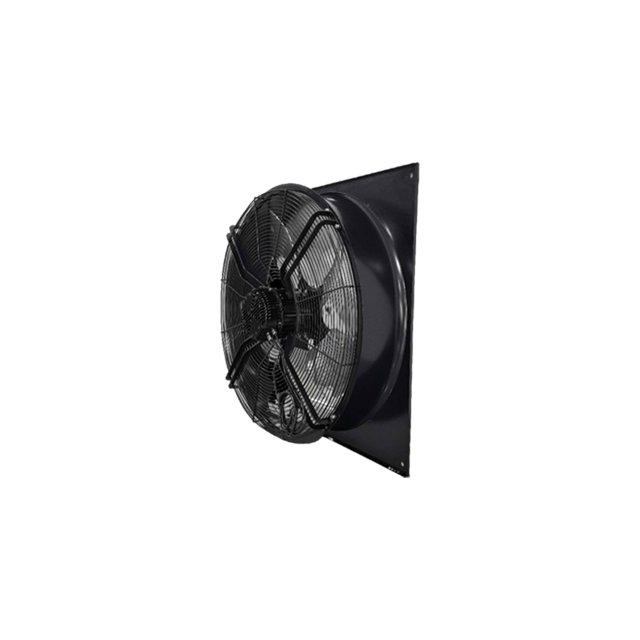
Engineers must evaluate several fan typologies when designing or retrofitting cooling towers. Understanding the functional differences helps you make the best choice. Here is a breakdown of how EC axial designs stack up against older alternatives.
First, consider the comparison against traditional centrifugal units. Axial profiles move massive volumes of air at low-to-medium static pressures. This specific aerodynamic profile perfectly fits cooling tower drafts. Bulky centrifugal units simply take up too much physical space. They also restrict natural airflow patterns. EC axial setups consistently outperform centrifugal systems regarding specific fan power (SFP) metrics. Lower SFP translates directly to better overall system efficiency.
Next, compare them to standard AC units utilizing external VFDs. System footprint plays a huge role in facility design. EC units are compact plug-and-play devices. An AC setup running off an external VFD requires complex electrical wiring. You need expensive shielded cables to prevent interference. You also must allocate space for massive separate motor control cabinets.
Long-term reliability sharply separates the two technologies. Built-in electronics inside EC units eliminate the risk of destructive bearing currents. External VFDs frequently generate parasitic capacitance. This phenomenon causes rapid motor winding degradation. Direct-drive EC technology sidesteps this catastrophic failure point entirely.
Below is a comparison chart illustrating these core differences:
| Feature / Technology | EC Axial Unit | AC Axial (External VFD) | Centrifugal Blower |
|---|---|---|---|
| Control System | Integrated 0-10V/PWM | Requires external VFD cabinet | Requires external VFD cabinet |
| Physical Footprint | Minimal (Plug-and-play) | High (Extra wiring/panels) | Very High (Bulky housing) |
| Drive Mechanism | Direct-drive hub | Belt-driven or direct | Typically belt-driven |
| Specific Fan Power (SFP) | Excellent (Low energy use) | Moderate | Poor at high air volumes |
| Routine Maintenance | Extremely Low | High (Lubrication/Belts) | High (Belts/Pulleys) |
Putting sensitive electronics into a wet cooling tower understandably raises skepticism. Facility operators constantly worry about water ingress. They fear rapid rust and electrical shorts. However, a properly specified cooling tower fan using EC technology mitigates these exact environmental risks. Reputable manufacturers engineer these units specifically for brutal, high-humidity environments.
You must demand a minimum ingress protection rating of IP54 or IP55. The internal electronics require heavy conformal coating. This chemical layer repels condensation and prevents circuit shorts. Additionally, ensure the rotor and blades utilize advanced corrosion-resistant materials. Specialized industrial composites work exceptionally well. Heavily coated marine-grade aluminum also prevents degradation from continuous moisture exposure.
Financial realities often dictate procurement decisions. Upfront capital expenditure (CapEx) for advanced technology runs higher than standard AC motors. Yet, the long-term return on investment (ROI) easily justifies the switch. You establish a transparent evaluation framework by comparing projected energy savings against initial costs. Most commercial facilities achieve a complete break-even timeline between 18 and 36 months. This rapid payback timeline shrinks even further depending on local utility rates. Continuous 24/7 duty cycles also accelerate your financial return.
Grid compliance represents another critical implementation factor. Modern EC units feature integrated active or passive power factor correction (PFC). This built-in technology actively minimizes harmonic distortion on your facility’s electrical grid. You avoid purchasing expensive, bulky external harmonic filters. The integrated electronics handle grid conditioning automatically.
Specifying the correct equipment requires a highly methodical approach. You cannot simply guess your HVAC load requirements. Follow these logical steps to choose the perfect unit for your cooling application.
Transitioning to an advanced direct-drive setup represents more than a simple energy-efficiency play. It is a highly strategic move. You significantly improve overall system reliability. You also drastically reduce lifecycle maintenance demands by eliminating outdated belts and pulleys. Your maintenance team reclaims valuable man-hours.
Before requesting vendor quotes, engineering teams should conduct a comprehensive baseline energy audit. Measure your current cooling tower performance accurately over several weeks. This baseline data ensures you calculate a precise ROI. It helps you justify the required capital upgrade budget to internal stakeholders.
Take the next logical step today. Consult directly with specialized technical sales engineers. Leverage advanced manufacturer selection software to input your exact operating points and ambient conditions. Proper upfront planning guarantees you reap the full aerodynamic and financial benefits of your new installation.
A: Yes, provided they are specified with the correct ingress protection (typically IP55 or higher), sealed bearings, and corrosion-resistant coatings designed for continuous moisture exposure.
A: While variable based on local energy costs and operational hours, payback typically ranges from 1.5 to 3 years, driven by the elimination of transmission losses and high partial-load efficiency.
A: No. EC fans have an integrated electronic controller (inverter) that accepts standard analog or digital signals (0-10V, Modbus) for seamless speed control, eliminating the need for an external VFD and shielded motor cables.
A: EC technology includes integrated electronics with wide voltage input ranges and built-in protections against overvoltage, undervoltage, and phase failure, making them highly resilient to grid instability.
