


Views: 0 Author: Site Editor Publish Time: 2026-07-10 Origin: Site


Ventilation represents more than a basic animal welfare requirement. It acts as the primary driver of energy overhead and flock yield in modern agricultural facilities. Poor airflow directly harms your bottom line. Traditional fixed-speed or belt-driven AC fans carry significant limitations today. They cause high energy waste, suffer from rapid mechanical wear, and provide imprecise climate control. Farm operators struggle to maintain stable temperatures using these outdated mechanical solutions. Many older barns still rely on simple on-off timers. These rigid setups fail to adapt to rapid weather changes. They leave flocks vulnerable to heat stress or excessive chilling. Upgrading to an EC animal husbandry fan allows farm operators to achieve exact climate mapping. You can reduce electrical consumption by up to 50% at partial loads. This guide explores how these units integrate seamlessly into modern environmental control (EC) house systems.
Relying on outdated ventilation equipment carries compounding business risks. Many farm managers underestimate these hidden operational drains. We often view barn air exchange simply as a survival requirement. However, airflow dictates feed conversion ratios and overall energy bills.
Energy overhead drains profits daily. Traditional AC fans draw near-maximum power constantly. Even when controllers throttle them down using basic triac dimmers, they consume excessive electricity. They run highly inefficiently during transitional seasons. You pay for full electrical power regardless of the actual airflow needed. This creates massive utility bills over a single flock cycle. AC motors generate excess heat when slowed down artificially. This wastes energy and damages internal copper windings over time.
Flock health and yield suffer under inconsistent airflow. Fluctuating air speeds trigger severe biological consequences. Broilers generate immense body heat during their final weeks. Heat stress spikes rapidly during summer months. This requires rapid tunnel ventilation to cool the birds effectively. Winter presents a completely different challenge. Ammonia and moisture build up quickly in enclosed spaces. You need precise minimum ventilation to remove noxious gases. You must accomplish this without freezing the young flock. Traditional fans struggle to balance these extremes accurately. Birds suffer from respiratory issues or heat exhaustion as a result.
The maintenance burden remains a hidden financial drain. Older mechanical systems hide extensive manual labor tasks. Farm staff spend hours replacing worn belts. They must constantly grease bearings and realign pulleys. Belt slippage reduces airflow by up to 30%. You might think fans run properly, but they deliver inadequate cooling. Motor burnouts happen frequently due to regional voltage drops. These breakdowns often occur during peak summer heat. Such failures risk catastrophic bird loss in mere hours.
Farm owners often ask what makes EC technology different. Let us break down the underlying mechanics simply. You must understand the hardware to appreciate the long-term energy savings.
What exactly is an EC fan unit? An EC (Electronically Commutated) fan uses a brushless DC motor. It includes a built-in electronic commutation board. It accepts standard AC power input directly from your panel. The internal electronics convert this alternating current into direct current. This eliminates the need for physical carbon brushes entirely. It creates a frictionless, highly efficient spinning motion. The onboard computer constantly monitors rotor position. It applies power precisely when needed.
The variable speed advantage changes your operational economics. Efficiency curves tell the real story here. AC motors experience a sharp drop-off in efficiency below 100% speed. They waste electricity as heat when throttled. EC motors maintain a flat, optimal efficiency curve across all speeds. They use drastically less power at reduced RPMs. Running an EC unit at 50% speed uses only a fraction of its total wattage. The affinity laws of physics apply perfectly here. Half the speed requires barely one-eighth of the power. This translates directly to dramatically lower utility bills.
Acoustic and thermal benefits improve the barn environment. Mechanical friction creates heat and loud noises. Brushless designs run much cooler under heavy workloads. They also operate smoothly and quietly. Lower noise reduces flock stress significantly. Relaxed birds feed better and grow faster. Cooler motors last much longer than standard AC equivalents. We see far fewer thermal overloads.
| Feature | EC Technology | Traditional AC Fans |
|---|---|---|
| Motor Design | Brushless DC with built-in electronics | Standard AC induction with brushes/belts |
| Speed Control | Native precise control (0-100%) | Clunky via external VFD or physical dampers |
| Efficiency at Partial Load | Extremely high across all speeds | Drops sharply below 80% operating speed |
| Maintenance Needs | Washdown and simple visual checks | Belt tightening, bearing grease, pulley alignment |
| Operating Temperature | Runs cool naturally | Often runs hot when throttled down |
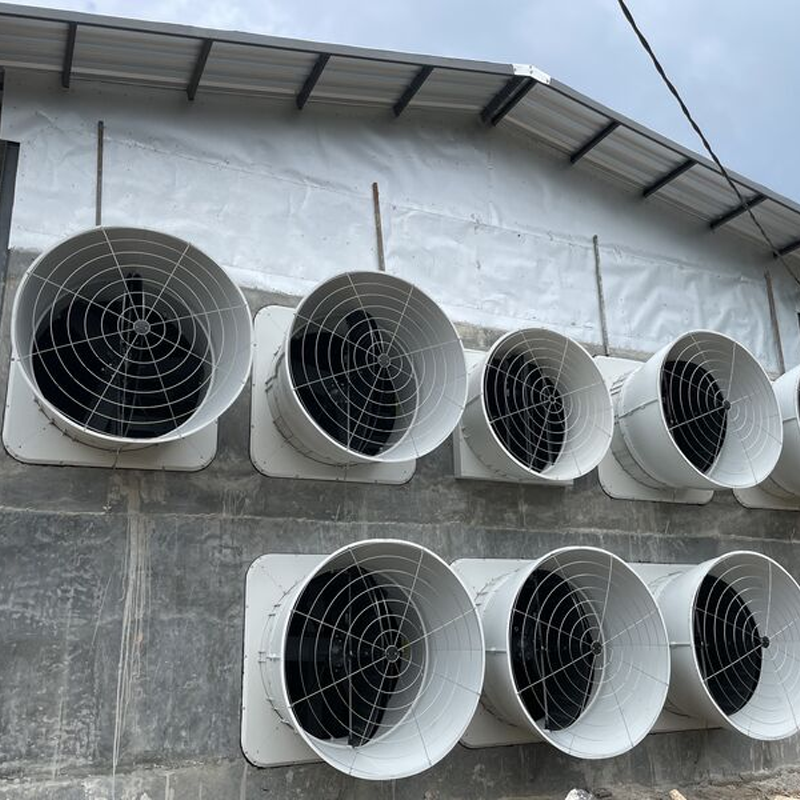
Choosing the right unit requires looking past basic marketing claims. You must evaluate specific engineering metrics. Farm environments destroy weak equipment rapidly.
Airflow metrics dictate your actual cooling power. We measure this using Cubic Feet per Minute (CFM) per Watt. Always evaluate these figures at specific static pressures. A standard agricultural benchmark is 0.10 or 0.15 inches of water column. Many AC fans boast high "free air" maximums. Free air means testing without any airflow resistance. Poultry houses always feature resistance from light traps, cooling pads, and ceiling baffles. Free air numbers mislead buyers completely.
A poultry barn creates a terribly harsh operating environment. Ammonia gas causes rapid metal corrosion. Daily dust accumulation chokes standard motor cooling fins. Frequent high-pressure washdowns introduce harmful moisture. You must establish strict hardware baselines. We strongly recommend housings made from heavy fiberglass. Coated galvanized steel also works well. Motor protection ratings remain non-negotiable. Look strictly for IP55 or IP66 ratings. An IP66 rating ensures complete dust tightness. It also protects against powerful water jets. This prevents electrical shorts during thorough flock changeover cleaning routines.
Older mechanical systems require constant staff attention. Workers must monitor belt tension weekly. Loose belts reduce fan RPM silently. Direct-drive EC systems eliminate these headaches completely. The fan blade attaches directly to the motor shaft. There are no belts to slip or snap. There are no pulleys to align perfectly. Greasing requirements drop to zero. This operational simplicity frees your staff for critical animal care tasks. You eliminate the physical failure points entirely.
Modern barns rely on centralized climate computers. Your ventilation hardware must speak their digital language. A poultry house fan setup evolves from simple on/off switches into a smart automated ecosystem.
System compatibility guarantees smooth operations. An EC fan interfaces easily with central climate controllers. It uses standard agricultural communication protocols. Most systems use a 0-10V analog signal. Some prefer PWM (Pulse Width Modulation) outputs. Advanced controllers utilize Modbus networks for detailed two-way feedback. The controller sends a precise speed command based on internal sensors. The fan responds instantly and accurately. This prevents the harsh electrical power spikes associated with starting heavy AC motors. You avoid tripping breakers during staged automated start-ups.
Stage-by-stage ventilation execution keeps conditions optimal. Effective climate control requires three distinct operational stages. Automated scaling keeps the flock comfortable year-round.
Upgrading your farm infrastructure requires careful financial planning. You must look beyond the initial purchase sticker price. A smart upgrade improves your overall business valuation predictably.
We must acknowledge the reality of equipment pricing. EC technology carries a higher initial price point than traditional mechanical equipment. However, standard cost analysis shows incredibly strong returns. You can calculate your payback period easily. Factor in your local commercial electricity rates. Estimate the fan runtime hours across all four seasons. Add the savings from reduced maintenance labor. Factor in better feed conversion from comfortable birds. Most operators see a full payback period between 18 and 36 months. Lower utility bills drive these fast returns consistently.
Upgrading existing barns introduces unique structural challenges. You cannot simply swap units blindly. First, check your main electrical panel compatibility. EC setups require dedicated breakers per circuit. Next, plan your control wiring routes carefully. You need separate shielded low-voltage lines for the 0-10V signals. Keep these away from high-voltage power lines. This prevents electromagnetic interference. Finally, measure your existing wall openings. You may need custom framing to seal the new fiberglass housings properly. Undetected air leaks destroy your static pressure.
New technology demands updated management skills. Farm staff must understand the new automated control parameters. Many workers intuitively switch fans to manual override when barn temperatures rise. They panic and force the fans to maximum speed. This negates all automated energy savings instantly. Training remains absolutely crucial. Teach them how the variable speed curves function. Show them how the fans adjust automatically to static pressure changes. Trusting the automated system prevents costly human errors. Let the climate computer do its intended job.
EC technology fundamentally changes barn management forever. It transitions daily ventilation from a blunt instrument into a precision tool. You gain exact, measurable control over airflow, energy use, and animal comfort. Outdated mechanical equipment drains farm profits through hidden inefficiencies and constant breakdowns. Precision upgrades protect your profit margins. They also protect your valuable birds from sudden stress.
Follow these practical steps to begin your upgrade journey confidently:
A: Yes. Many farms use a hybrid strategy successfully. You install EC units specifically for continuous minimum and variable transitional ventilation. You keep your existing AC units strictly for peak summer tunnel ventilation. This balances initial upgrade costs while maximizing your daily energy savings during the majority of the year.
A: All fans lose some CFM as static pressure rises. However, EC motors maintain a significantly more stable performance curve than AC models. If integrated with smart barn pressure sensors, the controller automatically commands the EC motor to ramp up its RPM. This instantly compensates for unexpected pressure drops.
A: No. Most agricultural models feature highly-rated IP66 motor enclosures. These withstand standard high-pressure washdown procedures completely safely. However, we warn against directing high-pressure spray directly at the electronic control housing seals. Use common sense cleaning practices to protect the internal digital components from physical damage.
