


Views: 0 Author: Site Editor Publish Time: 2026-06-30 Origin: Site


Heavy-duty commercial and industrial environments present a harsh engineering dilemma. Facilities must achieve massive air exchange rates to maintain continuous operations. They also require equipment capable of surviving endless exposure to moisture, humidity, and corrosive elements. Standard motors degrade quickly under these conditions. They often cause unacceptable downtime and operational halts. To solve this problem, engineers are shifting aggressively from legacy AC motors to Electronically Commutated (EC) technology. This shift now dominates modern large-scale infrastructure applications. These advanced motors combine intelligent variable controls with robust environmental protections. This article evaluates why the specific combination of a 950mm form factor, EC motor efficiency, and high waterproof ratings provides the optimal solution for demanding high-airflow deployments. You will learn how these advanced systems master extreme environments, optimize facility energy consumption, and guarantee reliable daily performance.
Industrial ventilation systems face intense operational demands. Standard commercial fans routinely fail when deployed in heavy-duty environments. Cooling towers, agricultural barns, and commercial greenhouses represent some of the most punishing applications. These facilities push equipment to the absolute limit. High humidity levels, continuous water splashing, and chemical vapors constantly attack mechanical components. Standard motors lack the necessary sealing and protective coatings. They ingest moisture easily, which degrades internal windings.
Moving massive volumes of air naturally creates an airflow versus resistance trade-off. Pushing high cubic feet per minute (CFM) volumes across dense filter banks or large facilities increases mechanical resistance. This resistance forces the motor to work harder. The motor subsequently generates excess heat. When you introduce humid or wet conditions, thermal management becomes complicated. Moisture traps heat around poorly ventilated motor housings. It accelerates the degradation of internal insulation. Standard fans simply cannot sustain peak output under these combined stressors.
Inadequately sealed equipment carries a massive cost of failure. Moisture penetration causes premature bearing failure. Water disrupts the grease layer inside the bearing, increasing friction and heat. Eventually, this leads to catastrophic electrical shorts and sudden motor burnouts. Facility managers face unplanned downtime and urgent replacement labor. To prevent these failures, engineers must specify the right foundational equipment. Using a large diameter axial fan establishes the necessary baseline for raw volume. However, the system requires specific motor upgrades and rigorous environmental protection to survive long-term.
Electronically Commutated (EC) technology fundamentally changes how industrial ventilation operates. EC motors use onboard electronics to convert alternating current (AC) into direct current (DC). This conversion eliminates the magnetic slip losses associated with traditional AC induction motors. The motor uses intelligent microprocessors to control stator commutation smoothly. They run significantly cooler and maintain precise speeds regardless of minor voltage fluctuations.
The energy curves highlight extreme performance differences. Standard AC motors lose massive efficiency when you modulate their speed. Conversely, a 950mm EC axial fan maintains peak electrical efficiency across its entire operating range. You can modulate it down to 50% capacity during lower demand periods. The motor responds by dropping its power consumption exponentially. Traditional AC equivalents waste energy as heat when choked or electronically dimmed.
Beyond electrical efficiency, EC technology delivers incredible acoustic advantages. High-volume air movement traditionally generates disruptive noise levels. EC systems address this noise factor directly. Optimized blade aerodynamics match the motor's smooth electronic commutation. This combination significantly lowers operating decibels (dBA). Lower noise profiles remain critical for OSHA compliance in industrial spaces. They also prevent noise pollution complaints in dense urban installations.
| Performance Metric | Standard AC Axial Fan | Advanced EC Axial Fan |
|---|---|---|
| Energy Efficiency | Low to Moderate (drops at low speeds) | Consistently High (up to 90% efficient) |
| Speed Control | Requires external VFD; causes mechanical stress | Native 0-10V/PWM control; smooth modulation |
| Heat Generation | High (wasted energy converts to heat) | Minimal (improves component longevity) |
| Acoustic Profile | Loud, prone to magnetic humming | Quiet, aerodynamic commutation |
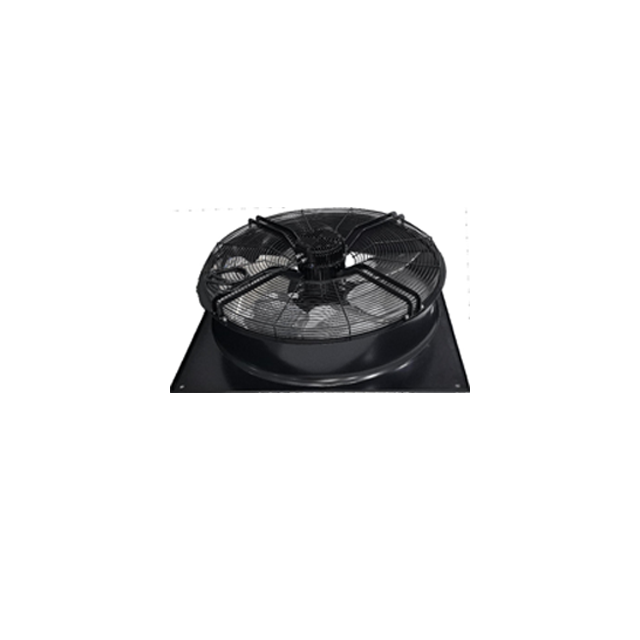
The term "waterproof" causes frequent confusion in industrial procurement. To evaluate equipment accurately, we must break down specific Ingress Protection (IP) ratings. Industrial fans utilize the IP scale to quantify environmental resilience. The first digit indicates solid particle protection, while the second indicates liquid protection. A splash-proof rating (IP54 or IP55) handles light water spray. However, it fails under direct hose washes or total submersion. Demanding environments require equipment fully sealed against powerful water jets or submersion, typically rated at IP68.
Manufacturing realities dictate the true survivability of a waterproof EC axial fan. Achieving high IP ratings requires intensive engineering at the component level. Manufacturers cannot simply add a rubber gasket to a standard housing. They must redesign the internal architecture. High-performance models feature fully resin-encapsulated electronics. The control boards sit inside solid potting compound, blocking all moisture. They also utilize double-sealed ball bearings packed with hydrophobic grease. Finally, manufacturers deploy corrosion-resistant blade materials. You will often see glass-fiber reinforced plastics or specially coated aluminum blades.
We must acknowledge transparent assumptions regarding environmental protection. "Waterproof" does not mean invincible. High IP ratings protect against specific test conditions, but real-world installation matters immensely. Facility teams must follow strict best practices to maintain motor integrity.
Engineers consistently select the 950mm dimension for high-volume applications. This specific volume-to-footprint ratio represents a strategic "sweet spot" in the industry. It offers a massive swept area for high CFM output. The larger the blade diameter, the more air it moves at lower rotational speeds. Lower RPM translates directly to reduced mechanical wear and lower noise. Crucially, the 950mm size fits perfectly into standard industrial mounting panels. It simplifies both retrofits and new OEM equipment designs.
We see application-driven design principles at play here. The 950mm size maps perfectly to heavy-duty use cases. Heavy industrial exhaust systems use these dimensions to clear toxic fumes rapidly. Large-scale HVAC condensers rely on them to reject heat from commercial chillers. Data center dry coolers deploy them in massive banks to maintain strict server temperatures. The physical size provides the exact balance of static pressure capability and raw volumetric flow required by these strict environments.
Scalability offers another major advantage. Relying on a single, oversized centralized blower creates a single point of failure. If that massive blower fails, the entire facility halts. Deploying an array of 950mm fans solves this problem. Array configurations provide built-in redundancy. If one unit requires maintenance, the others ramp up their speed to compensate. Furthermore, arrays allow for highly granular variable load management. You can spin up individual fans precisely matching real-time cooling demands.
Selecting the right equipment requires a strict evaluation framework. You must verify actual performance metrics against facility demands. Start by analyzing the CFM and Static Pressure curve matching. Request certified fan curves from the manufacturer. Ensure your required operating point falls near the fan's peak efficiency zone. Do not just look at free-air CFM figures, as they ignore system resistance.
Control integration forms the next critical evaluation dimension. Modern facilities run on complex Building Management Systems (BMS). Your selected fans must speak the same language. Ensure the equipment offers native Modbus RTU communication. If your system is older, verify compatibility with analog 0-10V or PWM control signals. Seamless integration prevents expensive third-party control gateways and complicated programming.
Compliance and certifications validate manufacturer claims. Never procure industrial fans without verifying specific regulatory marks. European installations demand ErP directive compliance to meet strict energy efficiency standards. North American deployments require UL or cUL standards to satisfy fire and electrical safety codes. Always look for the CE marking to guarantee baseline manufacturing conformity.
Watch out for common implementation risks during rollout. Many contractors underestimate the structural support needed for a large, high-torque fan. The mounting panel must absorb significant rotational forces without vibrating. Improper integration with legacy BMS control loops causes rapid start-stop cycling. This cycling defeats the efficiency purpose of EC motors. Plan your integration carefully to ensure smooth, continuous variable operation.
Specifying a 950mm waterproof EC fan represents a highly strategic engineering decision. It perfectly balances high aerodynamic output with unmatched electrical efficiency. These specialized units guarantee environmental survivability in the harshest industrial applications. By replacing legacy AC motors, facilities eliminate common failure points while gaining precise variable control.
Take actionable steps before finalizing your procurement. First, audit your facility's exact CFM and static pressure requirements. Second, evaluate your true environmental exposure to determine the necessary IP rating. Finally, always request specific aerodynamic fan curves and detailed BIM models from manufacturers. These steps ensure your chosen solution will perform flawlessly upon installation.
A: A quality EC motor typically delivers an L10 bearing life exceeding 40,000 to 50,000 hours, even in humid environments. The lifespan depends heavily on proper stator encapsulation and the use of double-sealed ball bearings. When manufacturers protect internal electronics with resin potting, humidity cannot penetrate the critical circuitry, maximizing operational longevity.
A: Yes, retrofitting is highly common. You must verify form factor matching and mounting hole spacing. Most modern 950mm EC units share standardized industry dimensions with legacy AC models. You will need to upgrade facility wiring, as EC fans require distinct control signal lines (like 0-10V) alongside main power to utilize variable speed capabilities.
A: No. IP ratings remain completely independent of the motor's RPM. The waterproof integrity comes from static physical barriers like resin encapsulation and specialized seals. However, running at very low speeds reduces internal airflow. Manufacturers engineer EC motors with excellent thermal management, ensuring they do not overheat even when heavily modulated.
A: Never rely solely on marketing claims. Request independent, third-party laboratory testing reports from the manufacturer. Look for specific NEMA enclosure ratings or standardized IP certification documents. Authentic industrial suppliers will readily provide data sheets detailing the exact testing parameters used to achieve their stated ingress protection levels.
