


Views: 0 Author: Site Editor Publish Time: 2026-07-05 Origin: Site


In high-density livestock and poultry environments, inadequate ventilation directly impacts animal health. Poor airflow degrades feed conversion rates and lowers overall facility profitability. When ammonia accumulates inside a barn, animals suffer severe respiratory distress. Galvanized metal housings frequently succumb to rapid corrosion from this constant exposure to ammonia and high humidity. Fiberglass Reinforced Plastic (FRP) has emerged as the industry standard to combat this decay. However, you must realize not all FRP is manufactured equally. Flimsy materials will still fail under harsh agricultural conditions.
Selecting the right equipment requires looking past surface-level marketing claims. You need to thoroughly evaluate structural integrity and aerodynamic efficiency. In this comprehensive guide, we will explore verifiable performance data under real-world static pressures. You will learn exactly what factors ensure your ventilation investment pays off. Our breakdown will help you confidently choose hardware designed for maximum longevity and energy savings.
Agricultural environments naturally produce highly corrosive gases. Animal waste generates constant ammonia emissions. Combine this alkaline gas with high indoor humidity, and you create a highly destructive atmosphere for standard metals. Traditional galvanized metal housings rust rapidly under these conditions. Rust compromises structural strength and creates invisible air leaks around the fan frame. These air leaks decrease overall fan efficiency. You eventually face frequent equipment replacement and rising maintenance costs.
Aerodynamics play a massive role in operational efficiency. A well-designed FRP cone fan housing changes how air exits the building. The flared cone shape smoothly expands the exhaust air as it leaves the fan blades. This expansion reduces air turbulence at the exhaust point. It effectively lowers the static pressure drop across the fan opening. This aerodynamic improvement translates directly to lower energy consumption. You move the exact same air volume while drawing significantly less electrical current.
Durability dictates your ultimate return on investment. You should expect a premium fiberglass enclosure to outlast its internal mechanical parts. High-quality FRP easily survives multiple motor replacements and prop upgrades. It provides a stable, rigid foundation for multiple equipment lifecycles. This eliminates the need to tear out wall framing just to replace a rusted exterior shell.
Below is a quick overview comparing material performance inside typical agricultural settings:
| Material Type | Ammonia Resistance | Aerodynamic Profile | Expected Structural Lifespan |
|---|---|---|---|
| Galvanized Metal | Low (Prone to rapid rusting) | Basic (Hard angles cause turbulence) | 5 to 7 Years |
| Standard Plastic | Medium (Resists rust, but warps) | Moderate (Prone to heat deformation) | 7 to 10 Years |
| Heavy-Duty FRP | High (Completely immune to ammonia) | Optimal (Smooth, molded curves) | 15 to 20+ Years |
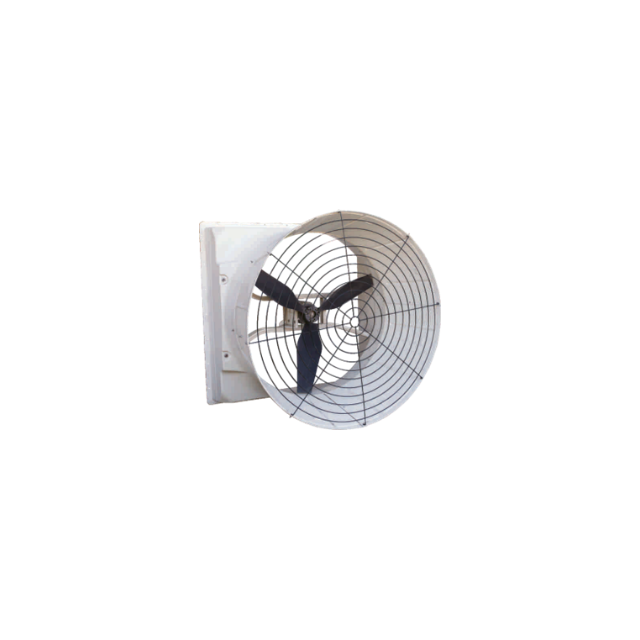
You must evaluate an agricultural ventilation fan based on its performance under resistance. Many manufacturers advertise impressive airflow numbers based on 0.0" static pressure. Engineers call this a "free air" rating. Free air ratings mislead buyers. A modern, tightly sealed poultry or swine facility never operates at zero static pressure. Evaporative cooling pads, inlet baffles, and dirty louvers all create airflow resistance. You must evaluate fan performance at 0.10" to 0.15" static pressure. This range accurately simulates the daily reality of a working barn.
Energy efficiency serves as your primary financial metric. The industry measures this efficiency in CFM/Watt (Cubic Feet per Minute per Watt). Higher CFM/Watt ratings mean lower monthly electrical bills. The precise molding of the fiberglass enclosure heavily influences this metric. A perfectly smooth inner surface reduces friction. The carefully engineered angle of the discharge cone minimizes air resistance. These combined physical traits force the fan motor to work less, pushing your energy efficiency ratings higher.
Never rely on in-house marketing data alone. You should strictly shortlist manufacturers providing certified performance test reports. Look for testing conducted by recognized engineering bodies like BESS Lab at the University of Illinois. Independent laboratories test fans inside standardized wind tunnels. They verify both CFM output and electrical consumption across multiple static pressure points. Transparent vendors gladly supply these test curves upon request. Hidden or missing data usually indicates subpar performance.
Fiberglass density varies wildly among manufacturers. Not all FRP provides the same structural integrity. Thin, flimsy fiberglass poses severe operational risks. High-speed fan blades generate intense vibrations. Thin walls warp and flex under this constant stress. This warping eventually causes the fan blades to strike the housing interior. You must demand high-density, heavily layered FRP. Thick walls absorb vibration, reduce operational noise, and maintain perfect blade tip clearance.
Exterior barn equipment endures harsh, direct sunlight. Ultraviolet rays ruthlessly attack standard plastics and resins. You need a premium, UV-resistant gel-coat applied over the raw fiberglass. Without this protective layer, fiberglass experiences a condition called "blooming." The outer resin degrades and exposes the raw glass fibers beneath. The surface becomes rough, brittle, and prone to cracking. A thick UV gel-coat seals the fibers and maintains structural flexibility for decades.
Hardware selection remains a notorious failure point in agricultural settings. Manufacturers sometimes pair high-quality fiberglass enclosures with cheap, low-grade bolts. The fiberglass survives the ammonia, but the bolts rust away completely. This rust causes the motor mounts to fail, leading to catastrophic equipment damage. You must insist on 304 or 316 stainless steel mounting hardware. Stainless steel brackets and fasteners guarantee the overall system integrity matches the lifespan of the fiberglass.
A high-performance housing must provide absolute stability for the internal motor. Evaluate exactly how the shell supports the drivetrain. Heavy-duty motor mounts made from cast aluminum or stainless steel are mandatory. These strong mounts prevent the motor from twisting during startup torque. You also need to verify compatibility with different drive systems. Determine if the enclosure easily accommodates both direct-drive and belt-drive configurations. Furthermore, ensure the design provides adequate cooling space if you plan to integrate Variable Frequency Drives (VFDs).
Air leakage severely impacts climate control when the fan cycles off. Look for designs featuring precision-fit recessed areas for shutters. A flush-mounted butterfly or louvered shutter prevents winter drafts from entering the barn. Worker safety also remains paramount. Ensure OSHA-compliant wire guards come completely standard. These metal guards must be corrosion-resistant. They should also feature quick-release clips. Easily removable guards encourage workers to perform routine maintenance safely.
Biosecurity requires aggressive sanitation protocols between flock or herd deployments. A proper cone fan housing must withstand intense washdown procedures. Farm crews routinely use harsh chemical disinfectants and high-pressure washers. Rough internal surfaces trap dust, feathers, and harmful pathogens. You need a completely smooth interior finish. Premium gel-coats repel dirt and resist chemical degradation. This smooth finish allows cleaning crews to sanitize the equipment rapidly without damaging the underlying fiberglass layers.
Choosing the right vendor involves evaluating their long-term commitment to your success. Warranty terms reveal a great deal about product confidence. You need to read the fine print closely. Clarify exactly what the warranty covers. Manufacturers often provide different coverage periods for the fiberglass shell, the electric motor, and the bearings. A robust warranty should offer extensive protection against fiberglass delamination and structural cracking. Additionally, assess the availability of replacement parts. Your chosen supplier must stock replacement belts, props, and motors locally to prevent devastating downtime during summer heatwaves.
Shipping large aerodynamic components presents unique challenges. Fiberglass cones are notoriously bulky. This bulk drastically increases freight costs. You need to factor freight expenses into your initial budget. You must also evaluate how the vendor ships the equipment. Some suppliers ship cones fully assembled. Others ship them "knocked-down" or unassembled to save space on the truck. Knocked-down shipping lowers freight costs significantly. However, you must account for the on-site labor required to bolt the panels together. Unassembled kits require specific worker skills to ensure the final product remains perfectly round and structurally sound.
Consider the structural risks associated with field assembly. Improperly assembled seams can leak air and vibrate loose. If you lack experienced maintenance crews, purchasing fully assembled units often prevents future headaches. Always weigh the upfront freight savings against the potential risks of poor site installation.
Investing in robust fiberglass ventilation equipment is a major infrastructure decision. The physical quality of your exhaust units dictates the environmental stability of your entire agricultural facility. Flimsy enclosures and cheap hardware will inevitably fail under the relentless assault of ammonia and humidity. Upgrading to heavy-duty, aerodynamic FRP ensures consistent climate control and protects your livestock.
Before generating a final purchase order, you should take specific action. First, audit your current barn static pressure requirements to understand your real-world resistance. Second, strictly request certified independent performance curves from all potential vendors. Finally, evaluate the warranty terms and shipping logistics carefully. Taking these calculated steps guarantees you secure reliable, highly efficient ventilation hardware for your farm.
A: Quality FRP generally boasts a lifespan of 15 to 20 years or more. High-density fiberglass completely resists the corrosive effects of moisture and ammonia. Conversely, galvanized metal housings typically begin degrading within 5 to 7 years in high-ammonia livestock environments.
A: While retrofitting is sometimes physically possible, experts usually discourage it. The fiberglass shell, prop design, and motor are meticulously engineered as a cohesive aerodynamic unit. Slapping a cone onto an incompatible frame often creates unwanted turbulence and fails to achieve optimal CFM/watt efficiency.
A: Direct-drive fans connect the prop directly to the motor, offering extreme simplicity and zero belt maintenance. Belt-drive systems separate the motor from the prop, operating at lower RPMs for high efficiency. However, belt drives require regular tensioning and belt replacements to maintain proper airflow.
A: The main body sits inside the wall, but the discharge cone protrudes outside the building. This exterior placement exposes the fiberglass to constant solar radiation. Unprotected fiberglass degrades quickly under UV rays, becoming brittle and prone to structural failure without a premium gel-coat.
