


Views: 0 Author: Site Editor Publish Time: 2026-08-27 Origin: Site


Facility managers and engineers face immense pressure today. We must optimize building energy consumption constantly. Stricter HVAC and refrigeration compliance standards demand smarter operational strategies. Conventional approaches no longer meet modern efficiency benchmarks.
Industry professionals are rapidly shifting from traditional AC (Alternating Current) motors to EC (Electronically Commutated) motors. This transition serves as a primary lever for operational efficiency in ventilation systems. Upgrading outdated fan arrays can drastically reduce facility power draw. You cannot afford to ignore these technological shifts.
While EC technology offers documented efficiency gains, upgrading requires strict evaluation. You must assess integration complexity, application suitability, and system compatibility. Evaluating an EC motor vs AC motor setup involves looking beyond basic specifications. This guide explores the core engineering differences to help you make informed equipment choices.
Efficiency: EC motors typically consume up to 30-50% less energy than standard AC motors, particularly at partial loads.
Control Integration: EC fans feature built-in speed control, eliminating the need for external Variable Frequency Drives (VFDs) required by AC systems.
Cost Dynamics: The higher initial procurement cost of an EC motor is generally offset by energy savings, with an average payback period of 1 to 3 years depending on duty cycles.
Implementation: Retrofitting AC to EC requires assessing dimensional differences, Building Management System (BMS) compatibility, and airflow matching.
Understanding the mechanical and electrical foundations of both technologies is crucial. The core differences dictate how they consume energy, generate heat, and respond to control signals.
Standard AC induction motors rely directly on the alternating current from the power grid. A stator creates a rotating magnetic field. The rotor chases this field to create motion. However, the rotor never quite catches up to the magnetic field's speed. Engineers call this difference "slip."
Slip is a mechanical necessity for induction, but it introduces inherent energy losses. The motor generates excess heat during this process. Furthermore, an AC motor depends on the line frequency (usually 50Hz or 60Hz) to dictate its speed. Running an AC motor at anything other than its full design speed reduces its efficiency significantly.
EC stands for Electronically Commutated. An EC motor is essentially a brushless DC motor equipped with an onboard electronic controller. It uses standard AC mains power. The internal electronics rectify this AC power into DC power. The controller then pulses this DC power to the stator coils precisely.
This design eliminates slip entirely. The permanent magnets on the rotor spin in perfect synchronization. You get the high efficiency of direct current technology without needing a separate DC power supply. The integrated controller manages all commutation, giving you seamless operational control.
Many engineers assume pairing a standard AC motor with a Variable Frequency Drive (VFD) equals EC performance. This is a common misconception.
Efficiency Drops: AC motors driven by VFDs lose significant efficiency at low speeds.
Harmonic Distortion: VFDs introduce electrical noise and harmonic distortion back into your power grid.
System Complexity: A VFD setup requires external drives, shielded cables, and separate cooling systems.
Integrated EC motors maintain superior efficiency across the entire speed curve. They handle their own commutation internally, preventing harmonic feedback and eliminating the need for bulky external drives.
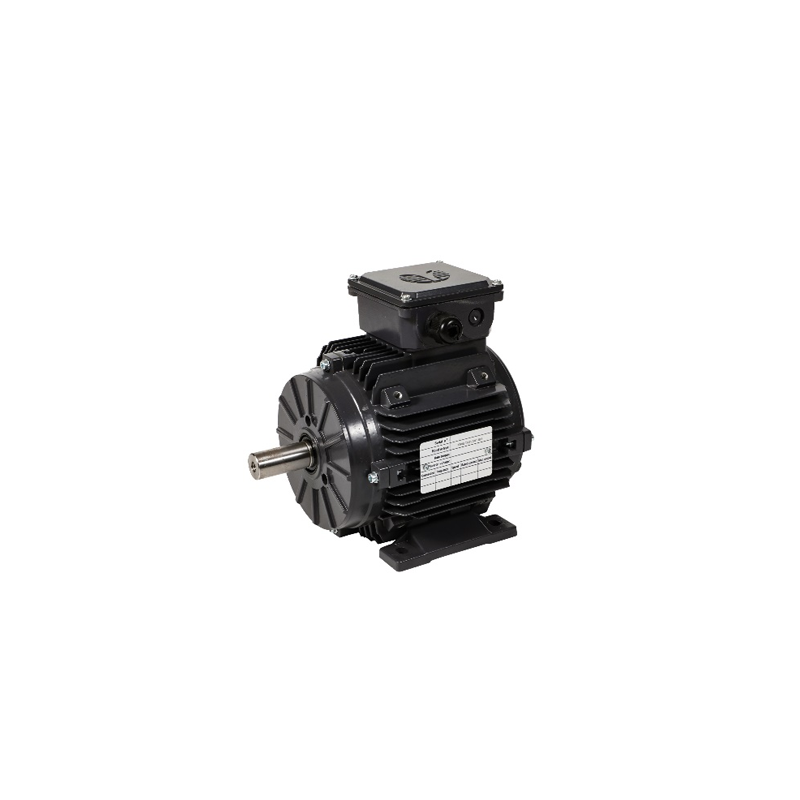
When specifying equipment, you must evaluate how these technologies perform under real-world conditions. An accurate EC motor vs AC motor,fan motor comparison requires looking at part-load efficiency, control inputs, acoustics, and thermal management.
Table: Performance Matrix of AC vs. EC Technologies
Evaluation Metric | Standard AC Motor | EC Motor (Electronically Commutated) |
|---|---|---|
Part-Load Efficiency | Drops sharply below 75% speed | Maintains 80-90% efficiency at low speeds |
Speed Control | Requires external VFD or step transformers | Native integration (0-10V, PWM, Modbus) |
Acoustic Noise | Prone to magnetic "hum" and VFD whine | Extremely quiet across all speed ranges |
Operating Temperature | Runs hot due to induction slip | Runs cooler, extending bearing lifespan |
Most ventilation systems rarely require peak airflow constantly. Fans operate at partial loads for the vast majority of their operational life. This is where power consumption profiles diverge drastically.
An AC motor loses substantial efficiency when dialed down. If you reduce an AC fan's speed by 50%, the motor struggles against its own design parameters. Conversely, EC motors maintain 80% to 90% efficiency even at partial speeds. The internal DC commutation ensures the motor draws only the exact wattage required to move the requested air volume.
Modulating airflow in legacy systems usually requires complex hardware. You might use mechanical dampers, which restrict airflow but waste motor energy. Alternatively, you might install complex VFDs or step-transformers.
EC motors feature native control inputs built directly into the housing. You can connect a simple 0-10V signal, a PWM (Pulse Width Modulation) connection, or use digital protocols like Modbus. The motor interprets these signals instantly. You achieve infinite speed modulation without installing extra electrical cabinets.
Best Practice: Always run shielded control wires separately from high-voltage supply lines to prevent signal interference in EC control networks.
Operational noise creates major issues in commercial and residential facilities. Standard AC motors generate a distinct magnetic "hum". When you pair an AC motor with a VFD, the chopped sine wave often induces a high-pitched mechanical whine at low speeds.
EC motors eliminate this problem. Because they do not rely on frequency manipulation to change speed, they remain remarkably quiet. Eliminating the VFD whine makes EC technology ideal for acoustic-sensitive environments like hospitals, recording studios, and open-plan offices.
Heat destroys electrical components. Because AC motors rely on slip, they generate significant internal heat. This heat degrades the winding insulation over time. It also dries out the grease in the mechanical bearings, leading to premature mechanical failure.
EC motors run much cooler. The synchronous rotation of the permanent magnets produces minimal waste heat. This cooler operation extends the lifecycle expectations of the bearings and the motor itself. Additionally, a cooler motor reduces the secondary cooling load on the facility. You spend less energy extracting the heat generated by your own fan motors.
Technology selection depends heavily on the specific facility requirements. Understanding where each motor excels helps engineers avoid over-engineering or under-performing system designs.
Data centers demand precise thermal management. Server loads fluctuate constantly based on computing demand. Precise airflow modulation is critical to maintaining a healthy Power Usage Effectiveness (PUE) metric.
EC fans excel here. They scale airflow up or down instantly in response to server temperature spikes. The lack of harmonic distortion also protects sensitive IT infrastructure from dirty power on the facility grid.
Indoor farming requires aggressive microclimate control. Plants experience variable transpiration rates depending on the lighting cycle. Humidity and temperature parameters shift dramatically between day and night phases.
EC fans manage these shifts efficiently. Growers can automate EC fans to ramp up during high-humidity periods and slow down during dry periods. This variable control prevents mold outbreaks while minimizing power consumption.
Upgrading Air Handling Units (AHUs) and Roof Top Units (RTUs) offers massive efficiency opportunities. Engineers frequently use fan arrays during retrofits. Instead of replacing one massive, failing AC blower, you install a "fan wall" of four to six smaller EC fans.
This approach provides built-in redundancy. If one small EC fan fails, the others automatically ramp up their speed to compensate. You maintain design airflow without emergency shutdowns. Furthermore, removing the old AC motor belts and pulleys eliminates routine maintenance tasks.
Despite the advantages of newer technology, legacy induction motors still hold value in specific scenarios. You should consider sticking with AC motors if:
Minimal Operating Hours: The system runs less than a few hours a week (e.g., emergency smoke extraction fans).
Strict Fixed-Speed Requirements: The application demands 100% constant airflow at all times, negating the benefits of variable control.
Extreme High-Temperature Environments: Some specialized industrial exhaust systems exceed the safe operating temperature limits of EC onboard electronics.
Replacing legacy equipment is rarely a simple swap. Facility managers must plan retrofits carefully to avoid unexpected downtime and structural incompatibilities.
Physical footprint differences pose the most common retrofitting challenge. An EC motor does not look like a traditional AC motor. They often feature a "pancake" or external rotor design. The mounting brackets rarely align perfectly.
You must source or fabricate custom adapter plates. Warn your installation team about depth clearance issues. Ensure the new motor assembly does not interfere with existing ductwork or structural supports. Additionally, verify airflow matching. A direct horsepower equivalent does not always guarantee the same CFM (Cubic Feet per Minute) output.
EC motors simplify external drive requirements, but integrating them into legacy systems requires thought. Older Building Management Systems rely heavily on basic relays or primitive analog signals.
Integrating native digital controllers may require specific protocols. If your existing BMS uses BACnet but your new fans only communicate via Modbus RTU, you face a communication barrier. You will need bridging devices or gateways to translate the signals. Map out the control wiring schematic before purchasing the hardware.
Common Mistake: Failing to run a dedicated, clean ground wire for the EC motor's electronics. Poor grounding causes erratic speed modulation and communication dropouts.
Global supply chains impact retrofitting schedules. Highly specialized EC motors often face longer lead times than standard off-the-shelf AC induction motors.
Standardize motor types across your facility whenever possible. Consolidating your fan sizes minimizes the need for a massive spare parts inventory. If you use identical fans in multiple AHUs, you only need to keep one or two spare units in your maintenance cage. Brief your procurement team on typical replacement lead times to avoid emergency air quality issues.
The engineering landscape continues to favor intelligent, highly efficient systems. In the debate between these two primary technologies, EC is objectively the superior choice for variable-load, continuous-duty applications. It eliminates mechanical slip, removes the need for bulky external drives, and drastically improves part-load efficiency.
Decision-makers should audit their facilities strategically. Identify your highest-usage fans first. Target systems running 24/7 with variable airflow demands. Upgrading these specific units yields the most immediate operational improvements.
For your next steps, consult a qualified systems engineer to review your current HVAC schematics. Consider conducting a pilot retrofit on a single non-critical AHU. Monitor the performance data, verify BMS communication, and validate the airflow improvements before rolling out a facility-wide upgrade.
A: It is rarely a simple plug-and-play process. You typically need custom adapter plates and new mounting brackets due to structural differences. You must also update control wiring to integrate the onboard electronics. Always assess physical dimensions and exact airflow requirements before attempting a swap.
A: No, they are not exactly the same. An EC motor uses standard AC mains power. It features an internal rectifier converting that AC to DC. This powers a brushless DC motor via an onboard electronic commutator. It gives you DC efficiency directly from an AC power grid.
A: Hardware premiums typically range from 20% to 50% above standard AC models. This initial premium pays for the highly efficient integrated controls, permanent magnets, and the elimination of external variable frequency drives. Energy savings generally offset this premium within an expected timeframe depending on runtime.
A: They are generally maintenance-free. Because they lack mechanical brushes and run at cooler temperatures, physical wear on bearings is minimal. However, their onboard electronics can be sensitive to voltage spikes. Installing proper surge protection ensures a longer lifespan for the internal controller.
