


Views: 0 Author: Site Editor Publish Time: 2026-08-26 Origin: Site


Increasing regulatory pressures squeeze facility managers today. Strict ErP directives and ASHRAE standards demand rapid adaptation across commercial building portfolios. At the same time, rising operational expenses force engineers away from traditional AC motors. Transitioning to Electronically Commutated (EC) technology is no longer just a sustainability trend. It represents a strict commercial necessity. Legacy systems waste power, consume valuable mechanical space, and require excessive maintenance hours. Modern facilities need reliable upgrades to survive tight operational margins and strict energy codes. Choosing the right EC centrifugal fan for HVAC requires moving beyond peak-efficiency marketing claims. We must rigorously evaluate partial-load performance, integration readiness, and overall financial impacts. You will learn practical selection frameworks to ensure your equipment retrofits yield actual financial returns. This guide explores the engineering fundamentals and practical integration steps required for successful HVAC upgrades.
Traditional AC centrifugal fans rely on external Variable Frequency Drives (VFDs) for variable speed control. This legacy approach creates inherent inefficiencies. External drives lead to significant electrical transmission losses. Belt-driven AC setups require a much larger footprint inside the air handling unit. They also demand higher maintenance overhead. Technicians must frequently tension belts, lubricate bearings, and align pulleys. These recurring tasks drain facility maintenance budgets and increase system downtime.
We can solve these problems by moving to a consolidated hardware approach. You should consider a Power-Saving EC Fan as your primary solution. This technology integrates the motor, controller, and impeller into one seamless unit. You eliminate external belts and drives entirely. This direct-drive integration removes transmission friction. It also vastly simplifies installation procedures for mechanical contractors.
We must evaluate the financial breakdown realistically. You will face a 20–40% higher upfront capital expenditure (CAPEX) when purchasing EC technology. However, the operational expenditure (OPEX) savings rapidly offset this premium. Most commercial installations achieve a full payback within one to three years. You achieve these savings through eliminated belt replacements, reduced mechanical friction, and significantly lower energy consumption.
You must maintain a skeptical lens during the specification phase. Financial return claims depend entirely on your system's runtime and partial-load percentage. Variable air volume (VAV) systems yield massive savings. Constant-volume, full-load systems see less dramatic financial benefits. Always evaluate your specific operational profile before approving the capital upgrade.
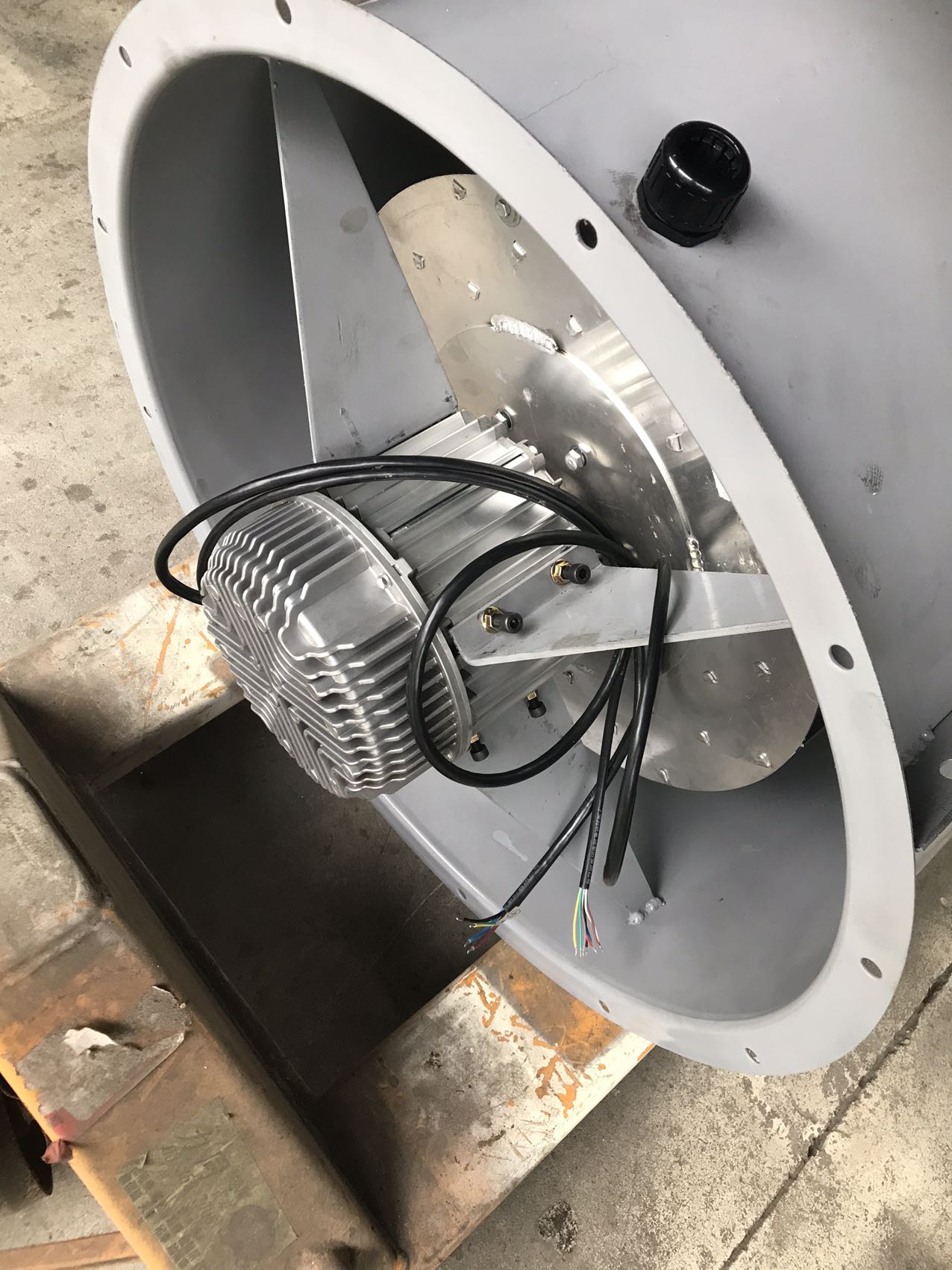
EC motors provide exceptional partial-load efficiency. Traditional AC induction motors suffer from significant slip losses when operating below their peak speed. EC technology uses a permanent magnet rotor and electronic commutation. This design allows the motor to maintain high efficiency across a remarkably wide speed range. When your building requires only 50% airflow, an EC fan consumes a fraction of its full-load power. The cube law of fluid dynamics maximizes these savings. Dropping fan speed by half reduces power consumption by nearly 87.5%.
Acoustic performance is another critical engineering advantage. Commercial spaces, hospitals, and data centers demand strict noise control. Traditional AC setups often generate structural vibration. VFDs frequently induce a high-pitched electrical whine in AC motors at low speeds. EC technology eliminates this tonal noise. The integrated electronics switch the magnetic fields smoothly. This smooth commutation prevents the jarring acoustic spikes associated with legacy variable frequency drives. Building occupants experience a much quieter environment.
Modern equipment design benefits immensely from the compact form factor. EC technology integrates the external rotor directly inside the fan impeller. This brilliant engineering choice drastically reduces the physical footprint. You can design slimmer Air Handling Units (AHUs). Mechanical rooms gain valuable floor space. During retrofit projects, contractors can easily maneuver these compact units through standard commercial doorways. You avoid the costly process of tearing down walls just to replace a mechanical fan assembly.
Modern facility management requires deep visibility into mechanical systems. EC fans excel in this area due to their seamless connectivity. They feature built-in control inputs as a standard offering. You do not need to purchase or program external variable speed drives. This native intelligence simplifies wiring schematics and reduces electrical panel requirements.
We generally categorize these control inputs into two standard methods:
| Feature | Analog (0-10V / 4-20mA) | Digital (Modbus RTU) |
|---|---|---|
| Installation Complexity | Low (Point-to-point wiring) | Medium (Daisy-chain network) |
| Data Feedback | Limited (Usually fault relays only) | Extensive (RPM, Watts, Temp, Faults) |
| Cable Cost | Higher (Individual runs per fan) | Lower (Single networked bus) |
| Best Application | Standalone single-zone AHUs | Large arrays and smart buildings |
Operational reliability increases significantly through closed-loop control. Building filters slowly load with dust over time. This increases the internal static pressure drop. A traditional fan would deliver less air as the filter clogs. An intelligent EC setup monitors this resistance. It automatically adjusts its RPM to maintain a constant airflow (CFM) output. Building ventilation rates remain perfectly consistent regardless of filter degradation.
Selecting the optimal equipment requires careful aerodynamic matching. You must choose between forward-curved and backward-curved blade geometries. Each serves a highly specific mechanical purpose.
Backward-curved fans excel in high static pressure applications. They feature a non-overloading power curve. This means the motor will not burn out if system resistance drops unexpectedly. We specify backward-curved units for standard AHUs, data center cooling, and cleanrooms. They offer the highest peak aerodynamic efficiency.
Forward-curved fans move high volumes of air at lower operating pressures. They operate at lower rotational speeds for a given flow rate. This makes them acoustically favorable for tight spaces. We specify them for fan coil units (FCUs) and compact duct transitions. However, they lack the high-pressure capabilities of their backward-curved counterparts.
You must size the equipment to the exact system curve. Do not simply match the maximum CFM listed on a legacy datasheet. You must evaluate the specific operating point on the fan performance curve. Selecting a fan that operates too far to the left of its curve causes surging. Surging creates severe aerodynamic noise and mechanical stress. Selecting a fan too far to the right risks stalling. The operating point must sit near the center of the efficiency envelope.
Always verify environmental and compliance specifications. Check the Ingress Protection (IP) ratings. Specify IP54 or IP55 for outdoor installations or highly humid environments. These ratings protect the sensitive internal electronics from dust and moisture. Furthermore, mandate UL and CE certifications. Local building inspectors will require these safety marks before approving your mechanical retrofit.
Upgrading to EC technology introduces specific implementation realities. You must assess the existing electrical infrastructure. Large arrays of EC motors can introduce harmonic distortion into the building's electrical grid. The internal rectifiers convert AC power to DC. This process pulls non-linear current. You should measure Total Harmonic Distortion (THDi) during the design phase. Specify active harmonic filters at the main electrical panel if you deploy a massive fan wall array.
Structural adapting requires careful mechanical planning. Legacy AC enclosures were designed for specific airflow patterns. You cannot simply drop a new unit into an old box. Bulkhead mounting panels must possess sufficient rigidity. Flexing panels destroy aerodynamic efficiency and create low-frequency rumbling. Furthermore, legacy enclosures often lack proper inlet clearances. You must specify airflow straighteners or inlet cones. These accessories prevent inlet turbulence, which would otherwise ruin the fan's performance and increase noise.
Facility managers should follow a strict shortlisting logic. Follow this three-step action plan before executing any purchase orders:
Upgrading to an EC centrifugal fan represents a strategic investment in long-term operational efficiency. It is never just a simple hardware swap. You are replacing legacy mechanical friction with intelligent, networked aerodynamics. We have seen how partial-load efficiency and integrated controls vastly outperform older induction technologies. The upfront capital cost yields swift returns through dramatically lower utility bills and eliminated mechanical maintenance.
You must match the aerodynamic blade profile to your specific system pressures. You must also prepare your electrical infrastructure for the new load characteristics. We strongly encourage buyers to consult with technical sales engineers early in the process. Ask them to run a specific lifecycle payback calculation. Demand a performance curve analysis based on your exact ductwork parameters. Careful engineering upfront guarantees a successful, high-efficiency mechanical upgrade.
A: The return on investment usually falls between 12 to 36 months. This timeline depends heavily on local energy rates and variable load requirements. Systems running 24/7 with fluctuating partial loads achieve the fastest payback. Constant-volume systems will take longer to recoup the initial capital expenditure.
A: No. EC fans feature integrated commutation electronics built directly into the motor housing. This native integration completely eliminates the cost, mechanical space, and complex wiring associated with external Variable Frequency Drives.
A: Most standard units support operating temperatures up to 60°C (140°F). However, the internal electronics are sensitive to extreme heat. It is vital to check the internal electronics' thermal protection ratings and specify customized cooling features for industrial high-heat applications.
A: It entirely depends on the application. Backward-curved blades excel in high-pressure efficiency and offer non-overloading characteristics. Forward-curved blades provide higher airflow volumes at lower speeds, making them ideal for tight dimensional spaces with lower static pressure requirements.
