


Views: 0 Author: Site Editor Publish Time: 2026-08-27 Origin: Site


Facility managers and design engineers face a constant battle. You must balance strict thermal requirements against rising energy costs. Tight acoustic regulations only add to this challenge. Keeping systems cool is no longer just about moving massive amounts of air. You have to move it smartly, efficiently, and quietly. Traditionally, engineers relied on standard alternating current fans. These units offered rugged simplicity and low upfront costs. However, strict efficiency mandates are forcing an industry-wide shift. ErP directives demand higher performance from every component. Electronically commutated fans are rapidly becoming the new standard for modern applications. They promise massive energy savings. Still, they also bring new integration challenges. We built this transparent, engineering-focused guide to help you cut through the noise. You will learn exactly how these technologies differ mechanically. We will help you evaluate system integration realities and operational ROI without relying on manufacturer hyperbole.
Efficiency: EC axial fans typically consume up to 70% less energy than AC equivalents at partial loads due to built-in brushless DC technology.
Control: EC fans offer seamless, out-of-the-box variable speed control (via PWM or 0-10V) without the acoustic humming or external VFDs required by AC fans.
TCO vs. Upfront Cost: While EC fans carry a 20-40% higher initial procurement cost, payback periods in continuous-duty applications (like data centers) often resolve in under 18 months.
Implementation Risk: Retrofitting AC to EC requires verifying electronic compatibility, power quality (surge protection), and control signal infrastructure.
AC fans run smoothly at full speed. But modern environments are highly dynamic. Data centers experience fluctuating IT loads constantly. HVAC systems deal with shifting ambient temperatures throughout the day. Fixed-speed cooling is inherently wasteful. Standard AC fans struggle to adapt gracefully to these changes. They waste significant power when demand drops.
You must establish clear success criteria for your upgrades. What makes an upgrade successful? It goes beyond simply replacing a broken motor. Success means lowering the Power Usage Effectiveness (PUE) in a server room. It means meeting strict local HVAC efficiency codes seamlessly. It also involves reducing scheduled maintenance intervals. You want your system to run longer without human intervention. Any complete axial fan comparison must start by examining these fundamental operational goals.
Many skeptical buyers fall into the "good enough" trap. They hesitate to change anything. Why fix a system if it still spins? This mindset leads to margin drain. Standard AC units bleed energy over time. You might save money today on procurement. But you pay a heavy operational tax every month. Relying on outdated technology erodes profitability rapidly. You have to look past the initial price tag.
Let us look under the hood. Mechanical differences dictate actual performance. AC axial fans rely on straightforward, traditional mechanics. They usually use shaded-pole or permanent split capacitor (PSC) motors. These motors depend entirely on the line voltage frequency to operate. This reliance creates rigid performance curves. They cannot easily deviate from their set speed.
AC motors typically use a capacitor to create a phase shift. This shift creates the rotating magnetic field. The rotor bars induce their own current to follow this field. This induction creates electrical resistance. Resistance manifests directly as heat. Furthermore, AC motors suffer from "slip." The rotor inherently lags behind the magnetic field. This slip represents lost energy. The fan must then dissipate its own internal heat, reducing overall system efficiency.
EC axial fans take a completely different approach. They integrate a brushless DC motor with an onboard AC-to-DC converter. You feed standard AC power into the unit. The onboard electronics convert it into direct current. Electronic commutation then manages the motor rotation. Permanent magnets sit directly on the rotor. The microcomputer senses the rotor position continuously. It fires the exact stator coil needed to pull the magnet forward.
This process allows the motor to run synchronously. There is absolutely no slip. The rotor precisely follows the magnetic field without lag. Consequently, the motor generates significantly less internal heat. Cooler operation extends the life of all internal components. You get higher efficiency and better durability in a single package.
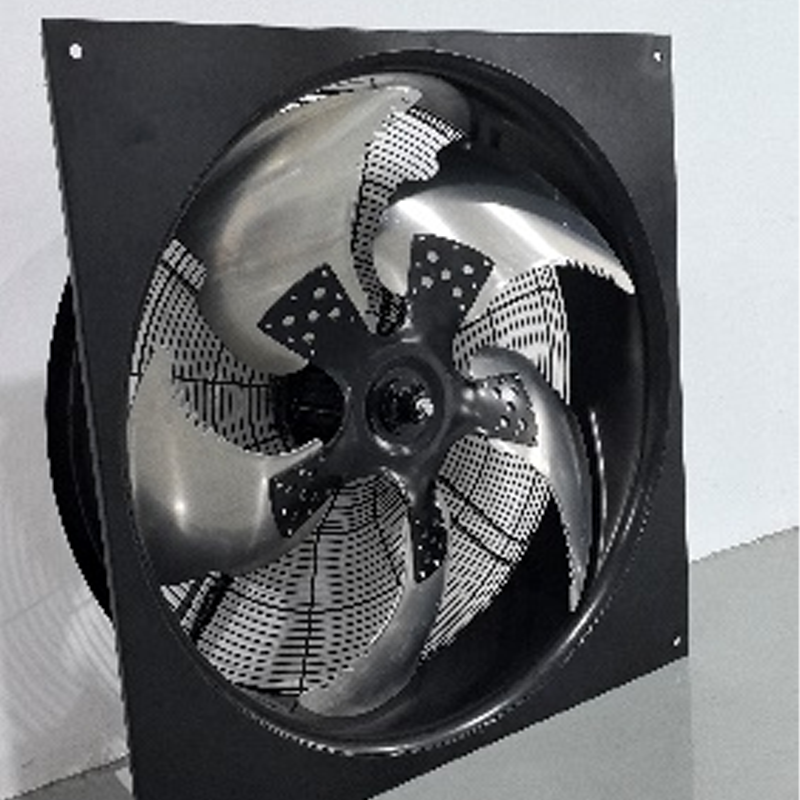
Peak versus partial load performance is a critical distinction. EC fans are more efficient at full speed. They often achieve 80-90% motor efficiency. AC fans typically sit between 40% and 70%. However, the real magic happens during partial loads. Most cooling systems rarely require 100% output continuously.
Consider a typical cooling tower application. An AC motor running at half capacity might still consume 75% of its peak power. An EC motor running at half speed consumes closer to 15% of its peak power. The physics of fan laws dictate this cubic relationship. EC motors allow you to harness these fan laws accurately. AC motors fight against them due to extremely poor low-speed efficiency. When you reduce an EC fan to half speed, its power consumption drops drastically. These compounding energy savings make the financial case undeniable.
You must calculate the financial equation accurately for your facility. Several inputs are required. You need the total operating hours per year. You need your local kWh electrical cost. Finally, you need a realistic baseline load profile. Continuous-duty operations yield the fastest payback periods.
Extended bearing life provides massive hidden savings. Bearings are usually the first mechanical point of failure. Heat destroys bearing grease over time. By operating cooler, EC fans preserve their internal lubrication. Mean Time Between Failures (MTBF) extends significantly. You spend far less on replacement parts and emergency labor.
Regulatory compliance adds another layer of urgency. EC technology inherently future-proofs your equipment. Global energy standards are tightening rapidly across all sectors. ErP 2015 directives and ASHRAE 90.1 standards demand higher baseline efficiency. Specifying EC fans ensures you meet these codes seamlessly. You avoid costly retroactive upgrades later.
Comparison of Efficiency and Operating Metrics
Feature | Standard AC Axial Fan | EC Axial Fan |
|---|---|---|
Peak Motor Efficiency | 40% - 70% | 80% - 90%+ |
Partial Load Efficiency | Poor (High power waste) | Excellent (Cubic power reduction) |
Internal Heat Generation | High (Due to motor slip) | Low (Synchronous operation) |
Regulatory Compliance | Struggles with strict modern codes | Easily meets ErP and ASHRAE standards |
Modern facilities demand precision control. EC fans excel perfectly here. They integrate directly with advanced sensors and Programmable Logic Controllers (PLCs). They connect easily to centralized Building Management Systems (BMS). You can control them using Modbus, 0-10V analog signals, or PWM inputs. This setup allows for closed-loop, continuous modulation. The fan adjusts its speed instantly to match thermal demand.
EC fans often provide a tachometer output as well. This output sends a pulse back to your controller. You know exactly how fast the fan is spinning. If a filter clogs, the fan can speed up automatically to maintain pressure. It alerts the BMS simultaneously. AC fans operate blindly. They have no innate feedback mechanism.
The AC control problem is well-documented in the industry. Varying the speed of an AC fan is frustratingly difficult. You typically have to use Triac voltage controllers or external Variable Frequency Drives (VFDs).
These older methods introduce significant drawbacks:
Magnetic Motor Hum: Chopping the AC voltage creates an aggressive acoustic hum.
Harmonic Distortion: VFDs introduce electrical noise back into your facility's power grid.
Reduced Lifespan: Modifying AC signals increases thermal stress on the motor windings.
Poor Efficiency at Low Speeds: AC motors lose massive efficiency when dialed down manually.
Acoustic signatures matter deeply in occupied spaces. EC fans provide distinct noise advantages. We must separate aerodynamic noise from motor noise. At full speed, aerodynamic noise dominates completely. Moving air sounds like moving air. However, at low speeds, motor noise takes over. AC fans produce an irritating electrical hum when dialed back. EC fans remain whisper-quiet at partial loads. You eliminate the low-frequency drone that plagues many commercial buildings.
Switching from AC to EC is not always a simple plug-and-play process. Form factor and wiring present the first hurdle. Many EC fans feature identical mounting footprints to legacy AC fans. You can often bolt them directly into the same metal chassis. But the wiring harnesses are completely different. EC units require separate low-voltage control wiring. Your existing infrastructure might lack these necessary signal cables. Updating the control logic takes dedicated planning and labor.
Power quality sensitivities pose a critical operational risk. EC fans contain sophisticated onboard electronics. These microprocessors are highly sensitive. They react poorly to voltage spikes and dirty power lines. Brute-force AC motors can shrug off minor electrical anomalies easily. EC fans cannot. Surge protection is a mandatory consideration. You must install proper electrical safeguards to prevent premature failure.
We also must discuss ingress protection. The electronics board needs protection from dust and moisture. Many EC fans achieve high IP ratings. However, pressure washing them requires extreme caution. Standard AC motors handle water ingress slightly better because they lack delicate circuit boards.
Operating temperatures require careful verification. EC motors run cooler internally. We established that fact clearly. But their electronic components have strict limits. Specifiers must verify the maximum ambient temperature ratings. Extreme high-heat industrial applications can fry the onboard AC-DC converters. If ambient air exceeds the electronic limits, the entire fan will fail. Always check the data sheet for thermal thresholds before retrofitting.
You do not always need the most expensive option. Smart engineering means matching the exact tool to the job. Both technologies still have their proper place. Let us break down the selection logic clearly.
When to specify AC axial fans:
Applications with strictly on/off requirements where the fan runs at a constant 100% load.
Extreme environments where basic ruggedness trumps efficiency entirely.
Applications with high ambient heat that might damage sensitive electronics.
Strictly capped short-term capital expenditure budgets, such as entry-level OEM appliance manufacturing.
Environments with severe power quality issues and no budget for surge mitigation.
When to specify EC axial fans:
Data centers, precision cooling units, and cleanrooms requiring variable airflow.
Systems requiring quiet operation at partial loads without magnetic humming.
Deployments where you can track operational ROI and high operational hours justify the upfront cost.
Modern HVAC installations needing strict compliance with ASHRAE or ErP standards.
Applications needing direct integration with a BMS via Modbus or 0-10V signals.
The core EC axial fan vs AC axial fan debate ultimately comes down to your operational goals. AC fans offer rugged simplicity and lower initial costs. They remain viable for basic, constant-load tasks in harsh environments. However, EC fans represent the undeniable future of efficient thermal management. Their brushless DC technology and onboard electronics provide unmatched precision. They drastically lower energy consumption during partial loads and eliminate acoustic headaches.
Your immediate next step is to audit your current baseline energy consumption. Identify older systems that run continuously but experience fluctuating thermal loads. Review local utility rebates for EC upgrades. Many power companies offer lucrative financial incentives for improving motor efficiency. Finally, request a detailed fan curve analysis from your manufacturer. Compare the partial-load data specifically. This data will reveal the true long-term value of your investment.
A: Mechanically, yes. Most manufacturers design EC fans with identical mounting footprints to legacy AC models. However, electrically, the swap requires extra work. You must run new low-voltage control wires for the speed signals (0-10V or PWM). You also need to verify that your system provides clean power, as EC electronics are highly sensitive to voltage spikes.
A: No. EC fans have the AC-to-DC converter and electronic commutation circuitry built directly into the motor housing. This onboard logic handles all variable speed control internally. You do not need to purchase, install, or program a bulky external Variable Frequency Drive. You simply send a control signal directly to the fan.
A: The price difference comes down to electronic complexity. An AC fan is essentially basic copper wire and magnets. An EC fan contains a brushless DC motor paired with a sophisticated onboard microcomputer. This integrated drive handles AC-DC conversion, synchronous commutation, and signal processing. These advanced electronics increase the initial manufacturing cost.
A: Yes, especially at lower speeds. At 100% speed, both fans produce similar aerodynamic noise from the blades moving air. However, when you reduce the speed of an AC fan using a voltage controller, the motor produces a loud magnetic hum. EC fans scale down smoothly and silently without this frustrating motor noise.
