


Views: 0 Author: Site Editor Publish Time: 2026-08-25 Origin: Site


Commercial HVAC and facility management sectors face intense pressure today. They must balance strict energy efficiency mandates against reliable air delivery requirements. Traditional belt-driven blowers often fail to meet modern operational standards. Forward-curved AC models consume excessive electrical power at partial loads. They also demand constant mechanical maintenance and lubrication. A backward curved EC fan integrates aerodynamic stability directly into intelligent motor control. This powerful synergy makes it the default specification for high-performance HVAC systems. Engineers constantly search for reliable ways to drop energy consumption. They need plug-and-play solutions for aging infrastructure. Our guide breaks down the engineering rationale behind this technology. We evaluate strict selection criteria and outline real-world implementation realities. You will understand exactly how this equipment transforms modern air handling. Facility managers can confidently upgrade their mechanical rooms using this roadmap.
Non-Overloading Profile: Backward curved impellers prevent motor overload at any point on the performance curve, ensuring stable operation in fluctuating HVAC conditions.
Lifecycle Efficiency: Integrated Electronically Commutated (EC) motors significantly reduce power consumption, particularly at partial loads, yielding a rapid ROI despite higher initial capital expenditure (CapEx).
Direct-Drive Reliability: Eliminating belts, pulleys, and external VFDs reduces mechanical failure points and routine maintenance overhead.
Compliance Ready: Designed to exceed stringent global efficiency standards (e.g., ErP Directive, ASHRAE 90.1).
Legacy AC induction motors suffer steep efficiency drops during throttling. Modern variable air volume systems demand continuous modulation. Building zones require different airflow rates throughout the day. Standard AC units simply waste energy when running below peak speed. They pull unnecessary amperage during partial load phases. This electrical waste translates directly into inflated monthly utility bills.
Mechanical wear presents another severe business cost. Belt-driven assemblies require frequent tensioning and bearing lubrication. Belts slip, stretch, and eventually snap over time. They also shed fine particulate dust into the clean airstream. Bulky forward-curved fans rely on large scroll housings to direct airflow. These heavy enclosures consume valuable internal cabinet space. Maintenance teams struggle to navigate cramped utility rooms.
Forward-curved fans also introduce severe overloading risks. System resistance can drop unexpectedly in any facility. Dirty filters might get removed during routine maintenance. Downstream duct dampers could fail in an open position. Forward-curved impellers will aggressively draw more power in these low-pressure states. This reaction often burns out standard motors completely. Engineers usually oversize legacy motors just to create a protective safety margin. Oversizing adds unnecessary weight and initial purchase costs to the project.
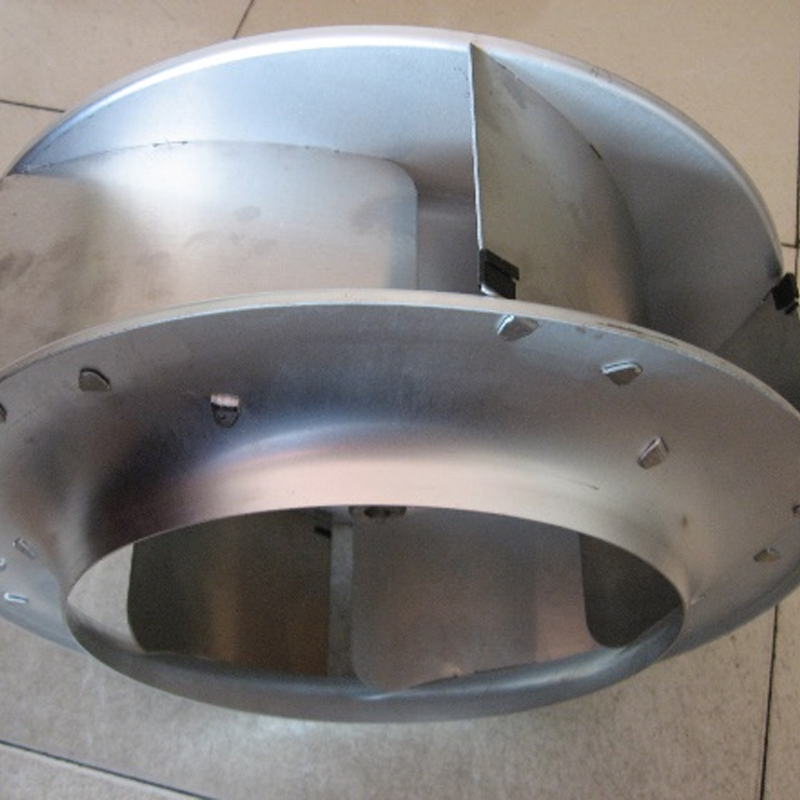
Aerodynamic stability strictly defines this equipment category. The internal blades physically curve away from the direction of rotation. This specific geometry generates high static pressure highly efficiently. The air flows smoothly across the backward-swept blade profiles. It operates perfectly as a freestanding plenum fan without needing a restrictive scroll housing.
A backward curved centrifugal fan possesses a true non-overloading power characteristic. Peak power absorption happens near the middle of its airflow performance curve. It actually demands less electrical power as it approaches free-delivery states. You never have to worry about catastrophic motor burnout during sudden pressure drops. The fan naturally regulates its own mechanical load.
Electronically commutated technology revolutionizes the internal drive mechanism. An EC unit functions fundamentally as a permanent magnet brushless DC motor. It includes onboard alternating-to-direct current rectification circuitry. It also packs intelligent control electronics directly into the motor head. The internal microprocessors constantly monitor speed and torque.
This integration eliminates external Variable Frequency Drives entirely. Traditional AC systems rely heavily on external VFDs for basic speed control. These external drives often introduce harmful harmonic distortion into building electrical grids. EC technology solves this interference natively at the source. It perfectly aligns electrical input pulses to match rotational demands. The motor runs exceptionally cool compared to older induction variants. This extended thermal stability protects the sensitive bearings inside.
Wire-to-air efficiency serves as the ultimate evaluation metric here. This specific calculation combines impeller aerodynamics, motor efficiency, and electronic control losses. It measures the true power consumed from the electrical grid to move the air. Upgrading yields massive operational impacts immediately. You can achieve up to 30-50% energy savings compared to standard AC setups. This performance easily satisfies demanding global frameworks like the ErP Directive. It also helps buildings comply with ASHRAE 90.1 energy standards. It simplifies your path to meeting aggressive corporate carbon reduction targets.
Facility managers must carefully evaluate sound power levels across the entire operating range. Backward curved blades actively reduce disruptive air turbulence at the discharge point. They slice through the air rather than slapping it. EC motors completely remove the electrical "hum" notorious in VFD-driven AC applications. Quiet operation remains absolutely critical for commercial offices, schools, and hospital environments. You gain precise airflow modulation without irritating low-speed frequency noise. Patients and office workers remain undisturbed during partial load operations.
Engineers heavily scrutinize equipment form factor and installation depth. Direct-drive architectures remove bulky transmission components entirely. Operating without a traditional scroll housing allows highly compact Air Handling Unit designs. You can seamlessly scale these individual units into dense fan array configurations. Fan walls maximize rentable building space by shrinking mechanical utility room footprints. Modular installation means maintenance teams can swap individual fans without shutting down the entire system.
Different facilities require specific deployment strategies. We mapped common operational environments below to highlight technical advantages.
Application Matching Matrix
Application Environment | Primary Airflow Challenge | EC Technology Benefit |
|---|---|---|
Air Handling Units (AHUs) | Constant VAV system modulation | Maintains peak efficiency at partial loads |
Data Center Cooling (CRAC) | Pushing air through dense server racks | Reliable high static pressure generation |
Cleanroom Fan Filter Units | Strict pressurization rules | Precise speed control and low heat emission |
Air Handling Units and Rooftop Units benefit instantly from this architecture. They serve VAV setups requiring constant modulation based on building occupancy. The fan precisely ramps up as conference rooms fill with people.
Data center cooling demands absolute zero-downtime reliability. Precision Computer Room Air Conditioning units must push air forcefully. They force cold air through raised floors and dense server racks. High static pressure generation ensures cooling reaches the furthest equipment aisles.
Cleanrooms utilize specialized Fan Filter Units to maintain strict room pressurization. Semiconductor labs and pharmaceutical facilities depend on this stable airflow. EC systems deliver precise control while minimizing internal motor heat loads. Less waste heat means the primary chilling system works less.
Initial capital expenditure for EC technology heavily exceeds standard AC equivalents. This premium price tag often pauses crucial procurement discussions. You must require your vendors to provide detailed lifecycle cost analyses. Facilities typically achieve a complete return on investment within one to three years. Consistent energy savings, local utility rebates, and drastically reduced mechanical maintenance drive this rapid payback.
Incompatibility with existing Building Management Systems poses a real retrofit risk. Legacy building controllers might easily misinterpret modern digital signals. Verify your new equipment supports standard communication protocols natively out of the box. Top-tier fans include onboard electronics fluent in Modbus RTU or BACnet protocols. They should also accept basic 0-10V analog or PWM signals. This prevents you from buying costly external gateway adapters later.
Replacing a directional forward-curved fan requires significant structural care. Installing a backward-curved plenum fan permanently changes internal cabinet airflow dynamics. Forward units blow air in a single distinct direction toward a duct. Plenum fans discharge air radially across a full 360 degrees. Assess your internal cabinet dimensions carefully before ordering. You need proper radial clearance around the fan wheel. Insufficient space creates performance-killing turbulence inside the metal box.
Choosing the right manufacturing partner dictates your ultimate project success. Focus heavily on verifiable engineering data and long-term support. Follow these critical steps when evaluating suppliers:
Demand fully verified performance curves from independent testing laboratories.
Verify communication protocol compatibility with your existing digital controllers.
Request detailed lifecycle payback calculations tailored to your facility.
Supplier Evaluation Scoring Chart
Evaluation Criteria | Importance Level | Verification Method |
|---|---|---|
Performance Data Transparency | Critical | Review combined wire-to-air efficiency curves. |
Hardware Customization | High | Check material options (aluminum vs composite). |
Integration Support | Medium | Request 3D CAD models and software tools. |
Look for performance data transparency above all else. Reliable manufacturers provide verified performance curves showing combined system efficiency. They test the impeller, motor, and electronics together as one unified system. Avoid suppliers who only advertise the isolated motor efficiency.
Determine hardware customization limits before signing expensive contracts. Suppliers should adapt impeller materials and voltage requirements to your specific environment. Salty coastal air requires highly specialized composites. Standard office buildings might function perfectly with lightweight aluminum wheels.
Prioritize strong technical support and transparent documentation. Top suppliers offer accessible 3D CAD models for your engineering team. They provide dedicated integration software to simulate aerodynamic performance accurately. Robust warranty terms protect your commercial HVAC investment over time.
A backward curved EC fan represents a strategic long-term facility investment. It is never just a simple mechanical component upgrade. Marrying aerodynamic stability with high-efficiency motor control solves modern air delivery challenges beautifully. Facilities eliminate ongoing mechanical wear while drastically cutting baseline power consumption.
Shift your procurement focus entirely away from the lowest initial price tag. Calculate the lowest operational cost per cubic foot of air over ten years instead. You ensure long-term reliability and environmental compliance by adopting direct-drive technology today.
A: The primary differences lie in blade geometry and performance curves. Forward-curved fans curve toward the rotation direction. They are compact but less efficient and risk motor overload if pressure drops. Backward-curved impellers curve away from the rotation. They operate highly efficiently, generate strong static pressure, and possess a non-overloading power characteristic.
A: Yes. Facilities often upgrade using an EC fan grid or wall retrofit. You must evaluate the physical cabinet space for radial airflow clearance. You also need to update your control signals. This upgrade completely eliminates routine belt and bearing maintenance.
A: It depends heavily on the motor placement. Standard EC motors contain internal electronics with strict temperature limits, typically around 40 to 60 degrees Celsius. For high-heat exhaust like commercial kitchens, you must physically isolate the motor from the direct hot airstream.
