


Views: 0 Author: Site Editor Publish Time: 2026-07-12 Origin: Site


Modern agriculture operates under intense and relentless margin pressures. Feed prices fluctuate unpredictably throughout the year. Utility bills constantly eat into hard-earned facility profits. Facility managers quickly realize ventilation often accounts for the vast majority of a livestock facility's electrical overhead. Legacy alternating current (AC) motors and belt-driven systems prove highly inefficient at partial loads. They cause massive energy waste during transitional weather or early animal growth stages. You need a more sophisticated approach to protect your bottom line.
Electronically Commutated (EC) technology offers the definitive upgrade path for precise, demand-driven climate control. Upgrading modernizes your airflow management while slashing daily power consumption. This article analyzes the critical implementation risks, efficiency gains, and vendor evaluation criteria for upgrading to EC technology. We will help you navigate the transition confidently. You will learn how to evaluate equipment specifications, avoid common retrofitting mistakes, and secure long-term operational stability for your livestock.
Climate control heavily burdens daily farm operations. It typically consumes 60% to 70% of a facility's total energy budget. This disproportionate share makes ventilation the prime target for operational cost reduction. Traditional systems rely primarily on single-speed AC motors. Operators often use Triac-dimming to slow them down during cooler periods. This approach wastes massive amounts of power. Running standard AC motors below maximum capacity causes them to overheat. They burn out quickly. You end up paying for electricity you do not actually use.
Furthermore, mechanical inefficiencies compound the financial drain. Every belt-driven unit requires regular tensioning and greasing. When maintenance lags, belts slip. Belt slip reduces air volume without reducing power draw. Facilities need modernization to survive these compounding inefficiencies. Introducing an energy-saving farm fan is no longer a luxury. It acts as a critical tool for protecting profit margins against rising utility rates. We must view these upgrades as essential survival strategies. Relying on outdated, power-hungry equipment simply costs too much in today's competitive agricultural landscape.
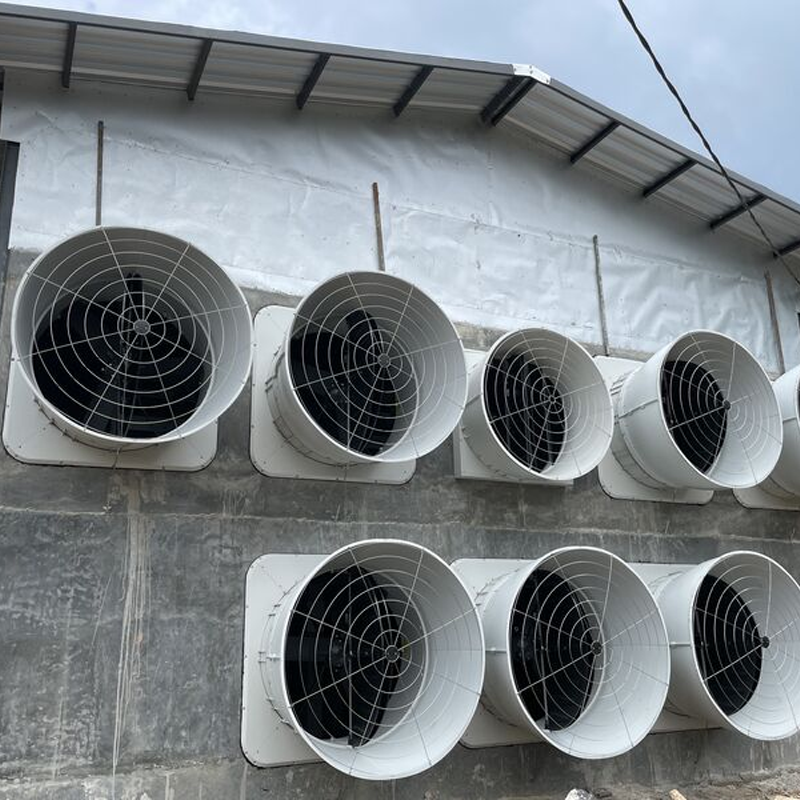
Understanding the core mechanism helps justify the initial capital investment. EC stands for Electronically Commutated. Think of it as a brushless DC motor containing integrated AC-to-DC electronics. You feed it standard alternating current power from the grid. The internal electronics convert it to direct current. This allows for precise, variable speed control. It bypasses the physical limitations of traditional analog motors.
Let us look at the efficiency curve reality check. An AC motor's efficiency drops off a cliff when slowed down. It turns excess electrical energy into heat instead of airflow. Conversely, a farm ventilation EC fan maintains peak electrical efficiency even at a 20% or 50% load. This variable-speed capability shines during cooler nights or early animal growth phases. You only consume the exact wattage required to move the necessary air volume. You stop paying for wasted heat generation.
Another major benefit is the direct-drive advantage. Older models use mechanical energy transfer via belts and pulleys. Direct-drive entirely eliminates these wearable parts. It translates to zero friction loss. You also experience zero belt-slip volume loss over time. The motor connects directly to the propeller, maximizing the transfer of kinetic energy.
| Performance Metric | Traditional AC Motor (Belt-Driven) | EC Motor (Direct-Drive) |
|---|---|---|
| Partial Load Efficiency | Drops significantly below 80% speed | Maintains high efficiency down to 20% speed |
| Power Conversion | High heat generation at low speeds | Minimal heat loss via internal AC-DC conversion |
| Mechanical Loss | 5% to 15% loss due to belt friction | Zero mechanical friction loss |
Standard commercial HVAC fans fail rapidly inside agricultural barns. Agricultural environments are uniquely corrosive and highly demanding. You must evaluate the absolute necessity for purpose-built agricultural designs. High levels of ammonia, constant moisture, and airborne dust easily destroy generic commercial motors. A specialized EC animal husbandry fan actively defends against these harsh elements.
Look for specific defense mechanisms to ensure longevity and prevent unexpected failures.
Next, evaluate performance metrics accurately. Look closely at Cubic Feet per Minute per Watt (CFM/Watt). Do not rely on misleading free-air testing. Animals, baffles, and cooling pads create airflow resistance. Your facility operates under constant static pressure. Always assess CFM/Watt based on real operational static pressure. Usually, this means demanding test data at 0.10 or 0.15 inches of water column. This simulates the exact resistance created when pulling air through wet evaporative cooling pads. By demanding accurate static pressure data, you guarantee the equipment performs when you actually need it.
Modern farming relies heavily on continuous data and automation. Advanced motor technology integrates seamlessly into these connected setups. They offer excellent scalability and compatibility across various control platforms. You can connect them directly to centralized farm climate computers. They easily accept standard 0-10V analog signals for straightforward speed adjustments. They also communicate via Modbus RTU protocols for complex digital integration.
This level of connectivity allows for true outcome-based performance. The system makes micro-adjustments based on real-time sensors. Monitors track temperature, humidity, and ammonia levels constantly. The units ramp up or down exactly as needed to maintain predetermined setpoints. This utilizes a Proportional-Integral-Derivative control loop. It prevents sharp temperature spikes. Sudden drafts cause respiratory stress in young animals. Smooth adjustments prevent this stress. Consequently, you reduce both heating and cooling costs simultaneously. You maintain an optimal environment without wasting expensive propane or electricity.
We must also consider technical risk mitigation. Barns contain highly sensitive electronics like RFID tags and automated feeding computers. Variable speed motors inherently generate electromagnetic noise. You must verify the presence of built-in Electromagnetic Compatibility (EMC) filters. These filters prevent the units from interfering with your other critical barn electronics. Proper filtering ensures your farm network remains stable and highly responsive.
Upgrading involves realistic capital considerations. We must acknowledge a common hurdle for skeptical buyers. Premium units typically carry a 20% to 40% price premium over standard AC models. However, the operational return easily justifies the initial capital outlay. We can use a straightforward ROI calculation framework to model this transition.
The payback formula is quite simple. You divide the upfront cost difference by the sum of annual energy savings and maintenance labor savings. Standard payback windows usually range from 1.5 to 3 years. This timeline depends heavily on your local utility rates and operating hours. Facilities running continuous ventilation see the fastest returns.
Retrofit projects carry specific structural and electrical risks. You must plan carefully to avoid costly operational delays. Some facility managers choose a phased approach. They retrofit one barn at a time to prove the savings before committing fully.
Do not bear the full capital burden alone. Many local governments offer utility rebates for agricultural efficiency. Explore energy efficiency programs in your specific region. Standard state and federal grants frequently exist to offset initial equipment costs. Check with your local utility provider to uncover hidden financial incentives.
Selecting the right vendor requires strict evidence-oriented vetting. Do not rely solely on manufacturer-claimed maximums printed on glossy brochures. Instruct buyers to demand third-party, independent testing data. BESS Lab certifications provide highly reliable performance benchmarks. They test units under strict, standardized conditions. This data cuts through marketing hype.
Look closely at the warranty evaluation during your selection process. Pay special attention to terms covering the integrated electronics. These components represent the most vulnerable parts in a livestock setting. They face extreme heat, persistent moisture, and potential power surges. A strong warranty indicates the manufacturer trusts their protective seals and thermal management designs. Read the fine print regarding power surge exclusions carefully.
Finally, evaluate the ongoing support and supply chain reliability. You need localized technical support to troubleshoot complex digital integrations. Replacement parts must be readily available when sudden failures occur. Investigate the vendor's specific track record. Experience in poultry, swine, or dairy applications proves their equipment can handle your specific environmental challenges. Downtime costs money and endangers animals. Partner with a vendor who intimately understands agricultural urgency.
The initial capital investment for advanced climate technology is undeniably higher than legacy systems. Yet, the operational reliability and massive energy savings justify the leap. This technology stands as the new standard for future-proofing livestock facilities. By eliminating belt maintenance and optimizing partial-load efficiency, you secure your long-term profit margins. You also provide a more stable, stress-free environment for your animals.
Take a proactive step today to begin your facility upgrade. Request a professional energy audit for your farm to identify specific weak points. Utilize an online ROI calculator to estimate your localized utility savings accurately. You can also schedule a site consultation to evaluate your exact retrofit feasibility. Action today ensures a much more profitable and resilient operation tomorrow.
A: The average payback period typically ranges from 18 to 36 months. This timeline depends heavily on your local utility electricity rates, available government rebates, and specific annual run-times. Facilities operating in extreme climates generally see faster returns due to higher baseline ventilation demands.
A: Yes, motor-only swaps are possible, but full unit replacements are often recommended. Existing housings and propellers may not be aerodynamically optimized for the new motor's torque curve. Always evaluate static pressure ratings to ensure a retrofit kit will actually deliver the required airflow.
A: No. They actually require significantly less maintenance. The direct-drive design completely eliminates the need for replacing belts, adjusting pulleys, or greasing bearings. Your maintenance shifts entirely to simple, periodic cleaning of the exterior housing, propellers, and associated environmental sensors.
A: Yes, numerous incentives exist. Many local agricultural extension offices, utility providers, and energy agencies like NYSERDA or the USDA offer specific energy-efficiency grants. We advise consulting these local organizations early in your planning phase to secure funds that offset your initial equipment costs.
