


Views: 0 Author: Site Editor Publish Time: 2026-07-14 Origin: Site


Commercial HVAC systems account for up to 40% of total building energy consumption. This massive power draw makes fan motor efficiency a critical target for facility managers and system engineers today. You simply cannot ignore the impact of ventilation loads on your facility's energy footprint. Stricter global energy directives, such as the ErP framework in Europe, enforce higher performance minimums. Concurrently, rising operational costs are forcing a rapid transition away from traditional AC motors. Building owners increasingly demand smarter, leaner air-handling solutions.
Integrating an EC centrifugal fan into an HVAC system or Air Handling Unit (AHU) offers a verifiable path to lowering energy consumption. You can achieve these efficiency gains without sacrificing system static pressure or continuous airflow volume. Provided the system is correctly specified for the application, the operational benefits are profound. Read on to discover the core mechanisms and integration strategies necessary for a successful facility upgrade.
Facility managers face constant pressure to optimize building performance. For decades, the industry relied heavily on standard AC induction motors paired with forward-curved fan wheels. These legacy components served their purpose, but they represent a massive bottleneck in modern energy conservation efforts.
Traditional AC forward-curved centrifugal fans suffer from significant efficiency drops when they operate below peak load. HVAC systems rarely run at 100% capacity around the clock. During partial-load scenarios, AC motors struggle to adapt smoothly. They convert wasted energy into excess heat and unwanted acoustic noise. This mechanical inefficiency forces chillers and cooling coils to work harder just to remove the heat generated by the fan motor itself.
Modern facility evaluation metrics have drastically evolved. System designers no longer prioritize the "lowest initial cost" above all else. Instead, success criteria revolve around strict compliance with carbon-reduction mandates and long-term energy sustainability. To meet these goals, facilities need equipment that dynamically responds to actual environmental demand.
We define the modern solution through hybrid engineering. EC centrifugal fans merge the convenient AC power supply grid with the voltage-controlled efficiency of DC motors. They pair this electrical architecture with optimized centrifugal aerodynamics. By upgrading to this technology, you eliminate the compromises inherent to older mechanical belt-driven systems.
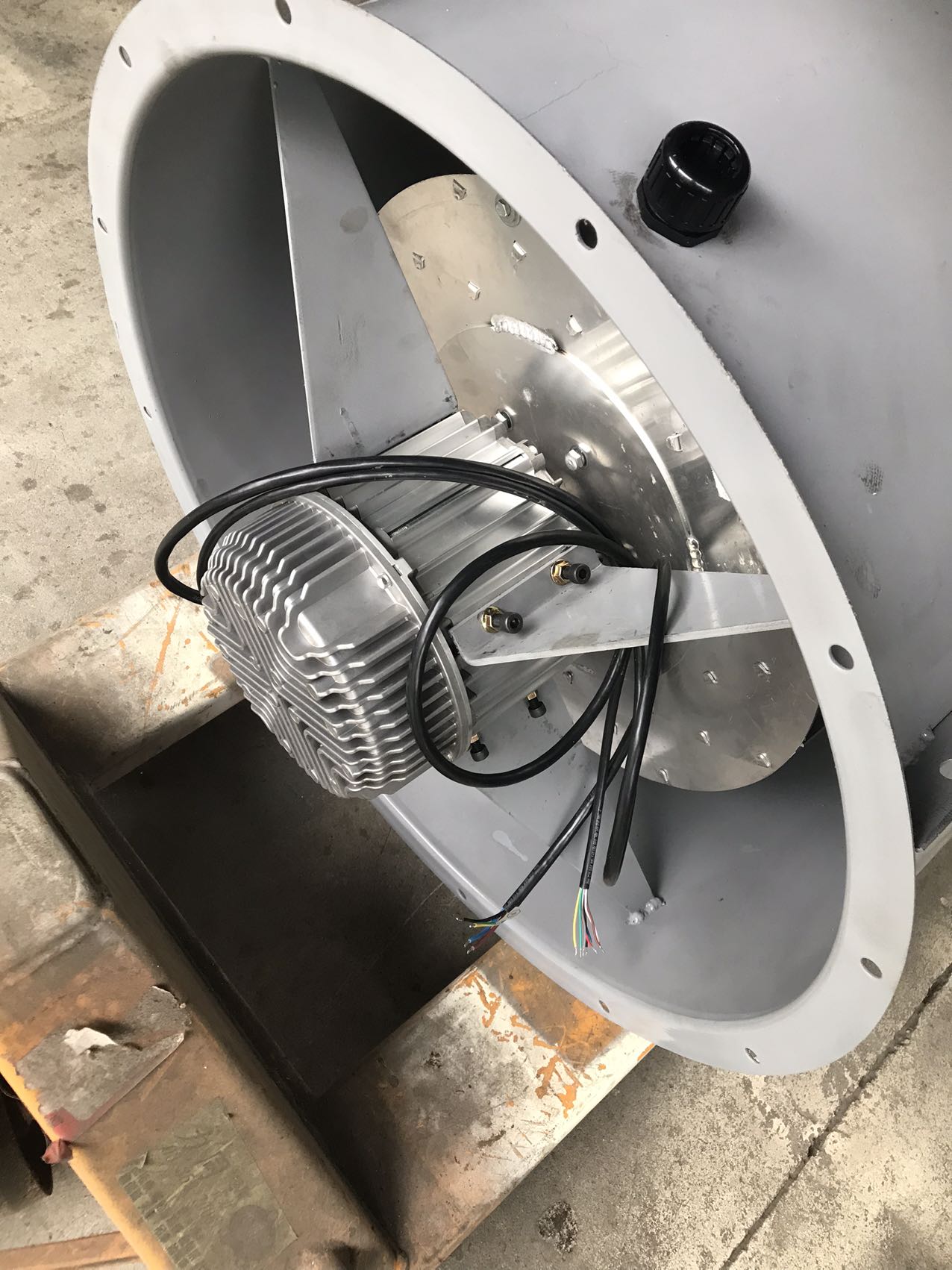
To understand the energy savings, we must look inside the motor casing. EC motors replace traditional mechanical brushes with intelligent electronic commutation. The motor incorporates an onboard microprocessor that precisely regulates voltage and current. This direct electronic control eliminates the magnetic slip losses inherent to standard AC induction motors.
Because they do not rely on magnetic slip to induce rotor movement, they demonstrate near-flat efficiency curves. A traditional motor's efficiency plummets the moment you reduce its speed. In contrast, an EC motor maintains peak electrical efficiency across an incredibly wide operating range. This means energy savings compound significantly during partial-load operations. If your building requires only 50% airflow on a mild day, the motor scales down its power consumption exponentially, rather than linearly.
Electrical efficiency is only half the equation. Aerodynamic efficiency dictates how effectively the motor translates its rotation into actual airflow. EC technology is frequently paired with backward-curved impeller blades.
Unlike forward-curved models, backward-curved blades do not require a restrictive scroll housing to direct the air. They operate effectively as "plug fans" or free-running impellers. This configuration reduces the physical footprint of the fan section inside the AHU. Furthermore, removing the scroll housing minimizes internal pressure drops, allowing air to flow more naturally across the heat exchangers.
Perhaps most importantly, backward-curved impellers feature a non-overloading power curve. Even if the system resistance fluctuates wildly due to dirty filters or closed dampers, the motor will not overload and burn out. This aerodynamic stability protects your investment.
Motor and Aerodynamic Profile Comparison
| Feature | Legacy AC Forward-Curved | Modern EC Backward-Curved |
|---|---|---|
| Efficiency at Partial Load | Drops significantly below 80% load | Remains above 85-90% at partial loads |
| Housing Requirement | Requires scroll housing | Scroll-free (Plug fan configuration) |
| Overload Protection | Prone to overloading if resistance drops | Non-overloading power curve |
| Drive Mechanism | Often belt and pulley driven | Direct-drive integration |
Modern smart buildings rely heavily on Demand-Controlled Ventilation (DCV). You need your ventilation systems to communicate fluidly with the central Building Management System (BMS). EC motors excel here because they feature native communication interfaces. They connect directly via Modbus protocols, 0-10V analog signals, or PWM (Pulse Width Modulation).
This native connectivity allows for precise airflow modulation. The BMS can read CO2 levels or temperature sensors in a room and tell the fan to increase its speed by just a few RPMs. You achieve this granular control without needing external, energy-draining Variable Frequency Drives (VFDs). Legacy AC systems require VFDs to alter speed, but VFDs introduce their own electrical losses and harmonic distortions. An EC motor handles speed modulation entirely in-house.
Regulatory bodies across the globe are tightening their grip on energy consumption. Utilizing an energy-saving HVAC fan simplifies your path to compliance. Stringent industry frameworks, such as ASHRAE 90.1 in North America and the ErP (Energy-related Products) Directives in Europe, demand high-efficiency ratings that standard AC motors simply cannot reach.
Furthermore, ESG (Environmental, Social, and Governance) reporting requires documented, verifiable energy performance data. Because EC systems offer precise monitoring capabilities via Modbus, facility managers can pull real-time power consumption metrics. This hard data proves invaluable when applying for green building certifications like LEED or BREEAM. You secure essential credits by proving your mechanical systems operate well below baseline energy thresholds.
We must acknowledge the financial realities of retrofitting a facility. The initial capital expenditure (CapEx) for EC technology runs higher than standard equipment. You can expect premium pricing often 20% to 40% higher initially than standard AC equivalents. However, evaluating this technology on purchase price alone ignores the massive operational savings.
Engineers must calculate ROI based on local utility rates and annual operational hours. Because HVAC fans often run 24/7, the cumulative energy savings add up quickly. A transparent framework for ROI calculation shows that the heavy reduction in kilowatt-hours shrinks the payback period. In most commercial applications, the energy savings cover the premium cost within 1.5 to 3 years. After that period, the reduced utility bills translate directly to improved operational budgets.
Swapping out old fans is not always a simple plug-and-play operation. You will face dimensional constraints inside older AHUs. An EC plug fan features a different physical form factor compared to a bulky, legacy belt-driven AC scroll fan. The footprint is shorter, but the airflow dynamics change.
When you retrofit, you highlight a major mechanical benefit: the removal of belts and pulleys. By eliminating belts, you remove mechanical transmission losses entirely. However, you must install custom structural adapters or blanking plates to mount the new direct-drive unit properly against the plenum wall.
Additionally, high-frequency electronic switching inside the EC motor can generate electromagnetic interference (EMI) or radio frequency interference (RFI). In highly sensitive environments—such as hospital operating rooms, laboratories, or data centers—you must note these potential electronic noise considerations. Ensure your electrical contractors use properly shielded cables and establish robust grounding to mitigate any interference risks.
Selecting the right equipment requires a systematic approach. You cannot simply guess the required horsepower. Follow a structured evaluation process to ensure you procure the optimal hardware for your specific building dynamics.
Upgrading your facility's ventilation infrastructure requires careful planning and precise execution. Transitioning to EC centrifugal fans is not merely a basic component swap; it is a strategic facility upgrade. By removing mechanical transmission losses and utilizing intelligent internal microprocessors, you directly reduce base energy loads. This modernization transforms a static, wasteful air handler into a dynamic system that responds instantly to environmental demands.
We advise system engineers and facility managers to take proactive next steps. Begin by conducting a localized energy audit to baseline your current AHU power consumption. Measure the amperage draw of your existing AC motors during peak and partial loads. Next, request detailed lifecycle cost projections from qualified fan suppliers. Armed with empirical data, you can build an undeniable business case for upgrading your HVAC infrastructure.
A: Yes, but it often requires a structural adapter (e.g., retrofitting a belt-driven scroll fan to a direct-drive EC plug fan) and bypassing legacy VFDs, as EC motors have built-in controllers.
A: While highly dependent on application and duty cycles, users typically see 30% to 50% energy savings, particularly in systems that run frequently at partial loads.
A: No. Because they are direct-drive and brushless, they eliminate the need for belt replacements, greasing bearings, and pulley alignments, significantly reducing routine maintenance costs.
