


Views: 0 Author: Site Editor Publish Time: 2026-08-21 Origin: Site


Modern facilities face a demanding engineering challenge. Cleanrooms, data centers, and advanced HVAC setups require pushing air through incredibly dense filters, robust heat exchangers, and complex ductwork. These dense components severely restrict airflow. Traditional AC fans struggle to perform efficiently under such high system resistance. They suffer from severe inefficiency, immense motor strain, and excessive noise. Facility managers cannot afford these ongoing performance penalties. We need smarter, more reliable ventilation solutions. Enter the modern high static pressure EC fan. This technology has become the industry standard for balancing rigorous pressure requirements with strict energy compliance mandates. You will learn how system impedance affects performance and why specific aerodynamic designs matter. We will explore the critical differences between fan types. Finally, we provide actionable guidance on evaluating performance dimensions, retrofitting risks, and vendor selection for your next major upgrade.
System Impedance Matters: High static pressure environments require fans designed specifically to overcome resistance without airflow drop-off.
Technology Edge: EC (Electronically Commutated) technology delivers up to 30-50% better energy efficiency at partial loads compared to standard AC motors.
Design Selection: Choosing between forward-curved and backward-curved centrifugal EC fans depends strictly on spatial constraints and specific acoustic requirements.
TCO over CAPEX: While initial procurement costs are higher, the ROI is typically realized within 12-24 months through energy savings and reduced maintenance.
Airflow needs a clear path to function optimally. However, modern industrial environments rarely provide one. Dense system components create significant physical barriers. We call this resistance system impedance. High-efficiency HEPA filters, deep cooling coils, and extensive duct networks block natural air movement. They demand significant mechanical force to push air through successfully. You must engineer your systems to overcome these intentional bottlenecks. Otherwise, your facility will fail to meet critical ventilation rates.
You must distinguish clearly between static pressure and dynamic pressure. Dynamic pressure relates directly to air velocity. It is the kinetic energy of moving air. Static pressure represents the potential energy required to overcome physical resistance. Think of it as the outward pressure pushing against the duct walls. In high-impedance setups, generating static pressure is far more critical. Velocity alone cannot force air through a dense HEPA filter. You need raw pushing power.
Standard AC fans fail miserably in these demanding environments. When they face high resistance, they drop immediately out of their optimal efficiency zones. They consume massive amounts of electrical power just to maintain basic airflow. You will notice significant motor overheating as they struggle against the back-pressure. Acoustic spikes become a constant nuisance in the facility. Furthermore, standard motors experience accelerated bearing wear under this strain. This rapid degradation reduces the equipment lifecycle drastically. You end up facing premature system failures.
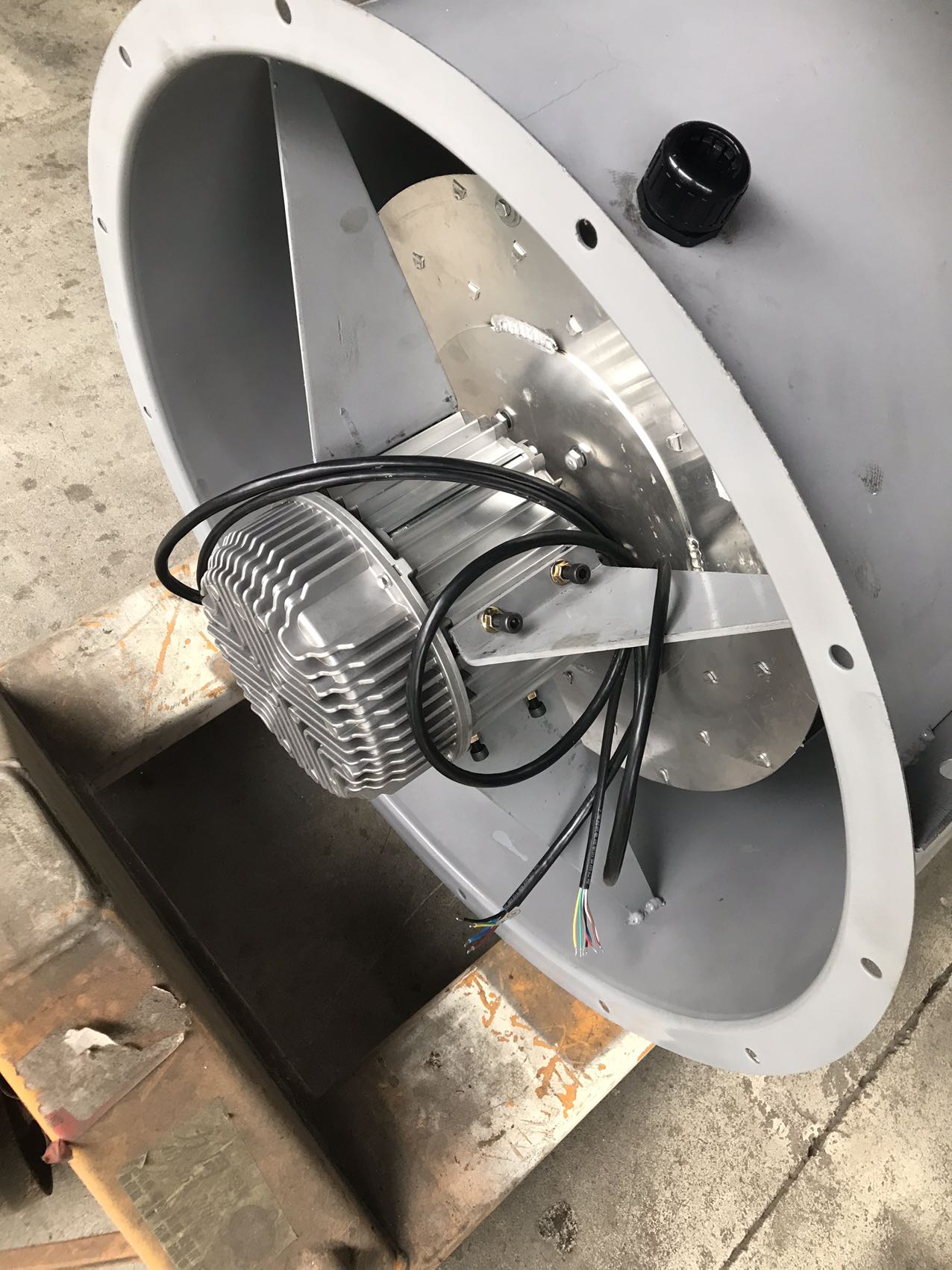
Why do engineers rely heavily on centrifugal designs? Standard axial fans excel at moving high volumes of air at very low pressure. They fail quickly when resistance increases. Centrifugal designs operate differently. They pull air in axially and redirect it radially outward. This abrupt 90-degree shift naturally builds much higher static pressure. Therefore, they are inherently better suited for demanding industrial applications. They push through resistance effortlessly.
These models represent the absolute gold standard for heavy-duty resistance applications. They handle severe back-pressure efficiently.
Strengths: They offer the highest peak efficiency for generating immense pressure. They feature non-overloading power characteristics. The motor will not burn out if system resistance suddenly drops. They are ideal for continuous, heavy-duty industrial cooling operations. They handle variable loads beautifully.
Trade-offs: They require greater spatial depth inside the air handling unit. They also operate at much higher RPMs to achieve their target pressures. This can introduce different acoustic profiles.
These specific models suit compact, noise-sensitive environments perfectly. They provide a different set of aerodynamic benefits.
Strengths: They deliver required airflow and pressure at significantly lower operating speeds. This lower speed results in much quieter overall operation. Their compact footprint makes them ideal for tight HVAC Air Handling Units (AHUs). They save valuable internal space.
Trade-offs: Their power curve can overload in certain conditions. If system resistance drops unexpectedly, the motor might draw excessive current. They also deliver slightly lower peak energy efficiency than backward-curved alternatives.
Using a reliable centrifugal EC fan ensures you match the correct aerodynamic profile to your specific spatial and acoustic constraints. You must choose the impeller design carefully.
Procuring the right equipment requires rigorous technical evaluation. You must analyze multiple overlapping dimensions. Do not base your choice on a single specification.
You must precisely match the fan's performance curve to your actual operating point. Look closely at the airflow volume versus static pressure generation. System resistance changes dynamically as filters load heavily with dust over time. You need an operating point sitting comfortably within the fan's peak efficiency window. Never select a unit operating on the extreme edges of its performance curve.
Evaluating specific fan power (SFP) is absolutely non-negotiable. Lower SFP indicates much better energy utilization per unit of airflow. You must ensure strict compliance with regional energy efficiency standards. Key frameworks include the ErP Directive in Europe and ASHRAE 90.1 in North America. These authoritative standards dictate strict minimum efficiency thresholds for commercial ventilation. Meeting them protects your facility from regulatory penalties.
High resistance inevitably generates significant aerodynamic noise. You must assess sound power levels across the entire operating spectrum. EC motor stabilization plays a crucial role here. Smooth electronic commutation prevents mechanical humming common in older AC motors. Pay close attention to casing breakout noise. Proper acoustic planning prevents disruptive noise transferring into occupied commercial spaces.
Modern facilities rely heavily on Demand-Controlled Ventilation (DCV). You must thoroughly assess the unit's communication capabilities. Most modern units support simple 0-10V analog signals or PWM control. For highly complex systems, Modbus or RS485 connectivity allows seamless Building Management System (BMS) integration. This enables predictive maintenance and real-time performance monitoring.
Key Procurement Evaluation Metrics
Evaluation Dimension | Primary Metric Assessed | Key Industry Standard / Protocol |
|---|---|---|
Aerodynamic Performance | Airflow (CFM/CMH) vs. Pa/inWG | System Operating Point Mapping |
Energy Efficiency | Specific Fan Power (SFP) | ErP Directive, ASHRAE 90.1 limits |
Acoustic Output | Sound Power Level (dB) | ISO Acoustic Measurement Standards |
BMS Integration | Signal Compatibility | 0-10V, PWM, Modbus RTU / RS485 |
Upgrading existing infrastructure introduces specific engineering risks. You must navigate these physical realities carefully to ensure a successful retrofit project.
Replacing legacy AC belt-drive blowers requires exact precision. Transitioning to direct-drive EC fan arrays changes the internal geometry of the AHU completely. You must conduct careful spatial planning. Evaluate the structural integrity of the existing bulkhead walls. They must support the new array configuration without flexing under high pressure. Ensure adequate clearance for maintenance access.
New motor technology interacts differently with your facility power grid. You must address potential harmonic distortion risks early. Ensure your facility's electrical distribution network supports advanced integrated controllers. Sometimes, active harmonic filters are necessary to maintain overall power quality. Do not ignore the total harmonic distortion (THDi) specifications provided by the manufacturer.
Engineers frequently over-specify static pressure margins. This is a common and incredibly costly mistake. Do not select a unit based on an artificially high resistance point. If you do, the equipment will operate inefficiently at its actual daily load. Map the realistic system curve accurately. Trust your empirical field measurements over inflated theoretical models.
Direct-drive models eliminate problematic routine belt changes completely. You no longer need to schedule regular bearing greasing. However, maintenance realities shift significantly. You need technicians trained properly in basic electronic diagnostics. They must understand how to troubleshoot communication faults. They need the skills to read and interpret digital controller alarms quickly.
Finalizing your selection requires a methodical, evidence-based approach. Do not rely solely on top-line marketing specifications. Take these crucial next steps.
Insist strictly on manufacturer-provided empirical performance data. General performance curves are never enough for high-stakes applications. Use custom fan selection software to model your exact operating conditions. This digital verification ensures the unit will hit your specific airflow and resistance targets flawlessly.
We strongly recommend executing a pilot phase first. Request sample units for a specific AHU retrofit before committing heavily. Test the performance in a real-world scenario. Measure the actual energy draw and acoustic output. Use this data to justify scaling procurement across the entire facility.
Look closely beyond the hardware itself. Assess the manufacturer thoroughly to ensure long-term reliability.
Evaluate the length and comprehensiveness of the hardware warranty.
Verify the local availability and lead times of critical replacement parts.
Assess their engineering technical support capabilities for complex BMS integration.
Check their track record specifically in high static pressure industrial applications.
Upgrading to a robust high static pressure EC system delivers immense strategic value. You gain highly predictable performance even under extreme system resistance. It ensures rigorous compliance with global efficiency directives. Furthermore, it generates measurable operational savings day after day. Remember to base your final procurement decisions strictly on mapped operating points. Isolated peak performance metrics often mislead buyers. Evaluate your spatial constraints, check your electrical infrastructure properly, and partner with a reliable vendor. Take the time to model your specific system curve accurately. By following these structured steps, you will secure a highly efficient, future-proof ventilation system designed to handle the most demanding environments seamlessly.
A: Standard commercial ventilation systems generally operate below 500 Pascals (2 inWG). High static pressure applications typically begin around 1,000 Pascals (4 inWG) and can easily exceed 2,500 Pascals (10 inWG). These elevated thresholds are extremely common in complex cleanrooms, dense HEPA filtration setups, and heavy industrial cooling processes.
A: While niche "Xtreme" series axial fans exist for high-pressure environments, they are not the standard choice. Axial designs naturally struggle against significant back-pressure. Centrifugal models remain the proven industry standard for high resistance. Their radial airflow pattern generates substantial static pressure much more efficiently and reliably.
A: Electronically Commutated (EC) technology utilizes an onboard microprocessor to monitor and adjust the motor continuously. This smart electronic commutation maintains consistent torque and precise RPMs against fluctuating back-pressure. Unlike traditional AC motors, EC motors actively prevent energy waste and severe efficiency drops when system resistance spikes.
A: For industrial setups running continuously (24/7), the return on investment typically falls between 12 to 24 months. These rapid financial returns stem directly from 30-50% lower energy consumption at partial loads. Furthermore, the complete elimination of routine mechanical maintenance like belt replacements accelerates this payback period.
