


Views: 0 Author: Site Editor Publish Time: 2026-08-21 Origin: Site


In mission-critical environments—such as data centers, cleanrooms, and large-scale HVAC systems—airflow isn't just about temperature control. It represents a strict compliance requirement and a primary operational cost metric. Facilities must maintain precise environmental conditions around the clock. Any deviation can lead to equipment failure or product contamination.
Traditional AC fans and standard plug fans struggle under these modern demands. They often fail to balance the dual requirement of high static pressure and strict energy efficiency mandates. Facilities push these legacy systems past their optimal limits, resulting in wasted power and frequent mechanical failures.
Upgrading to a modern airflow system requires significant upfront capital. This guide outlines the objective tipping points justifying this investment. We move past generic energy-saving claims to evaluate comprehensive lifecycle returns, system integration, and deployment realities. You will learn exactly when facility demands mandate an upgrade, ensuring your next infrastructure decision delivers measurable operational improvements.
High airflow EC fans are essential when variable speed control and high static pressure must coexist without energy penalties.
The primary ROI driver is not just reduced power consumption, but the elimination of external Variable Frequency Drives (VFDs) and reduced maintenance downtime.
Data centers (PUE optimization) and pharmaceutical HVAC (HEPA filtration impedance) represent the strongest use cases for immediate deployment.
Retrofit feasibility depends heavily on existing Building Management System (BMS) compatibility and physical footprint constraints.
Standard fans operate adequately in low-demand, constant-volume scenarios. Managers rarely need to replace basic ventilation equipment if it runs at a single speed in unconditioned spaces. The justification for an upgrade emerges under specific operational strains. When systems face dynamic thermal loads, legacy equipment quickly becomes a financial liability.
Modern data centers generate massive localized heat loads. Facility cooling often accounts for up to 40% of total energy consumption. When operators must hit stringent Power Usage Effectiveness (PUE) targets, a high airflow EC fan becomes necessary. These units allow for localized, variable load matching. They ramp up instantly during peak processing times. They slow down during off-peak hours. This continuous modulation drastically lowers facility power draw compared to older fans running at full speed constantly.
Pharmaceutical HVAC systems and semiconductor cleanrooms demand absolute air purity. Dense HEPA filters trap microscopic particles but create significant air resistance. As filters capture dirt over time, this resistance increases. Traditional blowers lose efficiency rapidly under these conditions. They consume excess power just to push air through the clogged media. EC fans maintain high CFM (Cubic Feet per Minute) against this resistance much more efficiently. Their integrated electronics adjust motor torque automatically, ensuring consistent airflow as filter impedance rises.
Commercial heat pump systems are becoming standard for modern sustainable buildings. Scaling these systems requires precise airflow adjustments across multiple zones. Legacy AC motors cannot provide this precision without excessive noise and mechanical wear. Attempting to restrict AC fan airflow mechanically creates disruptive turbulence. EC motors solve this seamlessly. They scale volume up or down electronically, adapting to the exact thermodynamic requirements of the heat pump array.
Common Mistake: Do not install advanced EC equipment in a facility lacking variable cooling demands. If a space strictly requires 100% constant airflow 24/7 without filter loading, the premium investment may yield a longer payback period.
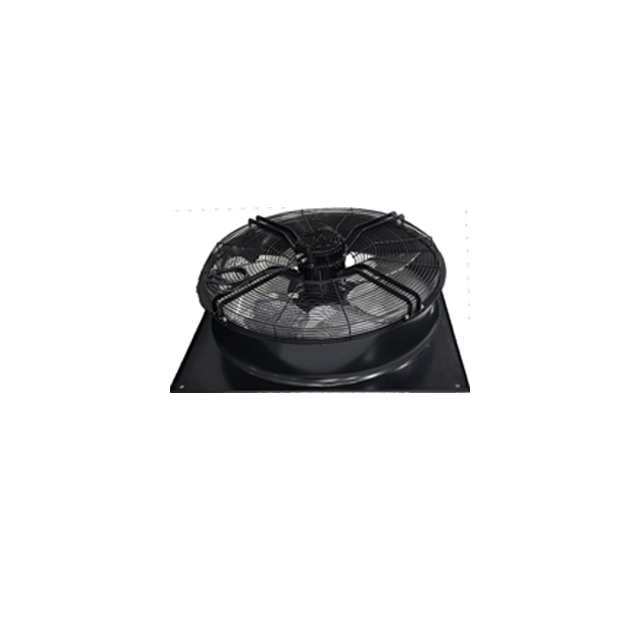
Comparing motor technologies reveals stark operational differences. Facility engineers must understand these technical distinctions to specify the correct equipment. The advantages extend far beyond basic power consumption metrics.
AC fans drop drastically in efficiency when operating below peak load. If an operator reduces an AC fan's speed to 50%, it still consumes a disproportionate amount of electricity. EC fans operate on a completely different paradigm. They maintain up to 90% efficiency across a wide range of partial loads. This flat efficiency curve guarantees maximum energy savings during low-demand periods. For facilities operating 24/7, this partial-load efficiency generates the bulk of annual savings.
Traditional plug fans often require bulky, external Variable Frequency Drives (VFDs) for speed control. These external VFDs consume valuable mechanical room space. They also introduce harmonic distortion into the electrical grid. An industrial EC fan solves this architectural problem entirely. It integrates the motor, the digital controller, and the aerodynamic impeller into a single compact footprint. This integration eliminates the need for separate VFD enclosures, complex wiring runs, and secondary cooling for drive cabinets.
Noise pollution dictates equipment selection in urban commercial buildings. High-density residential spaces require silent HVAC operation. Traditional motors emit distinct tonal noise, especially when paired with external VFDs. EC impellers utilize advanced aerodynamic designs to eliminate these harsh frequencies. The electronic commutation process itself runs smoothly, reducing mechanical humming. This acoustic compliance proves critical for hospitals, offices, and populated indoor environments.
Table 1: Efficiency and Feature Comparison Chart
Feature Dimension | Traditional AC Fan + VFD | High Airflow EC Fan |
|---|---|---|
Partial-Load Efficiency | Drops significantly below 80% load | Maintains up to 90% efficiency at low speeds |
Footprint & Integration | Requires external drive cabinets and wiring | All-in-one integrated motor and controller |
Acoustic Profile | High tonal noise, VFD harmonic hum | Low turbulence, aerodynamically optimized |
Maintenance Frequency | High (belts, bearings, VFD cooling) | Minimal (brushless design, cooler running) |
Evaluating new ventilation equipment goes beyond checking a specification sheet. Procurement teams must analyze how these units integrate into the broader facility ecosystem. We must look at intelligent controls, physical scalability, and regulatory compliance.
Intelligent control integration separates basic ventilation from smart building infrastructure. A premium unit must support Modbus RTU, 0-10V, or PWM inputs. These protocols ensure seamless closed-loop communication with your existing Building Management System (BMS). The BMS can read real-time RPM, power consumption, and error codes directly from the motor.
Additionally, we must consider lifespan and heat dissipation. EC motors run significantly cooler than their AC counterparts. Less internal heat extends the life of critical bearings. Furthermore, it reduces the secondary cooling load in the mechanical room itself. You spend less energy cooling the very equipment meant to cool your building.
Modern engineering favors redundancy. The industry is shifting away from single, massive AC blowers. If one large blower fails, the entire air handling unit shuts down. Evaluating the shift to N+1 redundant arrays—often called fan walls—is crucial. A fan wall uses multiple smaller units operating in parallel. If one unit fails, the remaining units ramp up their speed automatically to compensate. This strategy eliminates single points of failure, safeguarding critical operations in server rooms and pharmaceutical labs.
Governments worldwide continue to tighten energy regulations. Meeting strict ErP (Energy-related Products) directives is mandatory in many regions. Local energy codes increasingly penalize inefficient building operations. Specifying modern commutated motors ensures immediate compliance without relying on untested mechanical workarounds. It future-proofs the facility against upcoming carbon tax implementations.
Upgrading a facility involves physical and financial hurdles. A successful retrofit demands honest assessments of existing infrastructure. Ignoring these realities leads to budget overruns and delayed deployment schedules.
Advanced equipment carries a premium upfront cost. Expect prices to be 20% to 40% higher than standard AC equivalents. The financial model must factor in local utility rates and continuous operating hours to be accurate. Facilities running 24/7 in regions with high electricity costs will see rapid payback. Conversely, intermittent operations in low-cost utility zones stretch out the break-even timeline. You must demand hard data before committing capital.
Legacy control systems present major integration risks. Older buildings often rely on simple binary controls. Installing an advanced variable-speed unit in a strictly "on/off" control system negates its primary value. The motor will simply run at maximum speed or shut down entirely. To fully utilize the variable speed capabilities, facility managers may need to upgrade legacy BMS controllers. Budgeting for software integration is just as important as budgeting for the physical hardware.
While commutated motors are generally more compact, retrofitting older Air Handling Units (AHUs) requires careful planning. Engineers must conduct a thorough structural assessment of the existing bulkheads. Building a new fan wall often requires custom blanking plates. These metal plates seal the gaps between the new smaller fans, preventing internal air bypass. If air bypasses the fans, efficiency plummets. Electrical infrastructure updates, such as replacing oversized breakers, are also common requirements.
Best Practice: Always hire a structural engineer to evaluate the existing AHU flooring before removing a massive centralized blower. The new fan wall will distribute weight differently across the chassis.
Selecting the correct model prevents operational bottlenecks. Engineers must follow a rigorous shortlisting process to match the equipment to the environment. Skipping these steps leads to underperforming systems.
Start by defining your absolute airflow requirements. You must know your required CFM. Next, calculate the maximum static pressure the system will experience. Measure this in inches of water gauge (inWG) or Pascals (Pa). Remember to account for dirty filter conditions, not just clean ones. Altitude and ambient temperature variables also impact air density. You must adjust your CFM calculations if your facility sits at a high elevation.
Audit current BMS capabilities before specifying the integrated controller interface.
Identify whether your system outputs 0-10V analog signals.
Check if you have a digital Modbus network in place.
Confirm the availability of physical connection ports in the mechanical room.
Matching the motor's communication protocol to your existing network prevents expensive middleware purchases.
Demand precise vendor simulations. These simulations should show partial-load energy consumption over a standard 5-year period.
Input your exact local peak and off-peak utility rates.
Estimate the hours per week the system will run below 80% capacity.
Factor in maintenance labor reductions, specifically the time saved by not greasing bearings or replacing belts.
This comprehensive financial model justifies the initial capital expenditure to facility stakeholders.
Move from reading specification sheets to conducting a physical pilot test. Start with an engineering consultation to validate airflow dynamics. Deploy a single unit in one AHU or one specific server aisle. Monitor the energy draw and acoustic levels for 30 days. Real-world data always outweighs laboratory test metrics.
Transitioning to advanced airflow technology is a strategic facility decision. It solves specific problems regarding partial-load efficiency, physical space limitations, and precise environmental control. By moving away from outdated AC blowers, facilities can achieve superior air distribution while mitigating the risks of mechanical failure.
If your facility runs 24/7, experiences fluctuating cooling demands, or faces strict energy compliance audits, the high upfront cost is effectively subsidized by long-term operational savings. The elimination of VFD maintenance and the resulting drop in utility bills create a compelling financial argument.
We recommend taking immediate action. Consult with a specialized HVAC engineering team today. Ask them to run a comprehensive energy audit and financial lifecycle analysis based on your specific system impedance. Start with a pilot program to prove the concept within your own walls.
A: The payback period usually ranges from 1.5 to 3 years. This timeline is heavily dependent on total run hours, local utility rates, and whether the HVAC system operates frequently at partial loads. Facilities running 24/7 see the fastest returns.
A: Yes. Their ability to maintain precise airflow as HEPA filters load makes them superior. As static pressure increases due to trapped particles, the internal controller automatically adjusts motor torque to ensure consistent air delivery without stalling.
A: Not necessarily. Most units accept simple 0-10V analog signals found in older buildings. However, to access advanced diagnostics and predictive maintenance data, upgrading to a digital protocol like Modbus RTU is highly recommended for maximum efficiency.
