


Views: 0 Author: Site Editor Publish Time: 2026-08-23 Origin: Site


Increasing regulatory pressure from ErP directives and ASHRAE standards forces HVAC buyers to rethink equipment choices. Rising global energy costs make traditional, power-hungry components unsustainable. As a result, electrically commutated (EC) technology is becoming a mandatory standard rather than an optional upgrade.
Upgrading HVAC systems always requires significant capital expenditure. Buyers struggle to move beyond standard marketing claims to objectively measure real-world performance. You need hard metrics. You must evaluate how system-level performance and long-term operational expenses truly impact your bottom line.
This guide provides an evidence-based framework to evaluate EC technology objectively. You will learn to calculate realistic return on investment. You will also discover how to navigate common integration risks successfully. By the end, you will confidently assess these systems without falling for exaggerated energy-saving promises.
True Efficiency: EC fan efficiency stems from continuous, variable-speed operation rather than traditional on/off cycling, drastically reducing power consumption at partial loads.
Total Cost of Ownership (TCO): A high efficiency fan delivers financial returns beyond energy use—factoring in reduced maintenance, smaller spatial footprints, and lower thermal output.
Retrofit Viability: Replacing AC with EC fans requires careful evaluation of upfront costs (typically 20–30% higher) against realistic payback periods (usually 1.5 to 3 years).
Integration Realities: Successful deployment requires verifying Building Management System (BMS) compatibility and compliance with evolving global energy directives.
Traditional AC motors rely on frequency drives to adjust speed. They lose substantial energy through mechanical slip during this process. Heat generation wastes even more power. These standard motors often struggle to maintain optimal performance curves. The magnetic fields in AC stators and rotors simply do not sync perfectly. This lack of synchronization creates inherent inefficiencies.
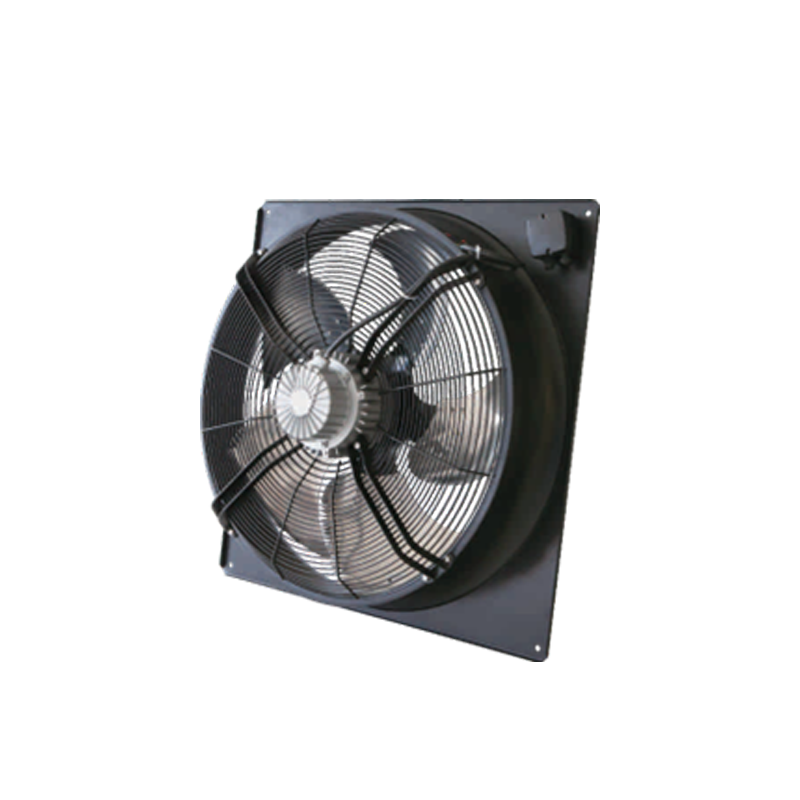
Conversely, EC motors combine AC power and a built-in DC controller. This integrated design eliminates mechanical friction points. The motor converts incoming AC voltage into DC voltage directly inside the unit. You can achieve up to 90% motor efficiency. We see significantly cooler operating temperatures as a result. Cooler temperatures translate to a much longer operational lifespan. Every watt draws directly toward moving air efficiently.
Commercial HVAC systems rarely run at 100% capacity. Facilities usually need maximum cooling or heating only during extreme weather events. Therefore, systems operate at partial loads most of the time. Standard motors simply cycle on and off to meet demand. They consume massive start-up currents every time they turn on.
Understanding the affinity laws is crucial here. These physical laws dictate how fan speed affects power consumption. Power drops proportionally to the cube of the speed reduction. A 20% reduction in motor speed yields nearly a 50% reduction in energy consumption. EC fan efficiency peaks during these partial-load conditions. EC units modulate their speed continuously. They deliver exact airflow requirements without wasting power on unnecessary RPMs.
You must establish a clear baseline before upgrading any equipment. Calculate your current energy usage precisely. Use this simple mathematical framework:
Identify the motor power input in kilowatts (kW).
Determine the annual operating hours for your facility.
Find your exact local utility rate per kilowatt-hour (kWh).
Multiply these three variables together: Power [kW] × Operating Hours × Utility Rate. Set transparent assumptions during this process. Actual savings rely on localized utility rates. They also depend on exact building load profiles. Do not rely solely on nameplate ratings. Nameplate ratings represent absolute maximums under laboratory conditions. We recommend attaching a power meter to your existing unit for one week. This provides accurate, real-world data.
Energy reduction is only one financial benefit. A high efficiency fan impacts several secondary expenses. You must evaluate these hidden savings to understand true return on investment.
Maintenance reduction: EC units lack carbon brushes. They do not use v-belts or external grease fittings. You eliminate routine belt replacements and tensioning tasks completely.
Space and acoustics: EC motors feature compact form factors. They free up valuable plenum space inside air handling units. The integrated controllers reduce acoustic noise levels. They also minimize mechanical vibration across the ductwork.
Thermal load: Traditional AC motors run hot. They transfer this wasted heat directly into the airstream. EC motors generate significantly less heat. Your HVAC unit requires less secondary cooling to offset internal motor heat.
Table 1: Energy Consumption Chart - AC vs. EC at Variable Speeds
Airflow Demand | AC Motor Power Usage | EC Motor Power Usage | Energy Saved |
|---|---|---|---|
100% | 100% | 90% | 10% |
80% | 95% (Using Damper) | 51% | 44% |
60% | 88% (Using Damper) | 22% | 66% |
Sometimes, AC systems remain a viable choice. You must analyze your facility's exact requirements before spending money. Consider an industrial exhaust system running continuously at exactly 100% load. Variable speed offers zero benefit in this specific scenario. The EC motor will never modulate down. The energy savings will be marginal at best.
Extremely constrained immediate budgets also play a role. AC fans carry lower upfront costs. If your facility plans a total demolition or relocation next year, a high-cost upgrade makes no sense. Stick with AC when short-term survival outweighs long-term returns.
Most commercial facilities benefit massively from retrofitting. You need logical criteria to shortlist replacements. Start by targeting units running 24/7 with fluctuating demands. Compare the initial procurement costs objectively. EC fans typically cost 20–30% more upfront.
However, they deliver a typical 18–36 month payback period. This fast recovery makes the initial premium negligible over time. Assess your installation approach carefully. You can choose modular plug-and-play retrofit options. These solutions slide directly into existing air handler frameworks. Alternatively, you can execute complete system overhauls. Plug-and-play options minimize facility downtime. They keep installation labor costs extremely low.
Modern heat pumps require optimal airflow to function efficiently. EC fans play a critical role here. They maximize the Coefficient of Performance (COP). A higher COP means the heat pump transfers more heat per watt of electricity used. This metric defines the absolute success of the system.
Ambient temperatures fluctuate constantly throughout the day. Fixed-speed fans cannot adapt to these changes. They force the compressor to work harder. EC fans adjust their speed dynamically. They align perfectly with changing weather conditions. This variable speed control prevents extreme pressure drops across the coil. It ensures the heat pump operates within its most efficient thermodynamic envelope.
Data centers represent mission-critical environments. They house sensitive, high-density server racks. These racks generate intense, localized heat. Standard cooling methods fail in these spaces. EC technology is absolutely necessary for precision cooling.
Computer Room Air Conditioning (CRAC) units rely on dynamic airflow adjustments. EC fans provide this granular control. They ramp up instantly when server loads spike. They throttle down during idle periods. This precise modulation manages localized heat density safely. It prevents costly server shutdowns. You maintain optimal temperature gradients across the entire server floor seamlessly.
Successful deployment requires careful planning. EC fans need specific control signals to operate correctly. They require compatible 0-10V, PWM, or Modbus connections. You must verify your Building Management System (BMS) compatibility early in the process.
Legacy control systems pose a major implementation risk. Older panels often send simple on/off relays. They fail to properly utilize the EC fan's modulation capabilities. If your BMS cannot send variable analog signals, the upgrade fails. You will essentially run an advanced motor like a basic AC unit. Always consult an integration specialist before purchasing hardware.
You must verify performance claims through standardized testing. Look for reputable third-party certifications. AMCA, CE, and UL labels prove the equipment meets rigorous safety standards. Do not buy uncertified equipment under any circumstances.
Global energy directives evolve rapidly. The ErP (Energy-related Products) Directive sets strict limits in Europe. Ensure your selected fans meet or exceed minimum efficiency grades (N-grades). Future-proof your installation now. Buying non-compliant hardware invites heavy regulatory fines. It also forces premature replacements when laws tighten further.
Define strict evaluation criteria for your vendors. Do not accept vague performance promises. Demand hard evidence before signing contracts.
Request verifiable case studies from similar facilities.
Demand clear warranty terms. Focus specifically on the integrated electronics. The motor usually outlasts the onboard circuit board.
Check localized supply chain availability.
You cannot wait six months for a replacement part during a peak summer heatwave. Reliable vendors warehouse critical spares locally. They provide immediate technical support when issues arise.
Maximizing efficiency requires moving past isolated component costs. You must embrace a holistic view of system-level performance. Focus heavily on partial-load performance capabilities. Prioritize long-term reliability over cheap upfront prices to secure real financial gains.
We recommend taking immediate action. Conduct an energy audit of your current AC fan array today. Identify the most power-hungry units first. Next, request specific payback modeling from your chosen vendors. Finally, download a detailed technical specification checklist to guide your procurement process. These practical steps guarantee a successful, profitable HVAC upgrade.
A: No, it remains highly stable. Traditional AC fans lose efficiency due to mechanical wear and tear. They rely on physical friction points like belts and carbon brushes. These components degrade and slip over time. EC motors lack these friction points. Their brushless, direct-drive design maintains consistent performance year after year.
A: You use a simple formula. Divide the initial cost delta (the extra cost of the EC fan minus the cost of a standard AC fan) by your annual energy and maintenance savings. If the upgrade costs $1,000 more, but saves $500 annually in power and servicing, your payback period is exactly two years.
A: Compatibility varies. Older systems typically use basic on/off relays. EC fans require variable signals to modulate speed. You will likely need analog-to-digital converters. Alternatively, you must run specific Modbus compatibility checks. Upgrading your legacy BMS controller is often required to unlock the full variable-speed benefits.
A: Controller failure is a known risk. Some designs require replacing the entire motor unit if the electronics die. Others feature modular repairs, allowing you to swap just the control board. You must choose reputable manufacturers offering robust warranties on both the mechanical motor and the integrated electronics.
