


Views: 240 Author: Site Editor Publish Time: 2026-04-29 Origin: Site


Facility managers and original equipment manufacturers (OEMs) face mounting pressure today. They must meet stringent energy compliance standards. They also need to reduce operational costs continuously. Traditional AC and brushed DC motors are steadily being replaced by electronically commutated (EC) technology. Older systems waste massive amounts of energy as heat and demand frequent maintenance. You need reliable upgrades to cut electricity bills without sacrificing performance. This guide strips away the marketing jargon to objectively evaluate what an EC Fan is. We explore how its lifecycle costs compare to legacy systems and highlight specific applications where it excels. You will learn the exact trade-offs so you can make informed specifying decisions.
Hybrid Operation: An ec motor fan connects directly to standard AC mains but operates internally using highly efficient DC voltage principles.
Maximum Efficiency at Partial Loads: Unlike AC motors, EC fans maintain 85-90% efficiency even when scaled down to 20% speed.
Simplified Integration: Built-in electronic control boards eliminate the need for bulky, expensive external Variable Frequency Drives (VFDs).
Clear Limitations: EC technology relies on permanent magnets that are sensitive to extreme heat (over 80°C) and are typically limited to applications under 22kW.
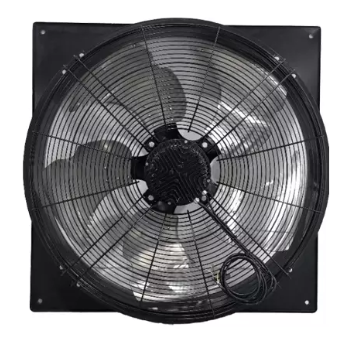
To understand this technology, we must first define "Electronically Commutated." An ec motor fan is essentially a brushless, direct-current, external-rotor motor. It integrates an AC-to-DC conversion board directly into the stator. This design eliminates mechanical brushes entirely. Mechanical brushes create friction and wear out over time. Instead, an EC motor uses a built-in microprocessor to manage the magnetic fields digitally.
The operational logic follows a precise, three-step internal process:
Voltage Rectification: The onboard electronics take single-phase or three-phase AC power from the grid. The circuit board converts this AC power into DC power. This step completely removes the need for physical carbon brushes.
Electromagnetic Interaction: The motor utilizes a permanent magnet rotor. These permanent magnets create a secondary magnetic field naturally. The system does not draw extra electrical power to magnetize copper windings, saving significant energy.
Smart Commutation: Integrated Hall-effect sensors constantly track the rotor's precise position. These sensors feed data back to the onboard stator board. The board then applies power only to the specific phases necessary for optimal rotation.
The form factor represents a massive engineering leap. You get an "all-in-one" physical footprint. Most EC fans use an external rotor design. The fan impeller attaches directly to the spinning outer casing of the motor. This integrated approach drastically reduces the required installation depth. It allows equipment designers to build much slimmer, more compact air handling units.
For decades, engineers had to choose between alternating current (AC) and direct current (DC) motors. Both legacy technologies carry significant drawbacks for modern efficiency standards.
Standard AC induction motors suffer from a very narrow peak efficiency window. They operate reasonably well at 100% full speed. However, they struggle immensely with speed control. When you run an AC motor at partial loads, it often wastes excess energy by converting it into heat. You also need an expensive external VFD to change the speed of an AC motor.
Legacy DC motors offer better speed control and higher efficiency. But they introduce a major mechanical flaw. Traditional DC motors require mechanical carbon brushes and commutators to operate. These physical parts rub together constantly. This leads to inevitable friction, rapid wear, and the generation of carbon dust. Facility teams must perform high-cost maintenance to replace these brushes regularly.
The EC fan solution elegantly bridges this gap. By replacing physical brushes with an electronic printed circuit board (PCB), the technology merges the best of both worlds. It accepts a straightforward AC power supply directly from the wall. Simultaneously, it delivers the precise control and high efficiency of a brushless DC motor.
Feature | AC Induction Motor | Legacy DC Motor | EC Motor |
|---|---|---|---|
Power Supply | AC Grid directly | Requires external AC/DC converter | AC Grid directly (internal conversion) |
Speed Control | Poor (requires external VFD) | Excellent (voltage regulation) | Excellent (internal digital control) |
Maintenance | Low to Medium | High (replace carbon brushes) | Zero maintenance (brushless) |
Partial Load Efficiency | Low (wastes energy as heat) | High | Exceptional (up to 90% at 20% speed) |
Upgrading facility infrastructure requires strict financial justification. Buyers frequently object to the higher upfront unit cost of an EC fan. An EC motor will almost always cost more off the shelf than a comparable AC motor. However, evaluating the total cost of ownership (TCO) paints a completely different picture.
You must offset this initial CapEx by evaluating system-level costs. EC fans do not require external VFDs. They do not need complex phase-control transformers. You eliminate the cost of buying, mounting, and wiring these external components. Furthermore, digital controllers for EC fans are significantly cheaper than equivalent heavy-duty AC controllers.
Operational OpEx (Energy) is where the true payback happens. EC motors consume up to 30-50% less energy than standard AC motors overall. You should focus heavily on partial load performance. Ventilation systems rarely need to run at 100% capacity around the clock. An EC fan running at half speed uses less than half the power of an AC fan doing the exact same job. According to basic fan affinity laws, dropping the speed yields exponential energy savings. EC electronics capture these savings perfectly without bleeding power as heat.
Operating Speed | Standard AC Motor Power Draw | EC Motor Power Draw | OpEx Savings |
|---|---|---|---|
100% Load | 1.0 kW | 0.85 kW | 15% |
80% Load | 0.85 kW | 0.45 kW | 47% |
50% Load | 0.60 kW | 0.15 kW | 75% |
Maintenance and lifespan metrics further strengthen the ROI. Because they lack carbon brushes, the internal components experience zero mechanical friction. They also operate at much lower internal temperatures. Heat destroys electronic components over time. The inherently cool operation of EC motors results in extremely low thermal stress. Industry benchmarks show standard failure rates of less than 1% for premium EC units.
Modern buildings demand intelligent automation. Facility managers expect ventilation to respond dynamically to occupancy levels, temperature shifts, and air quality metrics.
EC motors excel at on-demand ventilation. They respond seamlessly to low-voltage control signals. You can wire them directly to environmental sensors using 0-10V, PWM, or 4-20 mA inputs. If a carbon dioxide sensor detects a crowded room, it signals the fan to ramp up smoothly. When the room empties, the fan scales down to a minimal resting speed. You never waste energy over-ventilating an empty space.
Protocol compatibility makes them perfect for smart infrastructure. They are ready for Building Management Systems (BMS) right out of the box. You can network them in automated industrial environments via standard protocols like MODBUS. This allows central control software to monitor RPM, energy consumption, and fault codes remotely.
Equipment manufacturers (OEMs) in HVAC, data center cooling, and refrigeration utilize EC fans for several distinct competitive advantages:
Compact Unit Designs: The lack of external VFDs allows OEMs to shrink the overall chassis size of their equipment.
Lower Acoustic Noise: VFD-driven AC motors often emit a loud, irritating magnetic "hum" at lower speeds. EC fans operate silently across their entire speed range.
Regulatory Compliance: Global energy efficiency directives are becoming stricter. OEMs use EC technology to meet regional compliance standards without redesigning their entire product lines.
Despite their superior efficiency, EC motors are not a universal cure-all. You must approach system design objectively. Specifying this technology in the wrong environment can lead to catastrophic hardware failures.
Temperature limitations and demagnetization present the biggest hurdles. Inside an EC motor, the rotor relies on neodymium or rare-earth permanent magnets. These materials are sensitive to extreme heat. If the internal temperature exceeds 80°C (176°F), the magnets can permanently demagnetize. The motor becomes useless. Therefore, you cannot use them for emergency smoke extraction. Fire safety standards dictate smoke exhaust fans must survive 400°C for up to two hours. Only specially built AC motors can endure these fire conditions.
Power thresholds also restrict their usage. EC motors are generally limited to applications under 22kW. They are perfect for commercial data centers and office HVAC units. However, for massive infrastructural ventilation, you must look elsewhere. A 1-megawatt highway tunnel exhaust system requires massive power. Heavy-duty AC motors remain the only viable choice for these giant industrial applications.
Common Mistake: Repair vs. Replace Assumptions
Facility teams accustomed to legacy motors often expect to swap out individual broken parts. You cannot easily do this with an EC motor. Due to the highly integrated external-rotor and PCB design, a failure usually necessitates replacing the entire unit. Traditional AC internal-rotor motors allow for component-level repair, such as swapping just a broken impeller or a burnt winding. Budget your maintenance inventory accordingly.
Finally, consider the environmental supply chain. While they save massive amounts of electricity during operation, manufacturing them requires rare-earth metals. Mining and refining these materials carry a notable environmental footprint. Sustainability managers should weigh the operational carbon savings against the initial manufacturing impact.
Transitioning away from obsolete equipment requires a systematic approach. Fortunately, manufacturers design modern EC fans as plug-and-play retrofits. They are engineered as 1:1 drop-in replacements for outdated AC fans inside existing Air Handling Units (AHUs). You usually do not need to rebuild the ductwork or the metal housing.
Before purchasing hardware, facility managers should conduct a thorough infrastructure audit. Assess your current fan efficiency. Log the running hours and map out your speed variability needs. You will find the fastest ROI in high-running-hour scenarios that demand variable airflow. If a fan runs 24/7 but only needs maximum power for two hours a day, it is the perfect candidate for an upgrade.
Pay strict attention to compatibility warnings during installation. Do not attempt to "daisy-chain" legacy DC equipment directly with newer EC equipment. Older systems operate on different voltage and signal logic. Mixing these architectures on the same control loop can send improper voltage spikes through the network. This will fry the sensitive control boards inside your new equipment.
Upgrading your air movement systems is a critical step toward operational efficiency. We can summarize the transition to this technology with a few final verdicts and action items.
The Payback Justifies the Cost: While you face a slightly higher initial capital outlay, the elimination of VFD dependencies and superior partial-load efficiency make it a highly profitable long-term investment.
Unmatched Reliability: The zero-maintenance, brushless design drastically reduces downtime and routine service costs.
The Logical Choice: For 90% of commercial HVAC, data cooling, and OEM applications, this technology clearly outperforms legacy AC and DC alternatives.
Do not let outdated equipment drain your operational budget. We encourage you to consult with an engineering specialist today. They can audit your facility, calculate specific payback periods, and help you integrate the perfect retrofit solution for your specific needs.
A: Yes, the industry uses Electronically Commutated Motor (ECM), Brushless DC (BLDC), and EC interchangeably to describe this technology. They all refer to a motor that uses permanent magnets and electronic circuit boards to control commutation without mechanical brushes.
A: No. The commutation and variable speed control electronics are integrated directly into the motor's internal circuit board. You simply send a low-voltage control signal (like 0-10V or MODBUS) to the fan, and it adjusts its speed automatically without an external drive.
A: Yes. They plug directly into standard single-phase or three-phase AC mains. The internal electronics handle the conversion from AC to DC automatically. You do not need to install an external power rectifier or transformer to run them.


