


Views: 0 Author: Site Editor Publish Time: 2026-04-22 Origin: Site


Facility managers and engineers often face a critical crossroads during HVAC upgrades. They wonder if upgrading to an electronically commutated motor requires purchasing a Variable Frequency Drive (VFD). You want seamless speed control. You might assume standard industrial rules apply.
The direct answer is no. An electronically commutated motor inherently features a built-in electronic controller. It does not require an external VFD. Furthermore, these two technologies are functionally incompatible. You cannot wire them together.
This reality shifts the discussion to a bottom-of-funnel evaluation. Since you do not need a VFD, the real engineering decision changes. You must decide whether to specify a fully integrated, modern electronic system. Alternatively, you might prefer a traditional AC induction setup paired with an external drive. Let us explore the technical realities to guide your selection.
EC motors utilize built-in AC-to-DC rectification and microprocessors for speed control, eliminating the need for an external VFD.
While EC systems offer a highly compact footprint and eliminate the 5–7% efficiency loss typical of VFDs, their overall lifespan (MTBF) is generally shorter than modular VFD setups.
EC motors maintain near-flat efficiency curves at part-load conditions without the low-speed overheating risks associated with AC induction motors.
System integrators must account for hidden implementation realities with EC systems, particularly higher harmonic distortion and unsuitability for belt-driven applications.
Understanding the fundamental power path clarifies why external drives are unnecessary. The two technologies process alternating current completely differently.
An external variable frequency drive uses an AC-DC-AC conversion cycle. It takes incoming AC line power and rectifies it into direct current. It then uses an inverter to change this DC back into AC. By altering the output frequency, it controls the speed of a standard induction motor.
An electronically commutated system works differently. It acts essentially as a brushless DC unit featuring an integrated inverter. It uses an AC-DC path. The onboard controller takes AC line voltage and rectifies it directly to DC. It varies the voltage amplitude to modulate the rotor speed.
Adding an external drive to this architecture is electrically redundant. The internal circuitry already manages power conversion. Attempting to feed variable frequency AC into an electronic commutation circuit will cause immediate faults. It might even destroy the onboard electronics.
You handle speed modulation natively. You simply wire a 0-10V, PWM, or 4-20mA control signal directly to the onboard microprocessor. The integrated unit interprets this signal and adjusts the RPM perfectly.
You must evaluate core engineering variations before specifying equipment for commercial environments. These differences dictate energy usage, thermal profiles, and spatial requirements.
Traditional induction designs rely on electromagnetism to function. The stator must draw energy from the grid to induce a magnetic field within the rotor. This induction process creates an inherent energy loss. We call this slip.
Electronically commutated designs solve this physics problem. They use permanent magnet rotors. The permanent magnets provide a constant magnetic field. The system requires zero electrical energy to induce magnetism in the rotor. This fundamental design shift eliminates slip completely. It results in significantly higher baseline efficiency.
Running equipment at part-load conditions exposes major performance gaps between the two technologies.
Traditional setups drop the frequency to slow down. This reduction in the rate of current change (dI/dt) weakens the torque. It also causes induction coils to draw more current at low speeds. This excess current generates massive heat. If the RPM drops too low, the cooling fan cannot dissipate this heat. The windings eventually melt.
Contrast this behavior with an ec fan motor. It excels at deep turn-down ratios. The permanent magnet design maintains steady torque across the entire speed range. The onboard electronics modulate voltage without inducing excess thermal stress. You get reliable, low-speed operation without overheating risks.
Space constraints often dictate equipment choices in mechanical rooms. Integrated systems offer a distinct spatial advantage.
Many electronic designs utilize an external rotor configuration. The rotor spins outside the stator. This allows manufacturers to mount fan impellers directly onto the spinning rotor. It eliminates the need for an output shaft. The result is a highly compact "plug fan" module.
Traditional setups require a bulky layout. You need floor space for the heavy induction unit. You also need dedicated wall space for the remote drive panel. You must run heavy-gauge shielded wiring between them.
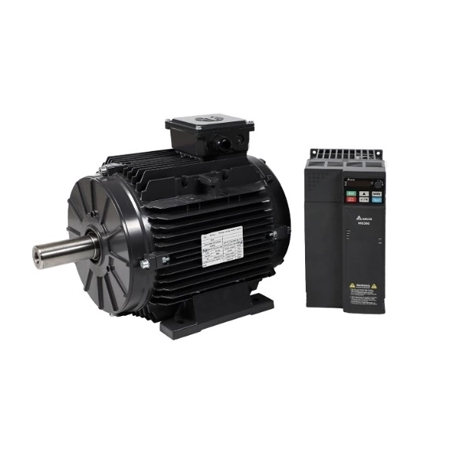
No technology solves every engineering challenge perfectly. You must weigh longevity and scalability against efficiency and size.
We must address the realistic longevity gap between these solutions. Traditional remote drives operate in clean, climate-controlled electrical closets. Industrial VFDs often boast an MTBF of up to 30 years.
Integrated electronics face a harsher reality. The controller sits directly on the housing. It is continuously exposed to thermal cycling. It absorbs operational vibrations. Due to this hostile environment, integrated units generally range between 4.5 to 10 years MTBF.
Your maintenance reality shifts dramatically depending on your choice. Traditional setups are modular. If a remote drive fails, you replace the drive. If a bearing seizes, you replace the bearing. You never throw away the functional half of the system.
Integrated systems are monolithic structures. Manufacturers pot the electronics in epoxy to protect against moisture. If a single capacitor fails on the onboard drive, you cannot repair it. You must unbolt and replace the entire assembly.
Scalability constraints often make the decision for you. Integrated electronics are highly practical for fan arrays up to 10-15 HP per unit. They perform brilliantly in multiple-fan bulkheads.
However, they lack high-horsepower single-unit scalability. If your cooling tower requires a single 100 HP prime mover, you must use a traditional induction setup paired with a remote drive.
System Comparison Chart
Assessment Metric | Integrated Electronic System | Traditional AC + VFD Setup |
|---|---|---|
System Architecture | Monolithic (Motor + Controller combined) | Modular (Separate motor and drive panel) |
Expected MTBF | 4.5 to 10 years | Up to 30 years (for the drive) |
Low-Speed Thermal Risk | Very Low (Constant torque) | High (Requires strict minimum speeds) |
Maximum HP Scalability | Typically limited to 10-15 HP per unit | Scales to hundreds of horsepower |
Repair Strategy | Complete unit replacement | Component-level replacement |
Engineers often specify high-efficiency equipment without considering grid quality. This oversight introduces severe hidden costs during commissioning.
Harmonic distortion remains a critical engineering blind spot. Standard remote drives feature built-in 6-pulse spectrums. They usually include internal DC chokes or 5% line reactors. These components smooth out the current waveform.
Integrated systems prioritize a compact size. They strip out bulky magnetic components. They frequently lack internal line reactors. Consequently, their power draw is highly non-linear.
This design choice can lead to current harmonics (THDi) double that of a standard drive. High harmonics overheat facility transformers. They trip breakers randomly. You will likely need to install expensive external harmonic mitigation filters to comply with IEEE 519 standards.
Both technologies generate significant electrical noise. They utilize fast-switching insulated-gate bipolar transistors (IGBTs). These components create high-frequency switching noise, typically between 10kHz and 15kHz.
This noise travels along power lines. It can disrupt sensitive building automation sensors. It can interfere with data center networks. Proper shielding is mandatory for both systems. You must use symmetrical grounding techniques. You must route communication cables far away from power lines.
You must know where NOT to deploy these integrated units. They feature permanent magnet rotors. These rotors have excellent running torque but notoriously low starting torque.
Never specify them for belt-driven applications. The breakaway friction of a heavy v-belt requires massive starting current. An integrated system will likely stall or trigger an overload fault during startup. Reserve them exclusively for direct-drive applications.
Procurement teams often reject modern upgrades based on sticker shock. A proper Total Cost of Ownership (TCO) calculation paints a different financial picture.
We need to dispel the myth of prohibitive upfront costs. If you buy a bare induction motor, it looks cheap. But you must price the total package.
You must add the cost of the induction unit. You add the remote drive. You add the shielded cable. You add the electrical labor to mount the drive panel. When you compare this total installed cost, an integrated EC Motor is often within ±10% of a traditional setup.
The true financial victory happens during part-load operation. HVAC systems rarely run at 100% capacity. Fan affinity laws dictate energy consumption.
Running an integrated unit at 80% speed drops the required power significantly. You can yield up to 50% energy savings. This massive OpEx reduction easily offsets any initial CapEx premiums.
Furthermore, you avoid the system efficiency penalty naturally incurred by remote drives. A VFD typically loses 5–7% of its energy simply converting AC to DC and back to AC. Integrated designs eliminate this specific conversion loss entirely.
Building codes constantly push mandatory efficiency minimums higher. Organizations like ASHRAE (Standard 90.1) and the International Energy Conservation Code (IECC) set strict rules.
They now require extreme efficiency levels for fractional horsepower motors. Traditional induction units simply cannot meet these metrics. This makes integrated permanent magnet technology the default compliance choice in commercial HVAC retrofits. Many local utilities also offer aggressive cash rebates for installing them, further accelerating your ROI.
An electronically commutated motor strictly does not need a VFD. Adding one guarantees immediate equipment failure. However, choosing between a modern integrated system and a traditional AC+VFD setup requires a calculated look at your facility’s specific needs.
Use the following shortlisting logic to guide your procurement:
Choose Integrated Electronic Systems for compact air handling units. They dominate in low-HP fan arrays. Use them for direct-drive applications. They are unbeatable when part-load energy efficiency is your primary metric.
Choose Traditional AC + VFD Systems for high-horsepower requirements. Use them in harsh environments where you must isolate the electronics in a clean room. Specify them when maximum MTBF and modular repairability are mission-critical.
Prioritize Harmonic Analysis before executing any large-scale upgrade. High-efficiency components can destabilize older power grids if left unchecked.
We encourage you to audit your current fan arrays. Consult with an engineering specialist to calculate the exact harmonic impact and TCO before retrofitting. A data-driven approach ensures decades of reliable, low-cost operation.
A: No. The internal controller is essential for electronically commutating the AC input to the DC required by the permanent magnets. They cannot be bypassed.
A: They are technically brushless DC motors, but they are designed to accept standard AC line voltage, bridging the gap between AC convenience and DC efficiency.
A: This is a fluid dynamics limitation, not a motor limitation. Below 30% speed, the fan's impeller tip speed is usually insufficient to overcome system static pressure and move air effectively, rendering lower speeds practically useless.


