


Views: 268 Author: Site Editor Publish Time: 2026-02-20 Origin: Site


When it comes to modern ventilation systems, EC fans are leading the way in terms of energy efficiency, performance, and adaptability. Understanding how an EC fan works is essential for engineers, procurement managers, and OEMs who are looking to implement reliable and energy-efficient solutions in their ventilation systems. At Suzhou Dowell Ventilation Technology Co., Ltd., we specialize in developing EC axial fans and EC centrifugal fans that integrate the latest EC motor technology to ensure efficient operation and easy integration into various systems. In this guide, we’ll take a deep dive into how EC fans operate, focusing on their motor design, speed control, and energy-saving advantages.
An EC fan relies on a brushless DC motor, which uses a permanent magnet rotor for generating motion. This design eliminates the need for brushes, which are commonly found in traditional DC motors. The permanent magnet rotor provides a more efficient method of generating power, as it requires less energy to create rotational movement. This results in a highly efficient motor design that uses less energy compared to traditional AC induction motors.
The brushless design further enhances the performance of the EC fan. By removing the friction caused by brushes, the motor operates more smoothly, generating less heat and noise. This smooth operation not only increases the fan's efficiency but also reduces maintenance needs, as there are fewer components that wear out over time.
The key advantage of EC fans is their electronic commutation. Traditional DC motors use brushes to create the necessary electrical connection for the rotor to spin. However, this system can lead to wear and tear on the brushes and decrease the motor's efficiency. EC fans, on the other hand, use electronic commutation to achieve the same effect without the use of brushes.
Electronic commutation is facilitated by integrated onboard electronics that control the switching of current in the motor coils. This allows the motor to function smoothly without the mechanical limitations of brushes. The result is a more reliable, efficient, and longer-lasting motor that requires minimal maintenance.
One of the unique features of EC fans is the ability to convert AC power into DC power within the fan itself. This transformation occurs through an integrated rectifier that converts the alternating current (AC) from the power supply into direct current (DC) to power the motor. The conversion from AC to DC is essential for the fan's high efficiency and flexibility.
The DC motor is particularly well-suited for variable-speed applications because it can operate at a wide range of speeds without the need for external controllers or additional components. By utilizing DC power, the fan can achieve precise control over speed and power consumption, which results in significant energy savings.
The integrated controller plays a vital role in the operation of EC fans. This controller is responsible for adjusting the fan's speed, based on real-time data about airflow demands. Unlike traditional fans, which rely on external speed controllers or manual adjustments, EC fans use internal electronics to constantly adjust their performance.
The integrated controller allows the fan to operate at the most energy-efficient speed, ensuring that it consumes only the necessary amount of energy. This level of control also enables the EC fan to adjust its speed automatically in response to changes in environmental conditions, making it ideal for dynamic applications such as HVAC systems and industrial ventilation.
One of the key benefits of EC fans is their ability to precisely control fan speed. This is achieved through various speed control methods, including pulse-width modulation (PWM), 0-10V control, and digital interfaces.
PWM works by rapidly switching the fan's power supply on and off, adjusting the duty cycle (the proportion of time the power is on) to regulate the speed of the fan. This allows for highly efficient control, as the motor is only powered for the necessary amount of time, reducing wasted energy.
0-10V control is another common method used to adjust fan speed. A 0-10V signal is sent to the fan's controller, which uses it to determine the fan's speed. This method is often used in HVAC systems, where a central control system adjusts the speed based on room temperature or airflow needs.
Digital interfaces, such as Modbus or BACnet, provide even more precise control by allowing the fan to integrate seamlessly with building management systems (BMS) and other smart controls. These interfaces allow for real-time adjustments to airflow, ensuring that the fan operates efficiently at all times.
The ability to match airflow demand is another critical feature of EC fan speed control. With variable-speed operation, EC fans adjust their speed automatically based on the required airflow. This means that when demand is low, the fan will slow down, using less energy, and when demand is high, the fan will speed up to meet the required airflow.
This dynamic adjustment helps to optimize energy usage, ensuring that the fan is always operating at the most efficient speed. This capability is particularly beneficial in applications where airflow needs fluctuate throughout the day, such as in office buildings, clean rooms, and industrial processes.
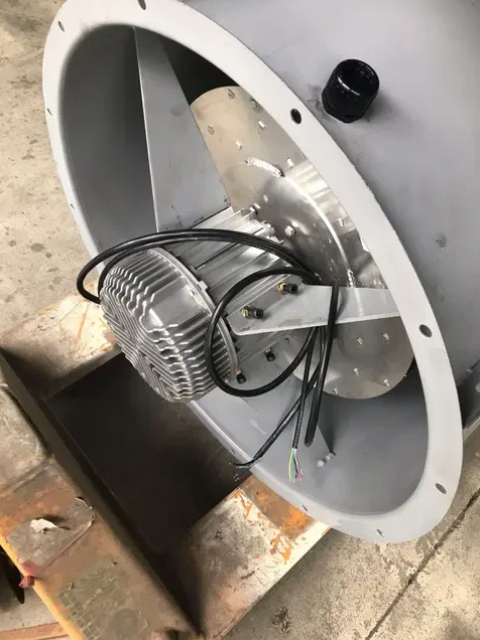
The efficiency of EC fans is determined by their ability to convert electrical power into airflow. The EC motor design is highly optimized to provide maximum airflow with minimal energy consumption. Unlike traditional AC fans, which operate at a fixed speed, EC fans can adjust their speed to match the required airflow, ensuring that only the necessary energy is used.
This efficiency is particularly important in systems where continuous operation is required, such as in HVAC systems for large buildings or in industrial ventilation systems. By adjusting the fan speed in real time, EC fans ensure that energy is used only when needed, reducing operational costs.
One of the key benefits of EC fans is their ability to produce less motor heat compared to traditional fans. Because EC motors are designed to be more efficient, they generate less waste heat during operation. This means that the fan can run at lower temperatures, reducing the risk of overheating and extending the motor's lifespan.
Lower operating temperatures also contribute to longer fan life and fewer maintenance requirements. The brushless design of EC motors ensures that there are fewer mechanical parts that wear out over time, resulting in a more durable and reliable fan.
EC fans are widely used in HVAC systems due to their energy-efficient design and precise speed control. In HVAC systems, EC fans adjust their speed based on the environmental conditions, ensuring that airflow is optimized for both comfort and energy efficiency. This helps to reduce energy consumption in buildings while maintaining optimal temperature and humidity levels.
Because EC fans are quieter and more reliable than traditional fans, they are also ideal for residential and commercial spaces where noise and maintenance are important considerations. The energy savings provided by EC fans can help businesses and homeowners reduce their energy bills while improving comfort.
Another key application for EC fans is in data centers and clean rooms, where precise airflow and temperature control are essential. In these environments, EC fans help maintain a stable temperature by providing consistent airflow, ensuring that sensitive equipment is kept cool and protected from overheating.
The ability of EC fans to adjust their speed to match airflow demands makes them perfect for these dynamic environments. Whether the data center requires full airflow during peak hours or lower airflow during off-peak times, EC fans can adjust accordingly to provide optimal cooling while minimizing energy consumption.
Step | Description |
AC Input | Standard supply enters fan |
Conversion | Electronics convert AC to DC |
Commutation | Motor rotor driven with precision |
Control | Speed controlled via signals |
In conclusion, understanding how an EC fan works is crucial for engineers, procurement managers, and OEMs who are looking to implement energy-efficient and reliable ventilation systems. The EC motor operation and integrated speed control technologies in EC fans provide significant advantages over traditional fan systems, including improved efficiency, longer lifespan, and lower maintenance needs. Whether you're installing HVAC systems, working in a data center, or setting up a clean room, EC fans provide the optimal solution for your ventilation needs.
If you're interested in learning more about our EC Axial Fans and EC Centrifugal Fans, or would like to speak to one of our experts about your specific requirements, contact us today. At Suzhou Dowell Ventilation Technology Co., Ltd., we're committed to providing high-quality, energy-efficient solutions that meet the needs of modern systems.
EC fans use electronically commutated motors for efficient speed control, while traditional fans rely on fixed-speed AC motors.
EC fans provide energy efficiency, quiet operation, and precise speed control, making them ideal for HVAC systems in residential and commercial buildings.
EC fans use PWM, 0-10V control, and digital interfaces to adjust speed based on real-time airflow needs, ensuring energy savings.
Yes, EC fans are ideal for data centers as they offer precise airflow control, helping to maintain optimal cooling for sensitive equipment.


