


Views: 0 Author: Site Editor Publish Time: 2026-04-20 Origin: Site


The industrial automation and HVAC sectors are experiencing a massive shift toward high-efficiency technologies. Rising energy costs and strict environmental mandates force engineers to rethink traditional system designs. Legacy alternating current setups often waste power through heat generation and lack precise operational control.
An EC Motor solves these critical issues by acting as a comprehensive system-level solution. It delivers substantial energy reduction, exact airflow management, and streamlined regulatory compliance. Upgrading your equipment is no longer just about replacing a broken part. It is a strategic move to optimize your facility's entire energy footprint.
This article will unpack the operational mechanics behind electronically commutated technology. We will evaluate the total cost of ownership and outline technical limitations you must consider. You will learn exactly when and how to implement this hardware for maximum return on investment.
Operating Principle: EC motors combine a permanent magnet rotor with an onboard electronic controller, eliminating the need for carbon brushes and preventing energy-wasting "slip losses."
Efficiency at Scale: While full-load efficiency is high, the true ROI of an ec fan motor emerges at partial loads (e.g., significant energy savings when running at 80% speed).
System Integration: Built-in electronics allow for seamless IoT connectivity (Modbus, 0-10V), predictive maintenance, and "soft start" capabilities without external Variable Frequency Drives (VFDs).
Application Constraints: Despite high efficiency, EC motors are restricted by power limits (typically under 22kW) and temperature thresholds (risk of demagnetization in extreme heat).
Understanding internal motor architecture helps you evaluate capital expenditures. These advanced motors demand a higher upfront investment. You must know how they function internally to justify this initial cost to stakeholders.
An electronically commutated motor relies on a precise interaction between internal electromagnets and external permanent magnets. The stator contains stationary electromagnetic coils. The external rotor fits around this stator. It houses a series of strong permanent direct-current (DC) magnets.
The real magic happens inside the integrated electronics. An onboard microprocessor continuously monitors the exact position of the spinning rotor. It gathers this data using Hall-effect sensors or by measuring back electromotive force (back EMF). The microprocessor then dictates exactly which stator coils to energize. It pulses power to specific coils at precise moments. This creates a rotating magnetic field pulling the permanent magnets along. You get continuous, perfectly timed rotation without mechanical brushes.
Traditional induction motors face a significant physical limitation. They must draw power from the grid simply to create a magnetic field in the rotor. We call this a magnetization current. It consumes power but produces no rotational work.
Electronically commutated designs remove this requirement entirely. The permanent magnets already provide a constant magnetic field. They need zero additional electrical power to stay magnetized. Furthermore, the rotor spins at the exact same speed as the magnetic field generated by the stator. This synchronous operation completely prevents "slip losses." Slip occurs in AC motors when the rotor lags behind the magnetic field. Slipping generates massive amounts of wasted heat. Eliminating this slip reduces internal operating temperatures. It preserves bearing lubricants and vastly extends the lifespan of internal components.
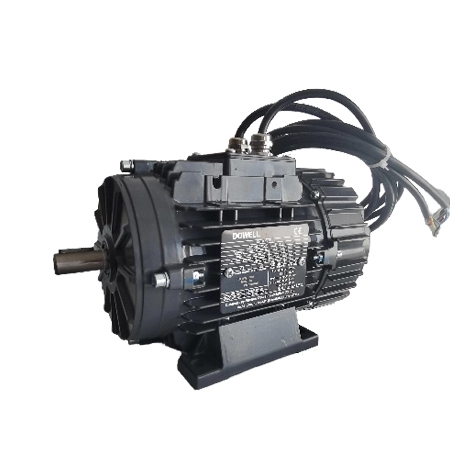
Engineers evaluate motor technology based on operational flexibility. You must also consider the physical infrastructure required to run them effectively. Let us compare these systems directly.
Standard AC motors run at fixed speeds dictated by the electrical grid frequency. You must install a bulky Variable Frequency Drive (VFD) if you want variable speed control. VFDs are expensive. They require additional wiring, wall space, and complex programming. They can also introduce electrical noise into your power grid.
Electronically commutated systems bypass this issue entirely. They function as self-contained, "plug-and-play" units. The required power conversion module sits directly inside the motor housing. It takes standard alternating current from the wall and rectifies it into direct current. It then controls the speed internally. You avoid external drives, save cabinet space, and drastically reduce installation labor.
You must look past maximum speed when evaluating energy metrics. At 100% load, the efficiency gains over premium AC motors look relatively marginal. However, most industrial systems rarely run at absolute maximum capacity all day.
Below 50% load, electronically commutated technology dramatically outperforms legacy systems. Traditional motors lose efficiency rapidly when slowed down. EC systems maintain efficiency levels above 80% even when running at lower speeds. We must apply the fan affinity laws here. These laws state power consumption drops exponentially as you reduce shaft speed. Cutting motor speed by just 20% can reduce energy consumption by nearly 50%. The ability to precisely match speed to demand creates massive operational savings.
Feature | Standard AC Motor | Standard DC Motor | EC Motor |
|---|---|---|---|
Speed Control | Requires external VFD | Requires external controller | Built-in variable speed |
Maintenance | Moderate (bearings) | High (carbon brush wear) | Low (brushless design) |
Partial Load Efficiency | Poor | Good | Excellent |
Grid Compatibility | Direct AC connection | Needs AC-to-DC rectifier | Direct AC connection |
We must translate technical specifications into tangible operational outcomes. Facility designers need practical reasons to specify these systems in their blueprints.
Starting an electric motor suddenly pulls a massive surge of electricity. We refer to this spike as locked rotor amps. It stresses electrical panels and mechanical linkages. Electronically commutated motors feature programmable gradual ramp-ups. We call this a soft start.
A soft start lowers your locked rotor amps significantly. It protects your electrical infrastructure. It also produces excellent mechanical outcomes. Gradual acceleration reduces wear on drive belts and mechanical bearings. In HVAC applications, it eliminates sudden duct pressure spikes. You no longer hear loud banging noises when the ventilation activates. Additionally, precise low-speed airflow improves humidity control across cooling coils. It allows condensation more time to drip away rather than blowing into the airstream.
Modern building management systems (BMS) require constant data. EC technology delivers exceptional compatibility out of the box. You can command these motors using standard industry protocols. They accept pulse-width modulation (PWM), 0-10V analog signals, and Modbus communications.
This connectivity enables bidirectional communication. The motor does not just receive speed commands; it talks back. You can harness this data for several advanced operational tactics:
Predictive Maintenance: Monitor internal temperatures and RPM fluctuations to schedule repairs before total failure occurs.
Real-Time CFM Monitoring: Maintain an exact cubic feet per minute (CFM) output even as air filters gradually clog with dirt.
Air Quality Integration: Connect directly to CO2 or VOC sensors to automatically increase ventilation when room occupancy spikes.
Building trust requires engineering transparency. We must outline the physical and environmental boundaries of this technology. Legacy alternating current options remain the superior choice in several specific scenarios.
Permanent magnets possess a critical vulnerability to extreme heat. Every magnetic material has a Curie temperature. Reaching this thermal threshold destroys the magnetic field permanently.
You cannot use standard electronically commutated systems for high-heat industrial exhaust or emergency smoke extraction. Fire safety codes often require ventilation fans to survive 400°C for two hours. Permanent magnets in these advanced motors can begin demagnetizing around 80°C. High ambient temperatures will also degrade the sensitive onboard microprocessors. Legacy AC motors without permanent magnets or delicate electronics handle these extreme thermal loads much better.
Power scaling presents another physical boundary. This technology remains largely capped at lower power ratings. Most commercial units stay well below the 22kW threshold. Heavy infrastructure projects like tunnel ventilation or mining exhaust require megawatt-level power. Massive AC motors dominate this heavy-duty landscape.
You must also consider the repairability tradeoff. This impacts your circular economy goals. These units feature a highly integrated design. The electronics, stator, and rotor exist as one cohesive package. A minor failure on the microprocessor board often necessitates replacing the entire fan and motor assembly. Conversely, legacy setups allow mechanics to easily swap individual impellers, bearings, or contactors. You must weigh this replacement cost against the energy savings.
Stick with AC when: Designing emergency smoke exhaust systems.
Stick with AC when: Ambient air temperatures regularly exceed 60°C.
Stick with AC when: Project requirements demand motors larger than 22kW.
Stick with AC when: Facility budgets prioritize piece-by-piece component repair over full-unit replacement.
Upgrading your facility's mechanical infrastructure requires precise technical analysis. Electronically commutated motors provide unmatched efficiency, but they are not universal solutions. You must weigh specific environmental constraints against your desired operational outcomes.
Keep these actionable takeaways in mind when planning your next project:
Choose this technology for variable-load, continuous-duty applications where precision control and noise reduction outweigh initial capital costs.
Conduct a thorough load-profile analysis. Ensure your systems actually spend time at partial loads to capture the real energy savings.
Avoid this technology in extreme heat environments or where fire safety codes dictate emergency smoke extraction endurance.
Launch a small pilot installation on a single air handler before greenlighting a massive, facility-wide retrofit.
Gather your operational data and consult with an experienced engineering team. They can calculate your exact projected return on investment and guide your purchasing decisions effectively.
A: It uses internal algorithms and sensor feedback, such as back electromotive force (EMF), to monitor shaft speed. As static pressure changes inside your ductwork, the microprocessor automatically adjusts torque and RPM in real-time. This maintains a perfectly constant cubic feet per minute (CFM) output without external controllers.
A: No. The inverter and power rectifier components are built directly into the rear housing of the unit. It takes AC mains power directly, converts it to DC internally, and manages its own variable speed control. You do not need to install an expensive Variable Frequency Drive (VFD).
A: Yes. Many modern models feature advanced, auto-sensing electronics. They can accept both 115V and 230V alternating current supplies. The onboard microprocessor detects the incoming voltage and adjusts operations automatically. You do not need to manually rewire terminals or flip selector switches during installation.
A: Both function as brushless DC motors mechanically. However, the industry uses "EC motor" to describe units featuring an integrated AC-to-DC rectifier. This internal rectification allows an EC unit to connect directly to standard AC wall power. A standard BLDC motor requires an external direct current power supply to function.


