


Views: 0 Author: Site Editor Publish Time: 2026-09-01 Origin: Site


Facility managers and original equipment manufacturers face an immediate business challenge today. Stricter energy regulations, like the European ErP directives, reshape our entire industry. Rising operational costs also force engineers to deeply re-evaluate their air movement components. You must address a core dilemma in modern HVAC and industrial system design. Should you choose the familiar, low-initial-cost AC fan? Or should you invest in a highly efficient, premium-priced EC unit?
This decision directly impacts your bottom line and system performance for years. We designed this guide to bypass empty marketing claims. It provides an objective, data-supported framework. You will learn exactly how to evaluate these technologies. We will explore application demands, integration realities, and long-term energy savings. By understanding these mechanical and electrical differences, you can confidently specify the right technology. You will secure optimal airflow performance for your specific environment.
CapEx vs. OpEx: AC centrifugal fans win on initial purchase price; EC centrifugal fans drastically lower long-term operating costs (frequently recovering the premium within 12–18 months).
Control & Precision: EC fans feature built-in, continuous speed control without the acoustic hum or added complexity of external VFDs (Variable Frequency Drives).
Compliance: EC technology inherently meets or exceeds modern stringent global energy efficiency mandates (e.g., ErP 2015), whereas standard AC models often fall short.
Application Fit: AC remains viable for steady-state, low-duty-cycle ventilation. EC is essential for dynamic, high-demand environments like data centers, cleanrooms, and variable air volume (VAV) AHUs.
Understanding fan performance starts at the motor level. The fundamental physics driving each motor type dictate its overall efficiency, heat output, and control capabilities.
They operate by creating a rotating magnetic field.
They use a stationary stator to induce an electrical current directly into the rotor.
They remain relatively simple and highly durable across various industrial applications.
They are inherently prone to magnetic "slip." The rotor never quite catches up to the rotating magnetic field.
This magnetic slip generates significant thermal losses and wastes valuable energy.
Motor speed depends entirely on the incoming line frequency (typically 50Hz or 60Hz).
Altering this speed requires mechanical dampers or external electronic interventions.
They function quite differently from traditional induction models.
They operate fundamentally as brushless DC motors.
They feature integrated AC-to-DC rectification directly inside the protective housing.
They pack advanced control electronics securely inside the motor hub.
Permanent magnets mounted on the rotor completely eliminate magnetic slip.
They also remove rotor copper losses entirely.
The resulting design delivers significantly higher motor efficiency.
You will see this massive efficiency benefit particularly during partial load operations.
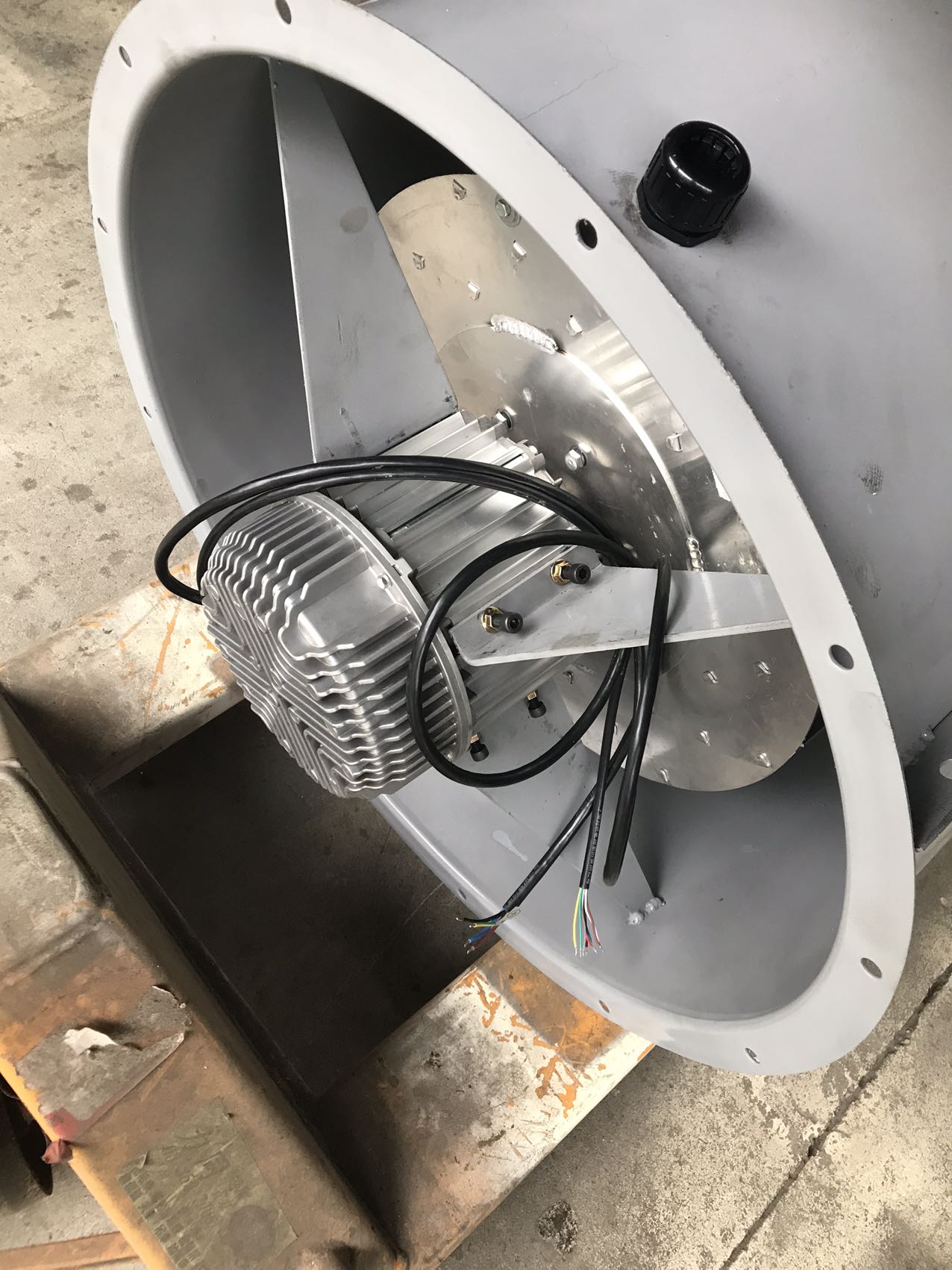
When conducting an EC centrifugal fan vs AC centrifugal fan evaluation, you must look far beyond basic airflow metrics. You need to analyze how the equipment performs across varying loads and environmental conditions over an extended timeline.
Energy consumption usually dominates a fan's lifecycle expense. An AC induction motor typically maxes out around 60% to 70% efficiency at peak load. Efficiency drops drastically when operated at partial speeds. If you run an AC fan at half speed, you waste a massive amount of power.
Conversely, an EC permanent magnet motor achieves up to 90% efficiency. It maintains a flat, high-efficiency performance curve. Even when you dial the capacity down to 20% or 50%, the motor barely wastes any power. This partial-load dominance makes EC technology vital for modern variable-demand systems.
Partial Load Efficiency Chart
Motor Type | 100% Load Efficiency | 50% Load Efficiency |
AC Motor | 65% | 35% |
EC Motor | 90% | 85% |
Modern smart buildings require deeply integrated, responsive systems. You must install external controllers to vary an AC motor's speed. You typically rely on triacs or Variable Frequency Drives (VFDs). These external devices often introduce noticeable motor hum, shaft vibration, and unwanted electrical noise into your power grid.
EC units give you plug-and-play variable speed control natively. You can manage them using simple 0-10V analog signals, PWM outputs, or digital Modbus/RS485 protocols. This capability allows seamless integration into advanced Building Management Systems (BMS).
Excess noise and heat severely impact surrounding equipment. AC induction motors generate significant waste heat. This waste heat often requires secondary cooling solutions in tight physical spaces. They also exhibit higher mechanical and magnetic noise. This noise profile worsens significantly when you modulate the operating speed.
Brushless EC motors run significantly cooler. This cooler operation directly extends internal bearing life. They also operate quietly across the entire speed range, making them ideal for noise-sensitive commercial environments.
Let us model a typical 5-year operating calculation. AC motors certainly have a lower initial purchase price. However, EC units deliver drastic, continuous energy savings. They also reduce routine maintenance intervals. These combined operational savings easily offset the 30% to 50% higher initial capital expenditure. Facility managers frequently observe full financial payback in less than 18 months. After this break-even point, the EC unit generates pure operational savings.
Centrifugal Fan Technology Comparison Matrix
Feature | AC Induction Fan | EC Fan |
|---|---|---|
Peak Efficiency | 60% - 70% | Up to 90% |
Speed Control | Requires external VFD or Triac | Integrated 0-10V, PWM, or Modbus |
Heat Output | High (magnetic slip generates heat) | Low (cooler operation extends life) |
Acoustic Noise | Moderate to High (especially at partial loads) | Low (quiet across all speeds) |
Many engineers try to cheat the system using older technology. The common proposition involves adding a Variable Frequency Drive (VFD) to an existing AC induction motor. They hope to achieve variable speed without paying the premium for a new brushless motor. You must understand the harsh reality and risks behind this specific workaround.
Cost parity: Purchasing a standard AC motor plus a quality VFD adds up quickly. You must also buy specialized shielded cables and pay for extensive installation labor. This total cost often matches or exceeds the cost of a single, fully integrated EC unit.
Footprint & Wiring: VFDs require additional electrical panel space. They demand complex wiring configurations. You must carefully mitigate Electromagnetic Interference (EMI) to protect other sensitive digital equipment nearby.
Performance Gap: Even utilizing a top-tier VFD, an AC motor cannot match the partial-load efficiency of a permanent magnet motor. The induction motor still suffers from inherent magnetic slip at every speed level.
Replacing old equipment sounds simple on paper. However, field implementation reveals several physical and electrical challenges. You must prepare for these realities before approving a facility retrofit.
EC centrifugal fans are generally much more compact. Manufacturers integrate the control electronics directly into the central motor hub. This intelligent design saves valuable space inside Air Handling Units (AHUs). However, it requires careful mounting alignment during retrofits. You cannot simply bolt the new unit into the old legacy holes. You often need custom adapter plates.
Moving from traditional AC contactor logic requires careful planning. You must install modern control signal wiring. You will run low-voltage cabling alongside your main power feeds. You must isolate these communication lines properly to prevent signal degradation.
Standard AC fans are ubiquitous globally. You can swap them easily using generic parts from local industrial suppliers. Replacing an EC unit often requires more precision. You might need to match specific software parameters. You must verify OEM configurations and communication protocols before initiating installation.
Always assess your expected IP ratings. Modern electronics are usually well-potted against moisture. However, harsh, highly corrosive environments pose severe threats. You might necessitate specialized protective coatings for the circuit boards. In purely rugged, dirty environments, a purely mechanical AC induction motor sometimes survives better because it lacks sensitive microprocessors.
Every application demands a highly specific engineering approach. Use this framework to guide your specification process and protect your operational budget.
Sometimes legacy technology remains perfectly appropriate for the task.
You face strictly limited initial capital budgets. Capital expenditure priority rules the entire project scope.
Your application requires simple On/Off operation. The system needs 100% full speed or nothing at all.
You operate in environments where sophisticated electronic controls prove unnecessary. Highly corrosive or vibrating environments might damage delicate internal electronics.
Modern commercial challenges require highly optimized, modern solutions.
Data Centers & Precision Cooling: Heat density runs exceptionally high here. You must meet strict Power Usage Effectiveness (PUE) targets to remain profitable.
Air Handling Units (AHUs) & HVAC: These represent highly variable demand scenarios. Your ventilation fans rarely need to run at full speed 24/7.
Compliance-Driven Projects: You must meet stringent European (ErP) or local energy regulations. Legal compliance is mandatory to sell your final product.
Conduct a thorough energy audit of your existing AC equipment. Calculate the potential return on investment based on your exact local utility rates. Consult with a reliable supplier to organize a small-scale retrofit pilot. Test the theory in your actual facility before rolling it out globally.
A comprehensive centrifugal fan comparison reveals a clear industry shift. The AC induction motor remains a reliable legacy solution. It works perfectly for basic, budget-constrained, steady-state needs. However, the EC motor represents the modern standard. It delivers unmatched energy efficiency, precise digital control, and strict regulatory compliance.
Do not make your final purchasing decision based on unit cost alone. Calculate your full lifecycle operating expenses based on your specific duty cycle. Use your local energy costs to fully justify the investment. We invite you to download a fan selection calculation matrix today. You can also contact our dedicated engineering support team for detailed sizing and specification assistance.
A: Yes, the upfront purchase price is typically 30% to 50% higher. However, EC technology consumes significantly less energy during operation. This extreme efficiency frequently recovers the initial premium within 12 to 18 months. You must evaluate the long-term operational savings rather than just looking at the initial price tag.
A: Direct drop-in replacements are rarely simple plug-and-play operations. You usually need custom adapter plates or modified physical mounting brackets. You must also run new low-voltage control wiring for 0-10V or Modbus signals. Finally, you must physically bypass any old VFDs or traditional contactors in your main electrical panel.
A: EC models generally outlast standard AC units. Because EC motors generate far less waste heat, their internal bearings run significantly cooler. Cooler bearings degrade much slower over time. Assuming you provide clean electrical power and proper installation, this thermal advantage adds several years to the expected equipment lifespan.
A: No. In fact, they often require far less maintenance. Because they utilize brushless DC motor technology, there are no physical carbon brushes to wear out or replace. Beyond standard scheduled cleaning of the impeller blades to prevent weight imbalance, these units operate essentially maintenance-free throughout their operational life.
